
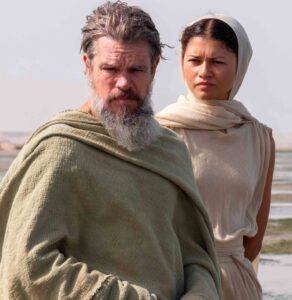
Odysseus and Athena in Christopher Nolan’s ‘Odyssey.” Photo: Melinda Sue Gordon (Universal Pictures)
Editor’s Note: For the last couple of weeks I’ve been writing about Homer’s Odyssey in a variety of forms without my reaction to Christopher Nolan’s blockbuster film. Here are my thoughts after seeing it twice – once at an Ultra DLX premium format theater and once at my local multiplex.
Spoiler Alert – This post is a discussion of Nolan’s movie that assumes you have seen it or want to know about it. If you don’t want details about plot points and major movie themes, don’t read it.
TL:DR version – Nolan has created an excellent movie that tells a version of The Odyssey that differs substantially from a scholarly translation and brings a lot of modern sensibilities to this classic story. Much as Peter Jackson substantially changed J.R.R Tolkien with his Lord of the Rings movies and Denis Villeneuve did with Frank Herbert’s Dune, Nolan has created his own story from classic material.
Ralph’s Reaction – Full Version:
Christopher Nolan’s big-budget adaptation of Homer’s Odyssey is an immensely entertaining film at its core about the ushering in the of modern world away from the time of gods and monsters during Bronze Age Greece. It tells a version of the story of Odysseus that changes and omits substantial, some would say essential, parts of the original story in order to make it match the requirements of a 21st century blockbuster film. But unlike so many modern action movies, it is, even with a nearly three-hour running time, tightly edited. It also depends on practical special effects grounded in a fantastical but real world that brings to mind pre-digital sword and sandals epics like Spartacus, Ben Hur, Clash of the Titans, or even Jason and the Argonauts.
Central to it is the tradition of the hospitality of Zeus in which you treat strangers as guests as though they might be gods in disguise. But in spite of this tradition, Odysseus and the Greeks in King Agamemnon’s army attack Troy in a brutal fashion with the nominal excuse of “rescuing” Menelaus’ beautiful wife Helen. But it is clear that their real goal is exacting revenge on the Trojans for years of war. Odysseus and company break the norm of hospitality and respect for the gods by sending in the famous wooden “Trojan Horse” as a gift to the temple of Athena following an eight-year-long stalemate of a war. But instead of the horse being a gift of peace as claimed, it is full of fighters who burn, loot and defile the greatest city of its age.
In Homer’s epic poem, Odysseus and his men work their way home facing perils from the gods, from the sea, and from witches, monsters and other foes. Along the way, Odysseus uses his cleverness and intelligence to outwit and defeat whomever he faces while increasing his hoard of treasure. But given that his actions have offended multiple gods in multiple ways, all of Odysseus’ men are killed along the way and much of his treasure is lost. Also, he has affairs with demigods and fathers multiple children.

Is Bugs Bunny the trickster in contemporary American mythology?
f you look at Dr. Emily Wilson’s 2017 translation of The Odyssey (discussed at length here), she describes Odysseus as “a complicated man” who is first and foremost a trickster – a common figure in almost every culture’s mythology. The coyote trickster is Native American traditions, Loki is the trickster Norse mythology (as well as in the Marvel Cinematic Universe), and even Bugs Bunny plays the role of the trickster in contemporary American mythology. (What, you dare question Looney Tunes characters as modern mythological characters? For shame…)
But that is not central to who Odysseus is in Nolan’s film. Instead, he is a tired man who wants to escape from the violence he has been living with for the past two decades. Nolan takes the lotus flower and its power of forgetfulness from its position early in Homer’s narrative where Odysseus rescues his men from its indolent narcosis. For Nolan, it is one of his final challenges Odysseus faces with the nymph Calypso using it as a drug to calm him and help him forget all that he has been through, perhaps in the way cannabis and hallucinogens are used now as a treatment for PTSD. He is no longer primarily a prisoner of the gods but a prisoner of this own suffering.
All of these factors serve to make Nolan’s Odysseus a much more sympathetic character to modern audiences that Homer’s would be. Homer’s Odysseus had sex with women he interacted with as a matter of course, and he fathered multiple children by multiple women. Odysseus’ long-suffering wife Penelope’s requirement of chastity and faithfulness was a given for her and irrelevant for Odysseus. Odysseus and his men routinely burned villages, assaulted locals, and took badly needed supplies along with treasure wherever they went. Odysseus and Telemachus fight together to kill all of Penelope’s suitors, accepting no quarter from any in the original, as well as hanging and beheading all the serving women who had sex (voluntary or not) with Penelope’s suitors. Given that these women were slaves, they had very little agency over their lives, and yet they were still all slaughtered.
This concept, along with the idea of that Odysseus and Penelope will go away into the West actually owes as much to Tolkien’s Lord of the Rings (LOTR) ending as it does to Homer’s Odyssey. If you recall, after Frodo, Sam and Golem destroy the ring, many of those directly associated with the destruction of the ring head off to the West while Aragorn and his now mortal half-elfin consort Arwin are the rulers of Middle Earth, using in the age of men. (I’m talking only here about the movie, not the novels. So don’t @ me about the complications of deep LOTR lore.)
Dr. Emily Wilson, author of the respected 2017 new translation of The Odyssey, has made some highly publicized criticisms of Nolan’s film, essentially for following the requirements of a big-budget movie. I would argue that it is impossible to make a large-scale film without making extensive changes to the source materials and reconceptualizing major characters and plots. This was absolutely the case with the aforementioned adaptation of LOTR as well as Denis Villaneuve’s excellent but strongly redeveloped version of Frank Herbert’s Dune saga. All have taken extensive criticism from serious scholars/supporters of the original texts.
I would never beg to differ from any of Dr. Wilson’s critiques of Nolan’s film, but to accept them is to accept that The Odyssey could not be made into a large-scale modern film. Perhaps it could be done “authentically” as an extended HBO miniseries in the style of Game of Thrones where there is more room for complex and unappealing characters, but then it would lose the virtues that Nolan brings to his brand of epic filmmaking.
To close this out, I would argue that there are many ways to tell and retell Homer’s Odyssey. You can have an authentic translation, a lively retelling, or an epic film. All are good in their own ways. I’m nearly finished reading Wilson’s translation, I’ve listened to Fry’s retelling of the Illiad and Odyssey multiple times, and I’ve loved Nolan’s revisionist film. I value all of them.
What did you think of each of these versions that you have read/listened to/seen? Tell us in the comments!
I will be away from the blog for a couple of weeks as recover from arm surgery, but I look forward to hearing all your thoughts!
Not sure why comments are disabled. Will try to fix.