Aside from the debates as to whether AI models are out of control and could take over/destroy the world, there is the smaller, but still important, question as to how much disclosure is required by people using AI to create things under their own name.
As anyone who has been reading this blog over the last few months will know, I’m highly skeptical of any use of AI in writing or creative work (and lots of other places as well), and strongly opposed to undisclosed use of it for that purpose. I recognize that there are appropriate uses of these tools, and I will have a guest post next week dealing with this issue.
But for now I’d like to take another look at a prominent individual using AI to create work under his own name for both academic journals and opinion pieces for legacy media.
Semafor has been doing reporting on how AI is finding its way onto prominent editorial pages. Reed Albergotti, tech editor for Semafor, reports that most guest submissions to The Wall Street Journal, The Washington Post, and The New York Times are still being written by human beings. The publication found that of the 310 guest submissions, only 10 of them were labeled as being “at least 80% ‘AI’ by AI detector Pangram.” They went on to say that another 40 articles were partialy AI generated.
Semafor did their analysis after it was revealed that billionaire Stanley Druckenmiller had created a WSJ commentary primarily using AI. (You can read more about the Druckenmiller controversy here.)
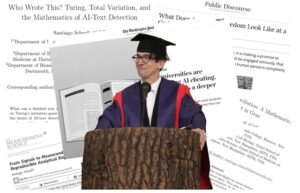
Photo by Alesandra Gonzales for The Dartmouth
Among the most interesting of the AI composed articles is one credited to Dartmouth provost Santiago Schnell for the Washington Post, who reportedly used AI-generated commentary to argue that AI can be useful to students and teachers in certain circumstances, but that students should not use generative AI as a substitute for their own educational efforts. (I would note that after reading his commentary that it was utterly without any personal flavor to the writing, which is often a characteristic of AI-generated work. But it can also be a characteristic of empty rhetoric from university administrators…)
Semafor spoke with a representative of the Post who noted a policy that “requires guest writers to confirm their submission was ‘not created or manipulated with artificial intelligence or editing software,'” but the representative did not comment on any of the guest commentaries they had published that were primarily or partially created by AI.
Journalists at The Dartmouth student newspaper found that Schnell’s academic articles and opinion pieces published in 2026 had a “median ‘AI-written’ text percentage of 96%” by using the artificial intelligence detector Pangram. In contrast, Pangram found that all of Schnell’s written work from before 2022, when Chat GPT 4.5 was released, was found to be “100% human written.” (Why does this matter? AI detectors usually carry a warning that they are more likely to show “false positives” for AI with text written by people for whom English is a second language. Schnell’s first language is Spanish. But given that none of Schnell’s writings prior to the release of Chat GPT 4.5 in November of 2022 show any sign of being AI generated.
In an e-mail to The Dartmouth, Schnell said he used AI for:
“Language refinement, copyediting, improving clarity and organization and making writing processes more efficient,” but “review[s] the final text and take[s] responsibility for its content.”
“I develop ideas and arguments, conduct the research, evaluate the evidence and sources, determine the structure, prepare drafts and decide what appears in the final text,” Schnell wrote. “I regard these technologies as assistive tools. They do not identify the problem, design the research project, guarantee the validity of research results, interpretations, citations, conclusions or substitute for my research, intellectual judgment or authorship.”
Schnell’s Sept. 18 email statement to The Dartmouth was itself “100% AI-written,” according to a Pangram test.
The Dartmouth article explains in depth how Pangram is able to distinguish between AI used for composition and AI used for editing and “polish.” In short, Schnell is making the exact same arguments that students do when caught making illicit use of AI to complete their homework. The fact Schnell used AI to create his arguments about the appropriateness of using AI is just too on the nose.
Coming up next – A defense of using AI from an old friend of the blog.

Dartmouth provost uses AI to do his homework
Aside from the debates as to whether AI models are out of control and could take over/destroy the world, there is the smaller, but still important, question as to how much disclosure is required by people using AI to create things under their own name.
As anyone who has been reading this blog over the last few months will know, I’m highly skeptical of any use of AI in writing or creative work (and lots of other places as well), and strongly opposed to undisclosed use of it for that purpose. I recognize that there are appropriate uses of these tools, and I will have a guest post next week dealing with this issue.
But for now I’d like to take another look at a prominent individual using AI to create work under his own name for both academic journals and opinion pieces for legacy media.
Semafor has been doing reporting on how AI is finding its way onto prominent editorial pages. Reed Albergotti, tech editor for Semafor, reports that most guest submissions to The Wall Street Journal, The Washington Post, and The New York Times are still being written by human beings. The publication found that of the 310 guest submissions, only 10 of them were labeled as being “at least 80% ‘AI’ by AI detector Pangram.” They went on to say that another 40 articles were partialy AI generated.
Semafor did their analysis after it was revealed that billionaire Stanley Druckenmiller had created a WSJ commentary primarily using AI. (You can read more about the Druckenmiller controversy here.)
Photo by Alesandra Gonzales for The Dartmouth
Among the most interesting of the AI composed articles is one credited to Dartmouth provost Santiago Schnell for the Washington Post, who reportedly used AI-generated commentary to argue that AI can be useful to students and teachers in certain circumstances, but that students should not use generative AI as a substitute for their own educational efforts. (I would note that after reading his commentary that it was utterly without any personal flavor to the writing, which is often a characteristic of AI-generated work. But it can also be a characteristic of empty rhetoric from university administrators…)
Semafor spoke with a representative of the Post who noted a policy that “requires guest writers to confirm their submission was ‘not created or manipulated with artificial intelligence or editing software,'” but the representative did not comment on any of the guest commentaries they had published that were primarily or partially created by AI.
Journalists at The Dartmouth student newspaper found that Schnell’s academic articles and opinion pieces published in 2026 had a “median ‘AI-written’ text percentage of 96%” by using the artificial intelligence detector Pangram. In contrast, Pangram found that all of Schnell’s written work from before 2022, when Chat GPT 4.5 was released, was found to be “100% human written.” (Why does this matter? AI detectors usually carry a warning that they are more likely to show “false positives” for AI with text written by people for whom English is a second language. Schnell’s first language is Spanish. But given that none of Schnell’s writings prior to the release of Chat GPT 4.5 in November of 2022 show any sign of being AI generated.
In an e-mail to The Dartmouth, Schnell said he used AI for:
“Language refinement, copyediting, improving clarity and organization and making writing processes more efficient,” but “review[s] the final text and take[s] responsibility for its content.”
“I develop ideas and arguments, conduct the research, evaluate the evidence and sources, determine the structure, prepare drafts and decide what appears in the final text,” Schnell wrote. “I regard these technologies as assistive tools. They do not identify the problem, design the research project, guarantee the validity of research results, interpretations, citations, conclusions or substitute for my research, intellectual judgment or authorship.”
Schnell’s Sept. 18 email statement to The Dartmouth was itself “100% AI-written,” according to a Pangram test.
The Dartmouth article explains in depth how Pangram is able to distinguish between AI used for composition and AI used for editing and “polish.” In short, Schnell is making the exact same arguments that students do when caught making illicit use of AI to complete their homework. The fact Schnell used AI to create his arguments about the appropriateness of using AI is just too on the nose.
Coming up next – A defense of using AI from an old friend of the blog.