
Editor’s Note: British artist David Hockney, famous for his vivid paintings of brief moments in southern California life, died June 11, 2026 at the age of 88. He was best known for his work “A Bigger Splash,” depicting the instant after a person dove into a residential swimming pool with the splash still in the air and no one visible. Hockney was a rare artist to become both honored and immensely wealthy while still alive. His obituary from the Washington Post says:
“Mr. Hockney’s art, which earned him international renown and a colossal fortune, encompassed paintings of azure swimming pools and the artist’s gay friends; kaleidoscopic portraits collaged together from dozes of cocktail-napkin-size Polaroids; room-size installations using computer-controlled theatrical light fixtures; and, in later years, garish landscapes “drawn” with fingers on an iPad.”
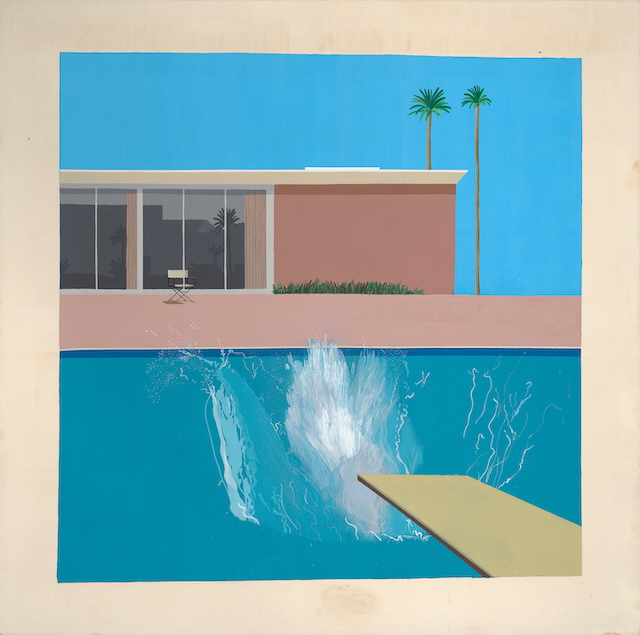
“A Bigger Splash,” 1967, David Hockney, appearing in the Washington Post.
Prior to the summer of 1998, I had never heard of British painter David Hockney, famed for his vivid colors and depiction of upscale, southern California gay life. If I had given his work any thought, I would have likely dismissed him as depicting a brightly colored fantasy of a modern idealized world. I personally preferred the dark drama of Edward Hopper’s “Nighthawks” or the pastoral yearning of Andrew Wyeth’s “Christina’s World.”
But then I saw an article in the Sunday Washington Post, dated June 27, 1998, about a giant set of 60 canvases with the title “A Bigger Grand Canyon” by Hockney that was being exhibited in the National Museum of American Art. Style section writer Henry Allen described the 24-foot wide collection of 60 sizable canvases arrayed in a grid as something that needed to be experienced, not just seen.
In the late ’80s/early 90s, Dear Wife and I resided in northern Arizona about an hour-and-a-half from the canyon, and we visited it multiple times. After all, when you live in Flagstaff you can say, “Want to go to the Grand Canyon this afternoon?” By 1998, when I saw the article about the Hockney’s painting, we lived in West Virginia, about four hours from Washington, D.C. and the Museum of American Art.
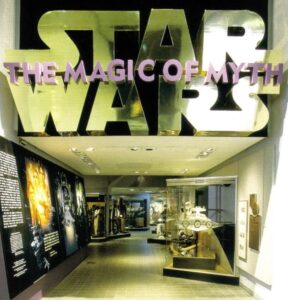
Entrance to the Magic of Myth exhibition.
I had promised my then eight-year-old son that I would take him to DC to see the Star Wars: The Magic of Myth exhibition at the Smithsonian’s Air and Space Museum. The year before I had taken him to see the theatrical screenings of the special editions of the original trilogy, and he had been quite impressed by the spectacle. So I thought I could stretch my luck, taking an eight-year-old boy to two art exhibits in one day. Unsurprisingly, he loved the Star Wars exhibit, with props and costumes from Star Wars, The Empire Strikes Back, and Return of the Jedi, along with the magnificent art-decoish original concept art by Ralph McQuarrie.
Oldest son was then patient with his father’s insistence on spending time with the Hockney painting that had little relevance to him, despite the fact that he had been born in Arizona.
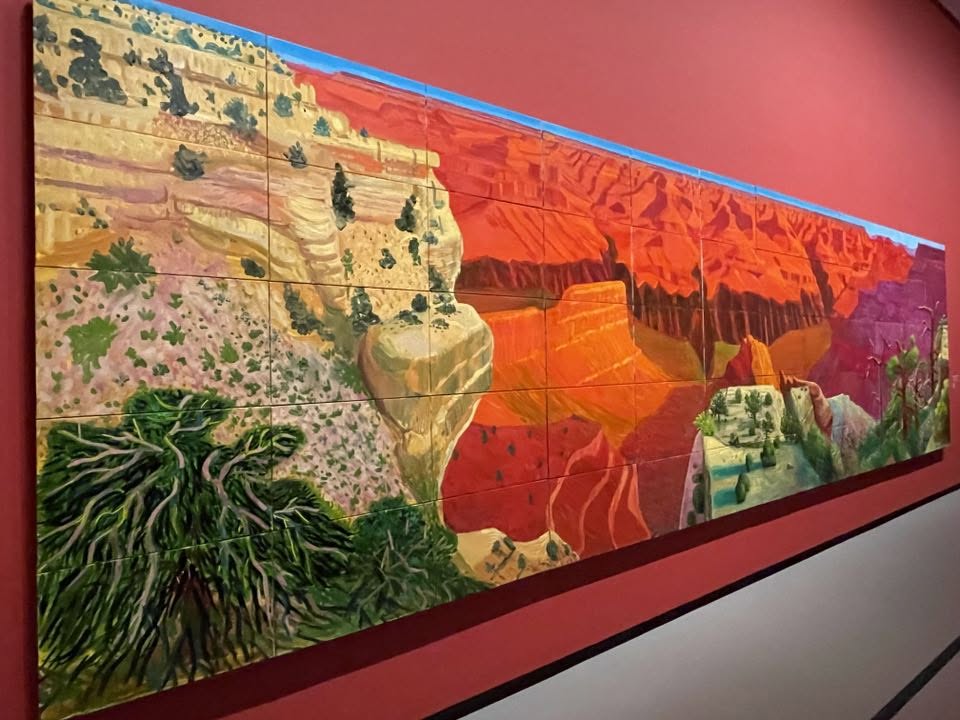
Photo of Hockney’s “A Bigger Grand Canyon” by Nathalie Matan from its permanent home at the National Gallery of Australia.
Hockney’s image of the canyon captures both the scope and grandeur of the Grand Canyon. He started with creating a panoramic view of the canyon by shooting an array of Polaroids about an hour after dawn, extending 5 images vertically and 12 horizontally, for a mosaic of 60 photos. He then painted “A Bigger Grand Canyon” in bright, more-vivid-than-life colors. In his review, Allen writes:
“[T]his [panoramic] view of the Grand Canyon has always been dismissed as impossible to paint. It is too big to paint in one-point perspective, where everything is drawn so it recedes to a single, hypothetical vanishing point where all of the receding lines would meet. Even three- or four-point perspective wouldn’t work without distorting the view until it lost the postcard quality this picture retains.”
Instead, Hockney creates a multifaceted portrait of the canyon, with 60 separate one-point perspective paintings that give the viewer a sense of being at the canyon itself. I am not an art scholar and am not qualified to give any sort of critique of Hockney’s giant collection of paintings, but seeing that work is one of the most memorable art experiences I’ve been to, along with small collection of Van Gogh’s at the Minneapolis Institute of Art, a show at the Vancouver Art Gallery focusing on Picasso’s relationships with the six most important women in his life, and a show at the Kimball Art Museum in Fort Worth on the friendship between Picasso and Matisse.
Please, do not think that I am putting Hockney in the same class as Van Gogh, Picasso and Matisse; I’m only talking about the impact these particular shows had on me upon seeing them in person.
If there is one lesson to take away from these exhibit visits, it’s the importance of getting to see original art in person. Reproductions and photos are all well and good, but there is no substitute for seeing the real thing.
Now, I really need to get the Art Institute of Chicago to see Hopper’s “Nighthawks.”
Whose art would you most like to see in person. Tell us in the comments.