
“Who lives, who dies, who tells your story?
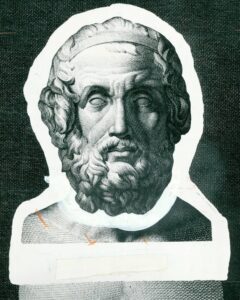
Illustration of Homer from the NY Times. Click on image for link to an essay on how our stories, like The Odyssey, tell us who we are.
My favorite line from Lin-Manuel Miranda’s Broadway musical Hamilton: An American Musical comes near the end of the show when George Washington asks the question: “Who lives, who dies, who tells your story?” That inquiry can be applied to so much of our art and literature – especially with all the various adaptations of Homer’s epic poem The Odyssey.
This summer’s biggest non-kids movie will undoubtedly be Christopher Nolan’s epic production of The Odyssey, which also promises lots of criticism from people who have yet to see it; though given The Odyssey’s history, that can hardly come as a surprise. People have been getting bent out of shape about a recent translation of the classic by Dr. Emily Wilson; been entertained by British comedian and actor Stephen Fry retelling of a range of Greek myths, combined with current commentary and a queer perspective; and been upset about Black actress Lupita Nyong’o playing Helen of Troy along with trans actor Elliot Page reportedly playing the Greek trickster Sinon (who is portrayed in Virgil’s Aeneid as allowing himself to be captured by the Trojans to convince them that the Greeks have all departed from Troy and left the Trojan Horse behind as a gift).
So instead of wallowing in internet twaddle surrounding all this, let’s find out a bit more about how who re-tells this classic story of Western culture affects how we perceive it.
Perhaps the hardest thing here is knowing where to start. So let’s start with Homer himself.
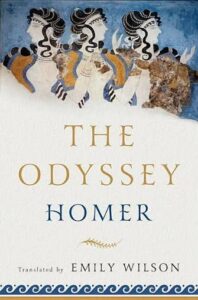
Click to purchase Emily Wilson’s translation of The Odyssey.
You’ve likely been taught somewhere along the way that Homer was a blind, illiterate poet who composed The Illiad, about the decade of fighting over the city of Troy; and The Odyssey, concerning primarily the hero/king/warrior Odysseus’s attempts to get home after the sacking of Troy. Wilson, with her translation published in 2017, starts off with an extended introductory essay explaining what we know of the origins of these two epics:
“This takes us to what is known as the Homeric Question, which is really a whole cluster of questions about the composition of The Iliad and The Odyssey. The Question is given a capital Q, because scholars still disagree on some crucial issues even after a couple of centuries of discussion. How exactly did the Homeric poems as we have them emerge from the oral tradition that preceded them? Who was Homer? Was there a single author of The Odyssey, or several? Did the same person produce The Iliad and The Odyssey? When exactly did the poems get written down, and how? Can we trace earlier and later parts of the poems, or tie particular passages to different geographical locations? And to what extent do the poems reflect real historical events, cultures, and peoples—a real Trojan War, or the real Mycenean civilization of late Bronze Age Greece (which existed from the sixteenth to the twelfth centuries BCE)? Most generally, how exactly did multiple people over hundreds of years across the Greek-speaking world work together to create this magnificent, challenging, and coherent work of poetic storytelling? Design “by committee” has a very bad name, and yet The Odyssey seems like an unexpected success. How was it done?”
Wilson doesn’t supply us with easy answers to these questions, but does note that our modern understanding of these epics is drawn from medieval manuscripts. Before that, where did these stories originate? It’s too complex to go into in depth here, but Wilson says there is a strong consensus that The Odyssey is a “written text based on an oral tradition.” Perhaps an oral poet worked with a literate scribe to compose the work. Wilson thinks it is most likely that the Illiad and Odyssey were written by multiple people over an extended period of time. As to when The Odyssey was written down is just as problematic, with the best estimate being something between the eighth and seventh century BC (or BCE – Before Common Era as scholars would typically put it).
In an essay for The New Yorker published in 2017, Wilson writes that people expected her to portray Odysseus’ wife Penelope in a more heroic light, as “an empowered woman.” But instead she instead portrays female characters in what she describes as a more realistic light, dealing with the limited choices women of the era had. While Odysseus had many affairs and fathered multiple children while he spent 10 years trying to get home, and he expected no criticism for his behavior; the ever-constant Penelope had only the options of either staying true to her missing husband or marrying one of her suitors. She did not have the agency to make any other decisions.
Wilson gives as an extend example how the slave women in Odysseus’ household are portrayed. A number of these “house maids,” as they are often called in previous translations, are presented as disloyal “sluts” or “whores” for having sex with some of the suitors of Penelope. Previous translations show them as being “disloyal servants” to their master. Wilson, portrays them as slaves who have little control over their lives and who are victimized a second time when they are all hanged for the crime of being raped.
Wilson has also been criticized for having the characters in her translation speak in modern English rather than some 18th or 19th century version of the language. Wilson points out that English didn’t even exist as a language when The Odyssey was being composed, so a modern translation is no less authentic of a presentation. While the original Greek text was written in dactylic hexameter, as was expected for poetry of the time, Wilson’s translation is written in iambic pentameter, the meter that Shakespeare and much of English poetry is composed in. So while she has changed the meter from the original, she has created a translation that feels like poetry to English readers.
For myself, I’m a little over halfway through Wilson’s translation of The Odyssey, and I find it eminently readable and enjoyable. And the more modern take on the language and meter makes it easier to read and allows it to maintain the spirit of the Ancient Greek original.
You can read more about what Wilson has to say about her translation in the following articles.
- The First Woman to Translate the ‘Odyssey’ Into English – Wyatt Mason, NY Times, Nov. 2, 2017
- A Translator’s Reckoning with the Women of the Odyssey – Emily Wilson, The New Yorker, Dec. 8, 2017
- No One Has Dealt With More Angry ‘Odyssey’ Bros Than Emily Wilson – Jason P. Frank, Vulture, June 23, 2026
Emily Wilson on why she has done new translations of Homer
Emily Wilson reads from her new translation of The Odyssey, in Greek and English:
Which translation of Homer’s The Odyssey have you read? Tell us about it in the comments.
If you’re interested: Instagram’s caffeineandphilosophy has gone off on Wilson’s translation a lot recently. He seems a twit and a pedant, but he offers a pretty good explanation of why the manosphere has its underwear in a bundle over Wilson’s book. I don’t do podcasts, but he’s also gone off there, and has been a regular on Jack Donovan’s podcast (a whole other story) with a similar manly defense of Odysseus, Achilles, et al.
He also has a lengthy article on his own substack “On Emily Wilson and the Spirit of Translation”. He basically carves out objections to Wilson’s translation of various passages but without the slightest hint that he can actually read ancient Greek, let alone Homeric Greek. He instead suggests that one can use AI for translation and then double-check those translations on Perseus, a repository of ancient texts and dictionaries. Although Perseus is a solid resource for ancient Greek texts, one still has to know how the language works in order to use its dictionaries. If not, this can lead to mistakes.
Without going into this too too far , one of the sentences the author objects to is Wilson’s translation of book 2:63-64, where Telemachus is complaining about the behaviour of the suitors in his home:
οὐδ᾽ ἔτι καλῶς οἶκος ἐμος διόλωλε.
The AI translation he quotes reads as follows:
Nor has my house any longer remained rightly—it has been utterly ruined.
He then compares it to Wilson’s translation:
They ruined my whole house! It is not fair!
He argues that “Homer didn’t have Telemachus say this bratty, entitled line. Indeed, there is no word like “fair” in the Greek here”.
Unfortunately, he is incorrect. The word in question is the meaning of’ καλῶς’, the adverbial form of ‘καλός, ή, όν’, which means ‘beautiful, fair, fine, well, proper, with prudence or good judgment”. Thus one can readily see that the word carries both an aesthetic as well as an commendatory sense e.g, that is a “fine” coat you are wearing and yesterday you did a “fine” thing by helping out that person. The point that it weds the embedded idea of balance and proportion with concept of proper behaviour. That is, the suitors are not behaving in a becoming way; they are breaking the rules of guest-hospitality, they are acting in an ‘ugly’ or ‘unseeming’ manner.
So in short Wilson’s translation is quite excellent because it incorporates both sides of the meaning of “καλῶς”. And it should be noted that Telemachus in the next two lines then outlines the checks and balances on behaviour:
You suitors all should feel ashamed! Consider
what others in the neighborhood will think!
And also be afraid! The angry gods
will turn on you in rage.
Thanks for your comments, Simon. Appreciate commentary from someone who knows Greek. I’m about 2/3rds of the way through Wilson’s translation, and I’ve found it very interesting and readable. Though I think my favorite part was her extended essay at the beginning explaining her process.
Yes, her essay and her translator notes are an excellent read: fully agree.
About three years I was sitting in our back yard relaxing and watching the butterflies swim in and out of our tall flowers. As chance would have it, my neighbour’s daughter starting to play a classical piece on her piano, but with her window open. For about five to ten minutes, the music and the butterflies seemed to become synchronized as if they were responding to the notes and the notes responding to their movements. It was a surreal almost dreamlike experience as I fell into the scene, unfocused but fully captivated.
Reading Emily’s notes, reminds me of that moment. I love her deep emphasis on sight and sound, images and rhythm, musicality intertwined with pictures to produce what she calls an “elaborate piece of embroidery”. I think this is right: hers is an aesthetic response rather than a mere justification of a translator’s decisions.
And she is also correct: Homer is not complex, this is true even in the original Greek. And as she observes its conspicuous lack of subordinate clauses “flattens” the poem, allowing the use of images rather than complex structures of thought to build the whole, all driven along by steady meter. But of course that simplicity is not simple: it allow readers to become immersed in the poem itself, getting lost in a song, permitting one to more fully experience the narrative.
She is quite excellence and has that rare skill to capture not the words but the feel of the poem.
For me at least it is like those butterflies glancing off tall flowers, fed by music, shifting and moving and establishing the demand for a narrative to make it whole, and then you want it to begin all over again.