Because movies that are shot in 3D from the beginning can look pretty good. Beyond the obvious example of Avatar, I would argue that the TRON remake was a gorgeous (if somewhat empty) 3D film, using 3D only in the computer world and keeping the “real” world in 2D.
I also thought the new Transformers movie looked great in 3D, even if it ran way too long.
But Thor looked absolutely terrible in 3D; it was dim and blurry on the edges if you weren’t sitting in the center of the theater. And unlike those previous three examples, it was a 3D conversion. Which is why I’m going to hold off seeing Captain America this weekend because the only screening I could get to would be a 3D one, and reports I’m seeing say that the Cap’n America 3D conversion is every bit as bad as the one for Thor. On the other hand, I can’t wait to see what Ridley Scott will do with his shot-in-3D Alien prequel Prometheus.
As a side note, noted movie critic Roger Ebert absolutely despises 3D movies of almost every sort. He’s presented his own thoughts on it and supported them with the views of respected people from the industry.
How do you feel about 3D movies? Will you skip seeing one because it’s in 3D? Leave your thoughts in the comments.
UPDATE: October 2014 – Alfonso Cuaron’s Gravity was largely a conversion, but it had been planned and shot as a 3D movie from the very beginning. I’ve come to believe that it’s planning and cinematography that matter more than the actual technique used to create the 3D effects.
On the one hand, the largest British newspaper has been involved in a scandal involving hacking a murdered girl’s phone, hacking the phones of British terrorism victims, payoffs to members of Scotland Yard, and improper connections to prominent British politicians. It’s gotten bad enough that former editors and reporters at the paper have been arrested or even sent to jail over the scandal. And there’s talk that News Corp. could be prosecuted in the US for violating the Foreign Corrupt Practices Act for bribing British officials. The scandal got bad enough that News Corp. shut down the embattled tabloid that had been publishing since 1843. (As a side note, NPR’s On The Media had a fascinating story recently on how easy it is to hack mobile phone voice mail.)
On the other hand, the fact that a sleezy London tabloid has been behaving sleazily is big news? Really? I mean…. News of the World’s sister paper The Sun runs pictures of naked women on its Page 3. (No, you don’t get a link . Find it for yourself if your curious.) Should we really act surprised that these News Corp. tabloids follow no normal set of acceptable journalistic conduct? It’s like Captain Renault in Casablanca proclaiming, “I’m shocked, shocked to find that gambling is going on in here!”
The fact that the News of the World is also owned by Rupert Murdoch’s News Corp. has made this a huge story within the press. And there is a strong defense of this. After all, News Corp. is a major news organization and the third or fourth largest media corporation in the U.S. On the other hand, there are a a lot of people out there in the media business who really hate News Corporation’s newspapers and Fox News operations. As the editorial writers of the Wall Street Journal (News Corp.’s most respected news outlet) put it so beautifully, “The Schadenfreude is so thick you can’t cut it with a chainsaw.” I’m not a fan of Mr. Murdoch’s, but I see the truth in what the editors at the WSJ are saying.
Suppose for a minute that Warner Brothers wanted to promote Harry Potter and the Half-Blood Prince as screwball teen comedy. The trailer might look something like this:
What would Steve Jobs do?
Want to design an elegant, effective product? Computerworld’s Jonny Evans says, ask yourself “What would Steve Jobs do?” Worth reading even if you are not an Apple fan.
Former Washington Post reporter Jose Vargas is a successful young journalist. He was part of a reporting team that won a Pulitzer for covering the Virginia Tech massacre, he wrote a well-regarded profile of Facebook founder Mark Zuckerberg for the New Yorker, and he’s written for numerous outlets around the country, including the Post, the Huffington Post, and the San Francisco Chronicle.
While all these things have been well known for some time, what has been a secret up until last week was that Vargas is an undocumented immigrant who entered the United States illegally from the Philippines.
He outed himself in a first-person article for the New York Times Magazine. In it, he tells the story of how he came to the US as a 12-year-old boy to live with his grandparents in Silicon Valley. He did not know that he had entered the country on forged papers until he took his supposed green card to the DMV at age 16 to get his drivers permit, and was told that his card was fake and that he should not come back again.
As he told MSNBC’s Rachel Maddow on Monday, Vargas was supposed to work shadow economy jobs until he could find an American citizen to marry and get a permanent residency permit that way. Only one problem: When Vargas was in high school, he came out publicly as being gay. So while he was out of the closet as a gay male, he remained secretive about his immigration status.
The story of Vargas and his outing of himself has caused a fair amount of controversy in journalistic circles because Vargas has been lying about his immigration status for his entire adult life. And lying is rather looked down on by journalists. Phil Bronstein, who had hired Vargas to write for the Chronicle, writes that he felt duped by Vargas, especially since Vargas wrote about the experiences of undocumented workers without mentioning that he was one himself. On the other hand, Bronstein hopes that Vargas’ story may lead to meaningful immigration reform:
But if he can come out, the force of his story – both good reaction and bad – and his project just might lubricate the politically tarred-up wheels of government and help craft sane immigration policy. If it has that effect, we should forgive him his lies.
You can hear more about Vargas‘ life and situation at the Define American web site he’s set up.
After writing about all of this, I’m left with this central ethical conflict: A journalist lying about his or her identity is always troubling for any reason. But if Vargas had not lied about who he was, he could not have been a reporter. This is, at its core, the definition of an ethical problem. Because ethics are all about what you do when no answer seems right, when all answers are problematic, when telling the whole truth stands in the way of telling any truth.
Note: The links from this post all contain NSFW language.
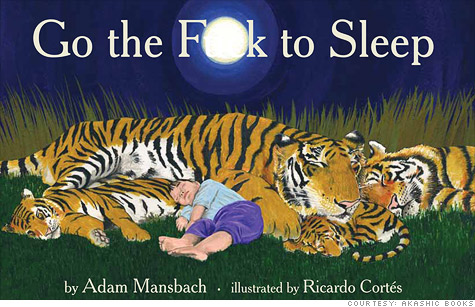
There has been a new parody of a children’s picture book being published this summer called GTFTS. It has all the sweet illustrations and baby animals you would expect in a bedtime book, but the message of it is pure frustrated parent. I know the parents reading this blog would never use this kind of language with your children. But I would bet more than one of you would think it!
Me? I used to sing my babies to sleep with songs from the Rocky Horror Show….
At any rate, here are several links to stories about GTFTS, how it was promoted online, and even a link to a free download of Mr. Samuel L. Jackson reading the book.
(If you actually read or listen to all the material listed below, you will have taken a comprehensive look at modern publishing!)
When I logged onto Twitter this morning, it seemed like everywhere I looked there was news about implications of copyright law and copyright alternatives:
Why YouTube is adopting the Creative Commons licensing and why you should care
YouTube is the biggest source of user-created online video, and Gigaom is arguing today that the service’s adoption of Creative Commons licensing is a big deal. Creative Commons is an alternative to traditional copyright that allows content creators to claim certain controls over their works while offering expanded fair use in other areas. In conjunction with this change of licensing, YouTube is now offering a mash-up video editor where users can bring together these various videos in creative new ways.
Apple nearing completion of licensing of music for cloud
Apple is getting ready to offer its new cloud music service and is in the process of paying music labels $25-$50 million each for the right to stream their music to people who already own it.
Say what?
Very simply, Apple is starting a new service that will let you listen to the music that you own anywhere. Apple will apparently look at the music you have on your computer and then make all those songs available to you from its data center so you can listen to it over any device that is capable of receiving a data signal (wifi or cellular). The thing is, Apple won’t hold your specific copy of the song. Instead, Apple will have a single copy of each song that it will stream to all the people who already have a copy of it on their computer.
Amazon launched a similar service back in March, only Amazon claims that it doesn’t have to license the music since the people who are listening already (supposedly) have a legitimate copy of the music. (The key difference is that Amazon requires everyone to upload a copy of their music to the Amazon server.)
How this gets handled is going to be a big deal because cloud storage (storage on a central server you connect to using wireless technology) is definitely the direction that media is moving in.