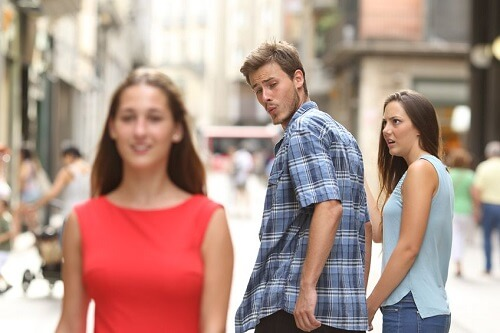
iStock photo from Getty Images – Disloyal man with his girlfriend looking at another girl, photo by Antonio Guillem
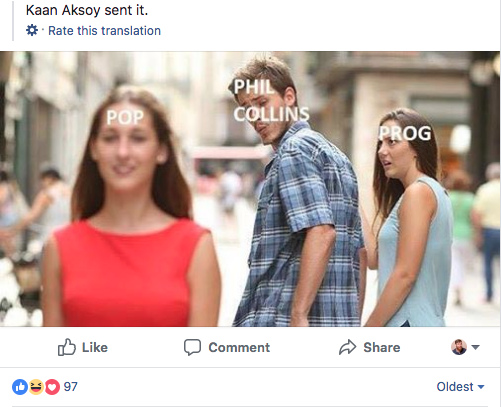
You all know this photo, right? It’s the image from the Distracted Boyfriend meme that you’ve seen used a 1,000 different ways. The image was made by Spanish photographer Antonio Guillem in 2015 as a stock photo that could be licensed from iStock photo for as little as $12.
“The setting was completely improvised as we didn’t have time to search for it. As I always work with the same models, it was quite easy to create the situation even though it was quite challenging to achieve face expressions that were believable. Mainly, because we always have a really great work atmosphere and almost all the time one of the models was laughing while we were trying to take the picture.”
Guillem has been pretty good natured about the widespread unlicensed use of his photo:
“All our images are subject to copyright laws and the license agreements of the microstock agencies.
It’s not allowed to use any image without purchasing the proper license in any possible way, so each one of the people that use the images without the license are doing it illegally.
This is not the thing that really worries us, as they are just a group of people doing it in good faith, and we are not going to take any action, except for the extreme cases in which this good faith doesn’t exist.
What really worries us and we are not going to allow it, taking the appropriate legal measures, is the use of the images in a pejorative, offensive or any way that can harm the models or me.”
(It might be noted that the memes based on his photo distributed in the United States are probably not illegal as they would likely be considered parody under the fair use provisions of American copyright law.)
But what brought this meme to mind this morning was a brilliant revival of the Distracted Boyfriend from legal issue blogger Ken White, who operates on Twitter under the handle @Popehat. I really liked his characterization of both major political parties heading into next month’s midterm election:
and
Add your favorite Distracted Boyfriend meme in the comments. (Just keep it reasonably clean…)
What happens when your university hires one fo the best reporters of her generation as a faculty member?
So University of Maryland at College Park hired Dana Priest to teach reporting classes. If you don’t recognize her name, you should. She’s a two-time Pulitzer Prize winning reporter for the Washington Post. She won them for reporting on the abuse of prisoners at black site prisons and for poor treatment of soldiers returning from war at Walter Reed Hospital. And when the University of Maryland’s Office of Strategic Communication launched a new marketing site disguised as a news site, Priest’s students were on it. Moral of the Story: If you are lucky enough to hire a brilliant journalist as a prof, don’t try to do anything skanky. You will be found out. (And I am so jealous of Maryland students getting to take classes from Priest!)
I hate writing about a Saudi journalist and Washington Post columnist Jamal Khashoggi going into the Saudi embassy in Turkey to get documents he needs to get married and is never seen going out of the embassy.
The Washington Post today published a blank space headlined “A missing voice” for Jamal Khashoggi, a columnist who’s been missing since he visited the Saudi consulate in Istanbul Tuesday. pic.twitter.com/MAFrmk4mQj
I don’t like writing about and linking to reports that the Saudi columnist for the Washington Post was reportedly tortured, killed and cut up so his body could be smuggled out of the embassy by a Saudi hit squad.
I’m devastated, shocked and enraged at this news that Turkish authorities believe that my colleague Jamal Khashoggi has been killed in the consulate of Saudia Arabia in Istanbul. https://t.co/lUAzTHkq3g
I hate the fact that I’m just barely starting to take notes on ideas for the eighth edition of my media literacy textbook, and these first notes are all about violence directed against journalists.
I hate that a columnist for an American newspaper has likely been murdered by another country’s government, and we’re all:
Sorry for the lack of posts lately. I’m working to finish all the supporting materials for the seventh edition of Mass Communication: Living in a Media World, which hasn’t left much time for blogging. Hope to get back on a regular schedule in the coming week.
With everything going on in the news lately, I’d like to post a few links to material old and new about how we deal with the news.
How our political biases can distort our reasoning
I’m a big fan of the libertarian law blog The Volokh Conspiracy. A really sharp conservative leaning, intellectually honest blog about a wide range of legal issues. Great place to go if you are looking for something other than pat, partisan answers. I really like a piece they ran recently about how smart people can engage in questionable reasoning when that reasoning is at odds with their beliefs. Essay uses examples from the Kavanaugh SCOTUS nomination hearings, but that’s not what it’s really about.
Do you really want unbiased news? C-SPAN is where you can find it
A lot of people claim they want just-the-facts, unbiased news. I really don’t believe them. Usually what they mean is news that matches their personal biases. But if you really want news presented straight, without any interpretation, C-SPAN is really the one place you can find it. Of course, that means you have to commit to listening to the an entire news event. Otherwise you would be getting the reporter’s interpretation, right? At any rate, here’s a great example of it. On the eve of the hearings the Senate Judiciary Committee held over sexual assault allegations against SCOTUS nominee Brett Kavanaugh, C-SPAN posted the entire opening statements by Prof. Anita Hill and Judge Clarence Thomas along with the complete hearings the Senate Judiciary Committee held on Hill’s allegations of sexual harassment against Thomas.
A week ago or so I saw and loved the popular movie Crazy Rich Asians. Not usually much of a rom-com kinda guy, but this film was clever and smart. One of the things I liked best about it was that none of the main characters acted stupid.(Something I really hate about comedies.) Surrounded by far-fetched circumstances? Certainly. But really good story. Highly recommend.
It also brings to mind what I thought after seeing Black Panther – that we need to see and hear more stories being told by people other than white men.
It’s not that white men don’t have good stories to tell. They have many great ones. But they don’t have the exclusive patent on stories. It is so refreshing to see stories, characters and families who are both the same and different from people from a range of backgrounds.
Just as Black Panther featured black actors from Africa, Europe and the Americas, so does Crazy Rich Asians give us a great range of Asian actors from around the globe.
Such a treat to see Michele Yeoh as a fully formed adult character and not just as a kick-ass action character. (Though don’t get me wrong – I loved her in “Crouching Tiger, Hidden Dragon” and the Bond film “Tomorrow Never Dies.”)
The movie left me wanting to read Kevin Kwan’s novel that the film is based on.
Another movie I saw recently had diversity of story telling in a very different way. I went to the Alamo Drafthouse to see the newly restored print of 2001: A Space Odyssey, complete with Overture, Intermission and post-credits music. While the movie is not diverse in terms of actors, having almost an exclusively white, male cast, it is very different in how it tells its story. Like Christopher Nolan’s recent World War II movie Dunkirk,2001 has almost no dialog and tells its story almost exclusively through stunning visuals, sound and music.
As I first wrote about 3 years ago, my parents took our family from small-town Iowa to Des Moines so we could see the movie 2001: A Space Odyssey at the River Hills 70 mm theater. For you too young to remember, that was the biggest film format of the late 1960s, at least for commercial films. That movie made such an impression on eight-year-old me that I can still tell you what the trailers were that we saw (Ice Station Zebra and Shoes of the Fisherman)
Ever since that night, I have been in love with going to see movies in the biggest theaters with the best projection system. I got to see Interstellar at a museum 70 mm film IMAX theater and Nolan’s followup of Dunkirk at a commercial digital IMAX theater.
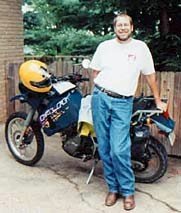
This has nothing to do with the media. It’s a brief story about a ride I took on my motorcycle to the United 93 Memorial on a rainy June day back in 2004. It was written shortly after I had recovered from a fairly serious illness, and I was happy just to be back on the road. I’ve taken to posting every year on 9/11.
Took a short ride last Saturday. The distance wasn’t much, under 200 miles, but I went through two centuries of time, ideas, and food. Which felt really good after having been ill for the last month-and-a-half.
Headed out of Morgantown about 7:30 a.m. on I68. Stopped at Penn Alps for breakfast. Nice thing about being on insulin is that I can include a few more carbs in my diet these days. Pancakes, yum! (Penn Alps, if you don’t know, runs a great Pennsylvania Dutch breakfast buffet on weekends that is well worth riding to. Just outside of Grantsville, MD.)
Then off on the real purpose of the trip. Up US 219 toward the Flight 93 Sept. 11 memorial. The ride up north on 219 is beautiful; I’ve ridden it before. I always like when you come around the bend and see the turbines for the wind farm. Some people see them as an eye sore; for me they’re a potential energy solution and a dramatic sight. Chalk one up for industrial can be beautiful.
Continue on up to Berlin, PA, where I take off on PA 160 into Pennsylvania Dutch country. I start seeing hex signs painted on bright red barns, or even hung as a wooden sign. Not quite cool enough to put on my electric vest, but certainly not warm. Then it’s heading back west on a county/state road of indeterminate designation.
Now I’m into even more “old country” country. There’s a horse-and-buggy caution sign. Off to the left there’s a big farmstead with long dark-colored dresses hanging from the line, drying in the air. They may not stay dry, based on what the clouds look like.
The irony of this ride hits pretty hard. I’m on my way to a memorial of the violence and hatred of the first shot of the 21st century world war, and I’m traveling through country that is taking me further and further back into the pacifist world of the 19th century Amish and Mennonites.
A turn or two more, following the map from the National Parks web site, and I’m on a badly scared, narrow road that is no wider and not in as good of shape as the local rail trail. (Reminds me why I like my KLR!)
It’s only here that I see the first sign for the memorial. No one can accuse the locals of playing up the nearby memorial. Perhaps more flags and patriotic lawn ornaments than usual, but no strident statements. And then the memorial is off a half-mile ahead.
The crash site is to the south, surrounded by chain-link fencing. No one but families of the victims are allowed in that area. Off a small parking area is the temporary memorial, in place until the National Park Service can build the permanent site. There’s a 40-foot long chain-link wall where people have posted remembrences, plaques on the ground ranging from hand-painted signs on sandstone, to an elaborately etched sign on granite from a motorcycle group. The granite memorial is surrounded by motorcycle images.
The messages are mostly lonely or affirming. Statements of loss, statements of praise for the heroism of the passengers and crew. But not statements of hatred. It reminds me in many ways of the Storm King Mountain firefighter memorial. Not the formal one in Glenwood Springs, but the individual ones out on the mountain where more than a dozen wildland firefighters died several years ago.
It’s time to head home. When I go to join up with US 30, it’s starting to spit rain, so I pull out the rain gloves, button down the jacket, and prepare for heading home. It rains almost the whole way back PA 281, but I stay mostly dry in my Darien. The only problem is the collar of my too-big jacket won’t close far enough, and water dribbles down inside. It reminds me that riding in the rain, if it isn’t coming down too hard, can be almost pleasant, isolated away inside a nylon and fiberglass cocoon.
I’m home before 1 p.m.. I’ve ridden less than 200 miles. But I’ve ridden through a couple of centuries of people’s thoughts, actions, and food. And I’m finally back on the bike.
This week has not suffered from lack of news for people like me who are obsessed with the coverage of news coming out of Washington.
First, there was all the fuss over Nike featuring NFL kneeling protester Colin Kaepernick being featured prominently in Nike’s latest “Just Do It” campaign, along with a tiny number of people getting an enormous amount of attention for destroying their Nike gear.
There was, of course, the ongoing live TV coverage of the Kavanaugh Supreme Court nomination hearings and all the accompanying drama.
And there were also the first excerpts and interviews about Bob Woodward’s new book Fear about conflict inside the White House along with the many comments from people who found it convenient to deny they had said what Woodward said they did. (I don’t have complete faith in many of the people who’ve written recent books about the Trump administration, but I have to say that Woodward has a good, though not perfect, track record.)
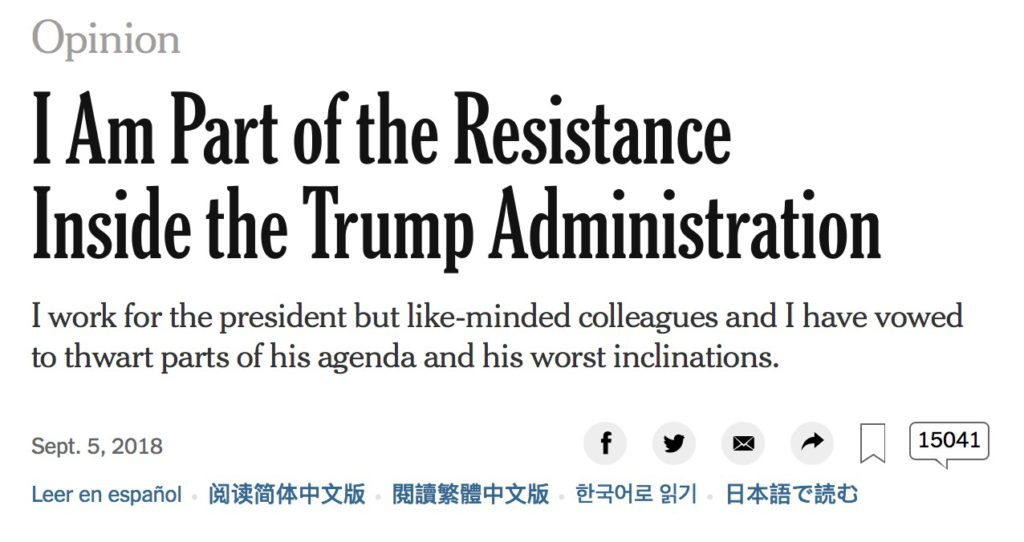
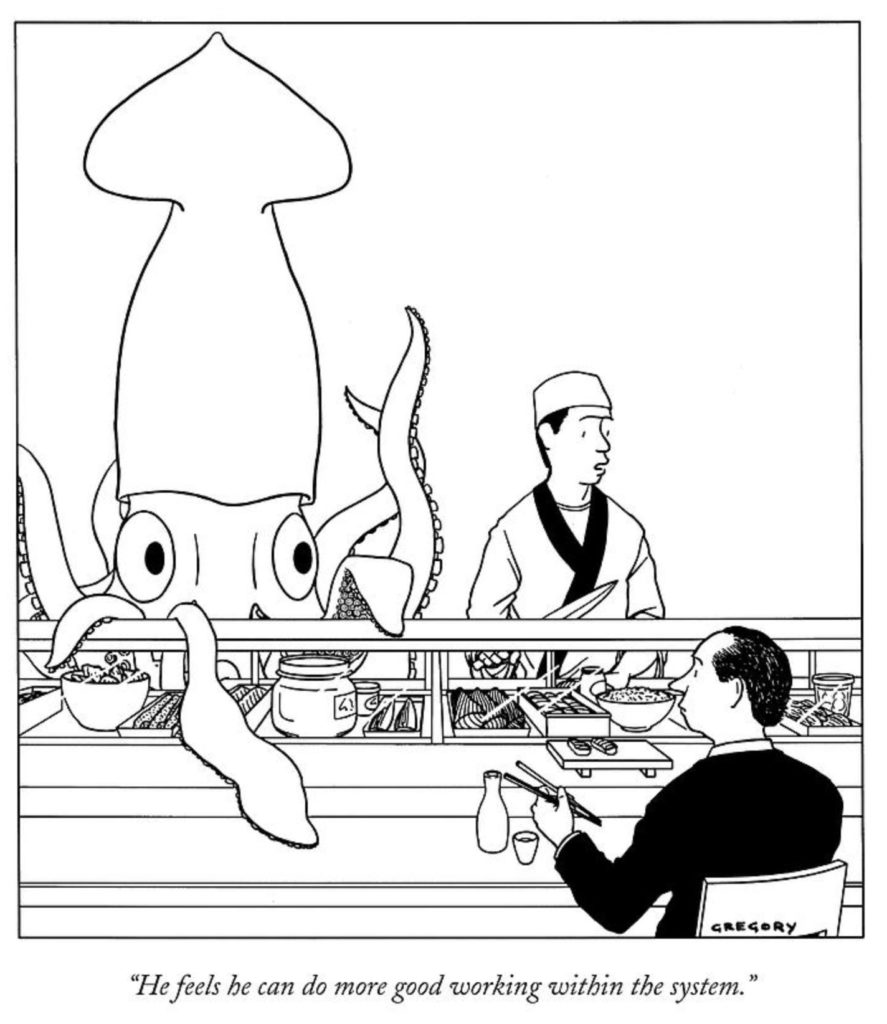
But the thing that really made the heads explode of the Twittering and chattering class was the anonymous Op/Ed written by a “senior official” at the White House published in the New York Times. (This has also rightly been called a column and wrongly called an editorial.)
In the commentary, the author writes:
“To be clear, ours is not the popular “resistance” of the left. We want the administration to succeed and think that many of its policies have already made America safer and more prosperous.
“But we believe our first duty is to this country, and the president continues to act in a manner that is detrimental to the health of our republic.
“That is why many Trump appointees have vowed to do what we can to preserve our democratic institutions while thwarting Mr. Trump’s more misguided impulses until he is out of office.
“The root of the problem is the president’s amorality. Anyone who works with him knows he is not moored to any discernible first principles that guide his decision making.”
Once this was published Wednesday afternoon, Twitter could find little else to talk about, despite the target-rich news environment.
Paige Lavender, of the Huffington Post, tweeted:
Rich Lowry, editor of the conservative National Review, noted:
So looks like the author is a "senior," but not a "top," official? ("a top official complained to me recently…") https://t.co/2m2qIPvd5K
Eric Lach, deputy news editor of The New Yorker, asked:
Which was actually a pretty good question. On the one hand, what a challenge to the reporting staff of the NY Times to find out who the editorial board gave a promise of anonymity to. (Remember: There is no connection between the editorial board/staff at the Times and the reporting staff.) But this could also be a problem for the Times, because as the Supreme Court case of Cohen v. Cowles Media showed, news organizations have a legal obligation to keep their promises to their sources.
University of Maine journalism prof Michael Socolow, pointed out in a series of tweets that the NY Times carrying a anonymous Op/Ed pieces while not common, is not unheard of. He gave several examples over the course of the following day:
And as any fan of the musical Hamilton and the Chernow biography of the first treasury secretary knows:
Absolutely. Was common. And Hamilton’s paper is now the New York Post https://t.co/uYggacETZg
— RalphIsNow@rhanson40@threads.net (@ralphehanson) September 7, 2018
There was also an extensive debate over what value publishing the anonymous opinion piece had, especially given that virtually everything in it had been reported many times before.
One thing I enjoyed was all the satire that spread from it:
Well, I guess there's no real utility in pitching anything else for the rest of the day, huh?
Tomorrow Rolling Stone will publish an op-ed from an anonymous member of Nickelback explaining how he’s trying to make them suck less behind the scenes
Trying to outline the coverage of this story could (and in some ways has) keep this blog post going forever, so let me just end with this excellent analysis from WaPo media columnist Margaret Sullivan (who used to be the NY Times public editor)
The NYT’s mystery OpEd was newsworthy — and fraught with potential ethical and legal issues. My column https://t.co/Ci6fHTq4mb
There’s been an ongoing battle going on in social media for the year or so over the meaning of Colin Kaepernick’s kneeling during the national anthem to protest police violence against black men and the fact that he has not been able to land a job as a quarterback for any NFL team.
As expected, this has set off a flurry of people tweeting about how it will destroy Nike, how it shows how brave Nike is, how it shows… Here’s a sampling of what’s being said:
Radio host and online personality Clay Travis, who loves mocking what he calls the dysfunctional liberal agenda of ESPN and other sports media, was predictably excited on how this campaign would help his conservative sports media brand:
This is also why having people with different opinions in your board room matters more than having people who look different, but all think the same. This will be a PR disaster for Nike. Insanely dumb.
I'd also like to thank @nike for ensuring my new book, "Republicans Buy Sneakers Too," has the perfect title and book cover. It's like Nike PR is trying to make me rich(er). Absolutely fabulous. https://t.co/ud4qRCuVYY
There’s also a host of profane posts from Travis you can check out if you are interested.
From conservative writer Ben Shapiro:
Name the thing he sacrificed. He was benched before he protested. He’s become far more celebrated and famous than his performance would justify. Now he’s got a lucrative ad contract. Ali sacrificed something. Kaepernick didn’t. https://t.co/cvnNAgiG9K
In the end, however, I think that ESPN The Magazine journalist Mina Kimes raised the most interesting points:
it's a powerful ad. so was the serena one. this is a corporation that was recently hit with a class action suit for gender discrimination. all of this matters. https://t.co/rP8ovQy6tw
here's what I find interesting: Nike knows its customers. The NFL ostensibly knows its fans. If we assume both companies are acting in their own self interest (as companies do)….is the demographic gap that wide? or are they making different bets?
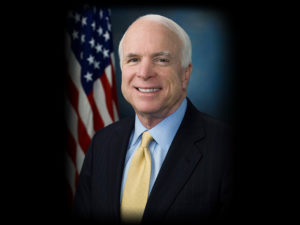
There is much about Sen. John McCain that I have admired throughout my adult life, starting when he was my senator in Arizona back in the early 1990s. The wide range of people praising Sen. McCain demonstrates that we do not have to see eye-to-eye with people in order to admire them.
Our country would be a much better place if we had more conservatives and progressives with the character and resolve of John McCain.
One of the things I have found particularly interesting about Sen. McCain is that he requested that both President Barack Obama and President George W. Bush speak at his funeral. These are the two men who came out on top in the race for the presidency with Sen. McCain.
I’m including links to a couple of tributes to Mr. McCain, followed by a blog post I put up in 2011 about President Obama’s 2008 victory speech and Sen. McCain’s concession speech. I consider both of these to be high points in contemporary political rhetoric. This was a hard-fought and consequential presidential race, and the two candidates emerged still able to be respectful to one another.
Both President Barack Obama and his challenger Senator John McCain were credited with giving excellent speeches on election night 2008. Take a listen to these two speeches, then read a transcript of them. Which gives you a better sense of what the speech was like?
I recently was in Washington, D.C. for an academic conference, and fortunately enough, the conference hotel was about three blocks from the National Portrait Gallery and Museum of American Art. I’ve been there on several occasions in the past, but given its proximity this time, I was fortunate enough to go there three times this time around.
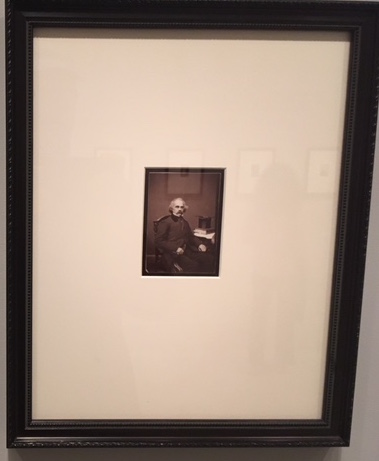
Matthew Brady Studio portrait of author Nathaniel Hawthorne.
My first stop every visit is to see the Matthew Brady Studio photographs down the hall on the main floor. Photographer Mathew Brady is often credited with inventing photojournalism in the mid-nineteenth century. In 1845, Brady began to become famous for his portraits of noted Americans. (The one at right is of author Nathaniel Hawthorne.) He attempted to sell printed reproductions of his photographs, and though the effort failed because the costs were too high, he set the stage for later celebrity photographers, such as Annie Leibovitz. Brady also realized that much of the value of his photographic portraits came from their being reproduced as engravings, woodcuts, lithographs, and the like. The original was valuable, but so were the reproductions. Today Brady is best remembered for his pictures of the American Civil War, the first war to be photographed from beginning to end. It should be noted that there were a number of photographers working for the Brady Studio who generally did not receive named credit for their work.
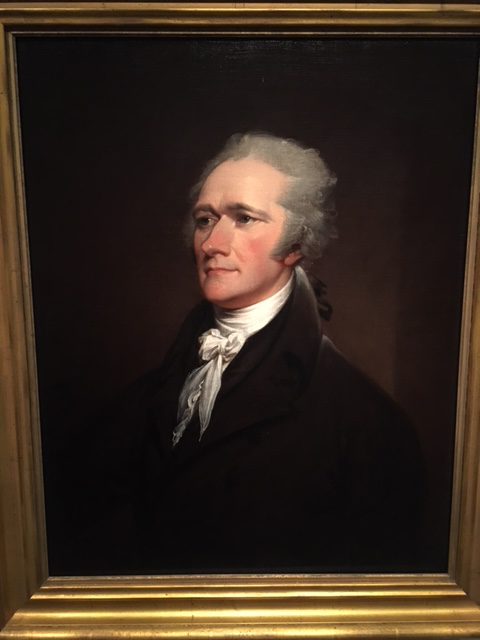
Following the Brady exhibit, I headed upstairs. Fans of the Chernow biography of Alexander Hamilton (and, of course, the hit musical) will find much to see in the section developed to American history. Two stood out for me. First was the John Trumbull portrait of Hamilton:
Alexander Hamilton, by John Trumbull.
John Trumbull was a prominent revolutionary era painter who is perhaps best known for his Declaration of Independence painting. There’s a song on the Hamilton Mix Tape that was cut from the musical that sums up the events of the political side of the revolution really well:
“You ever see a painting by John Trumbull? Founding fathers in a line, looking all humble Patiently waiting to sign a declaration and start a nation No sign of disagreement, not one grumble The reality is messier and richer, kids The reality is not a pretty picture, kids Every cabinet meeting is a full on rumble What you’re about to witness is no John Trumbull”
—Cut song from Hamilton
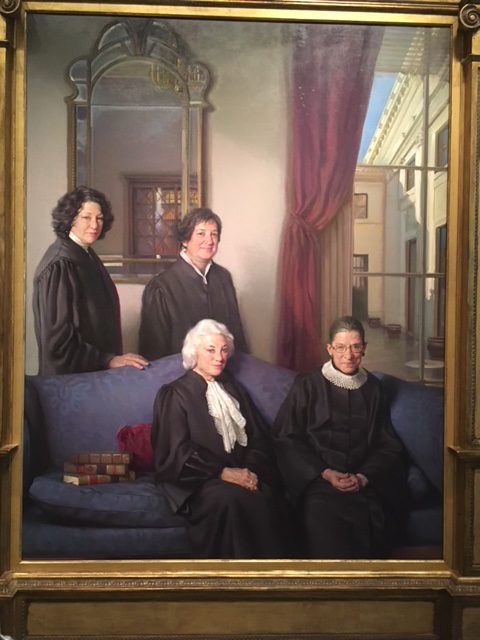
The other standout was Nelson Shanks’s “The Four Justices” featuring the only four women to have served on the U.S. Supreme Court.
Supreme Court justices Sonia Sotomayor, Elena Kagan, Sandra Day O’Connor, and Ruth Bader Ginsburg.
The painting is huge and dominates the second floor rotunda with these four very different women. (By the way, the Ruth Bader Ginsburg biopic RBG will be showing on CNN Labor Day weekend.)
The America’s Presidents is probably the best known of the gallery’s exhibits, containing many of the iconic images of our early presidents we grew up with in our textbooks. But it was the collection of the presidents of my lifetime that really captured my attention.
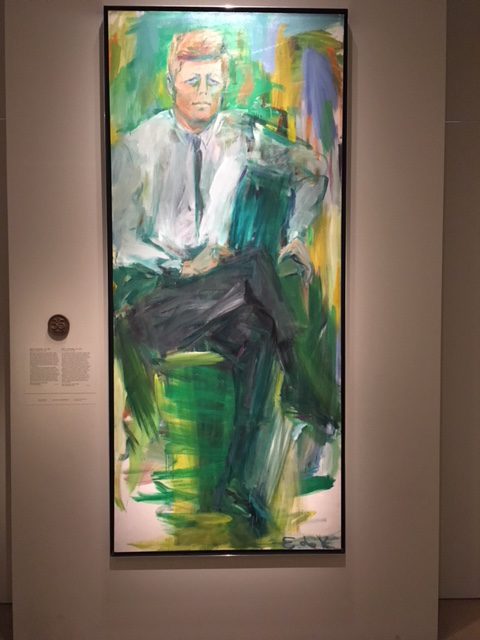
John F. Kennedy, painted by Elaine de Kooning.
Something about the colors, brushwork and “gestural” style really seems to capture who this young, dynamic president was in his too short life.
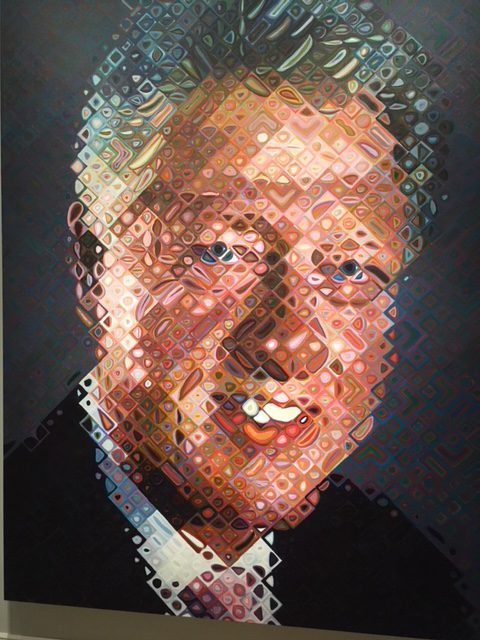
Bill Clinton, painted by Chuck Close.
I don’t know quite how to react to this portrait of President Clinton created out of a series of tiny abstract paintings. I have to say that it is oddly compelling.
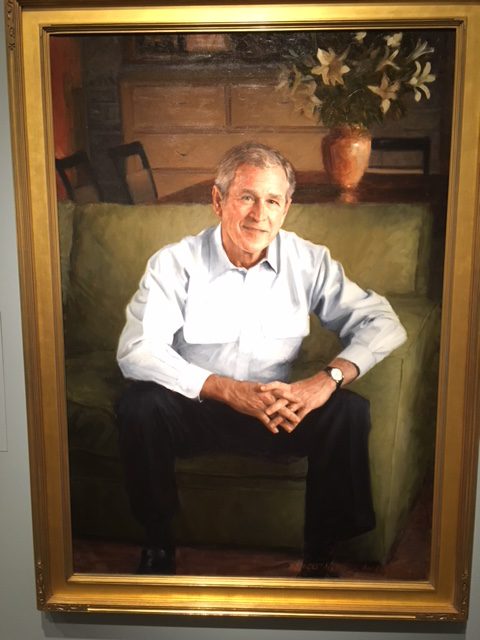
George W. Bush, painted by Robert Anderson.
In something that was a bit of surprise to me, one of my favorite portraits of a contemporary president was that of George W. Bush by his Yale classmate Robert Anderson. President Bush requested an informal portrait painted at Camp David. While I am not a big fan of Bush’s presidency, I feel like this painting really captures who Bush is, and who he might have been if the September 11th attacks had not happened.
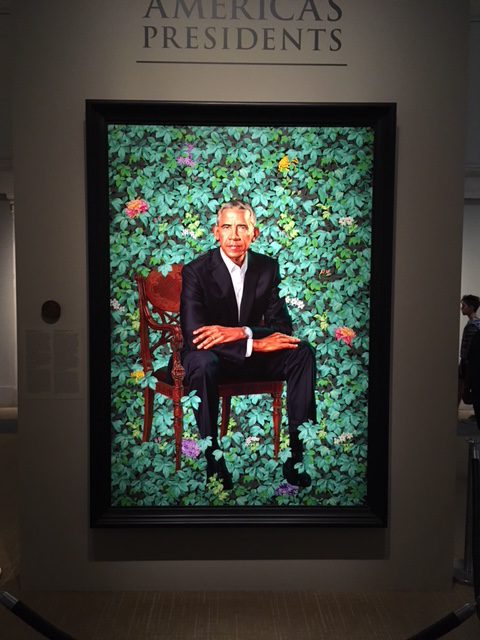
Barack Obama, painted by Kehinde Wiley, the first presidential portrait painted by an African American artist.
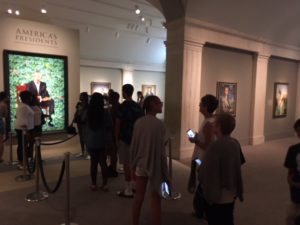
The Obama portrait was the biggest draw at the museum while I was there with a modest line of mostly young people waiting to take a selfie with the painting. Obviously Obama is the last of the presidential portraits, but it is located in the doorway that connects the hall of presidents to an exhibit called The Struggle For Justice about civil rights in its many forms. What perfect placement, seemingly in both exhibits at the same time.
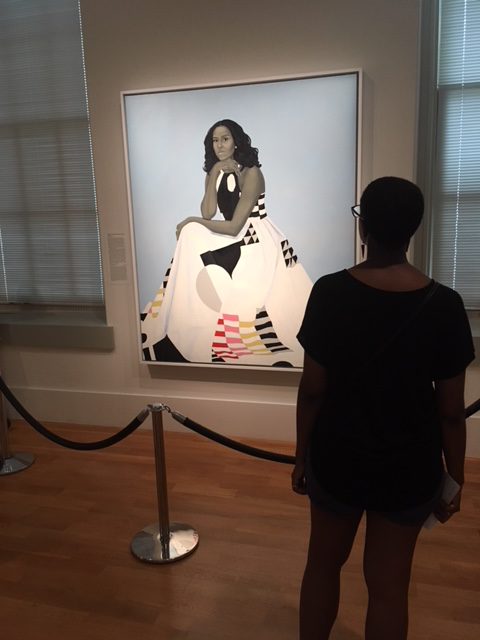
Young woman looking at Amy Sherald’s portrait of first lady Michelle Obama.
The final portrait I’d like to highlight is the stunning portrait of first lady Michelle Obama, painted by Amy Sherald.
I’m not an artist and have had only the simplest level of art appreciation education, but the time I spent at the portrait gallery gave me a lot to think about. Seeing the portraits of Hamilton, John Jay, and Presidents Washington and Jefferson gave me such a connection to the time of the Revolutionary War and the era Hamilton lived in. We obviously have no photos from this time, but the portraits painted from life give us a direct connection these historic and vibrant figures. The modern presidential portraits have a huge range of styles, from the realistic, casual portrait of George W. Bush, to the more stylized images of Presidents Kennedy and Clinton. But the two Obama portraits were the real standouts. The realistic image of the president stands in contrast with the more minimalist painting of the first lady.
I think my reaction to these paintings was heavily shaped by the context in which I viewed them. The line of young people who were so eager to take their smartphone pictures with President Obama’s portrait. The young African American woman with the close-cropped hair starring lovingly, admiringly, hopefully at the first lady. Doreen St. Felix, who reviewed the Michelle Obama portrait for The New Yorker, summed it up this way, “The portrait, beautiful and discomforting, is like a memory of what we never knew.”

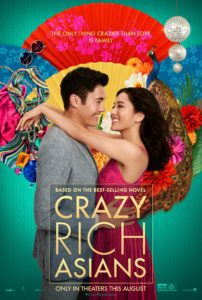 A week ago or so I saw and loved the popular movie Crazy Rich Asians. Not usually much of a rom-com kinda guy, but this film was clever and smart. One of the things I liked best about it was that none of the main characters acted stupid.(Something I really hate about comedies.) Surrounded by far-fetched circumstances? Certainly. But really good story. Highly recommend.