
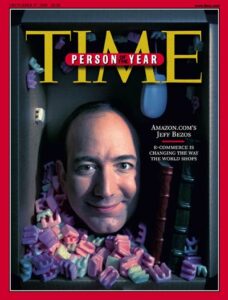
Jeff Bezos as Time’s Man of the Year in 1999. Cover by Gregory Heisler
Approximately 13 years ago, Jeff Bezos was recruited by the Graham family to purchase The Washington Post for $250 million. Bezos, the founder of Amazon and one of the world’s wealthiest men, bought the paper as an individual, not as a part of Amazon. At the time he purchased the paper, it made up less than 1 percent of his net worth.
When he first bought it, Bezos’s ownership of the Post was seen as a positive thing. He had the deep pockets to invest in improving the newsroom, he had the tech knowledge to move the Post into the 21st century, and he was rich enough to not have to worry about how profitable the paper would be.
So how did that work out?
Opinions have varied over the last decade or so, but lately Bezos has gone from being a largely hands-off owner to a self-serving owner.
In April of 2019, I took a look at how the Bezos/WaPo relationship was doing, five-and-a-half years in. As might be expected, it was somewhat of a mixed bag.
- Bezos moved The Post from being a paper “For and about Washington” to being one with a national or even global presence. This meant that the paper was no longer going to limit itself to news within its print circulation area. By 2016, the paper had a growing audience, improved reporting, and was gaining a reputation as a national news source.
- Bezos was hiring both journalists and tech people.
- The paper capitalized on the growing interest in Washington, D.C. news that came with the rise of Donald Trump as a politician.
- Surprising very few people, Bezos had conflicts with the unions at The Post. Between 2013 and 2018, Bezos’s net worth had climbed from approximately $26 billion to $158 billion. Meanwhile, the Washington Post Guild negotiated a contract for a $15 a week pay raise for staffers. At the same time, Bezos’ net worth was increasing by something like $10.8 million an hour.
- During this time, Bezos was also suffering from attacks by President Trump, for both the editorial policies of the Post (which at the time Bezos had reportedly little involvement) and for delivery contracts that Amazon had with the U.S. Postal Service.
I concluded this five year retrospective of Bezos’ time as Post owner by writing:
Bezos has been largely successful with his purchase of the Washington Post. Since acquiring it in 2013, he has improved readership, revenue and reporting at the paper. He has also worked at building it up as a national news source that is delivered primarily digitally. Like he did before with Amazon, Bezos is most concerned with investing in the future of the Washington Post than with short-term profits; more interested in reader engagement than revenue.
Overall, the newsroom is happy to have a forward thinking owner who has deep pockets investing in the long-term success of the paper, but the staff would like it better if Bezos were willing to share more of that revenue with them.
Ownership of the Washington Post has not always been an easy thing for Bezos, opening him up to attacks on himself and his businesses from both President Trump and his allies.
Jump forward another five years to 2024.
Donald Trump finished up his first term, failed to get re-elected in 2020, and was running once again for the presidency. The editorial staff of the Post had prepared an editorial endorsing the Harris/Walz ticket. But less than 24-hours before publishing the endorsement, Bezos killed the editorial. At the time I wrote:
The controversy exploding from this is not so much that the paper has discontinued endorsements at the presidential level as that it was done just 10 days before the intensely controversial 2024 presidential election. Criticism of the move by Bezos and [publisher William] Lewis to cancel the endorsement has been massive by the current and former staff of the Post, who see the move as being done out of fear that Bezos’ companies would be hurt should Trump win the presidency again. It has resulted in a number of resignations from the paper’s staff. One of the most outspoken has been former editor Marty Baron.
This has also led to a massive number of people publicly cancelling their subscriptions to the Washington Post in hope of sending a message to the paper. I have argued on social media that nothing readers can do will hurt Bezos. But cancelling subscriptions can and will hurt the journalists and opinion writers at the paper, none of whom had anything to do with cancelling the endorsement.
This was the beginning of Bezos working to seek the approval of the Trump administration, or at least avoid antagonizing it. It also suggested that his commitment to the newspaper as a treasured journalism outlet was not all it could be.
Dave Karpf, associate professor of media and public affairs at George Washington University, writes that for first ten years of his ownership, “[Bezos] was about as good of a steward as you could hope for. He hired Marty Baron and left the journalists to be in charge of the actual journalism. When the paper lost money, he wrote a check.”
But then in early February Bezos fired 300 of the 800 journalists working at the Post. Yes, he fired more than a third of the staff.
As Karpf points out, it can’t just be about the money. Bezos’ personal net worth is now up to nearly $250 billion. That’s more than 10 times what it was in 2013. He’s not suffering for money.
Karpf suggests that these cuts are because Bezos has decided that he’s now on “Team Billionaire,” where he doesn’t want the Post doing anything that will screw up his other business interests:
Team Billionaire isn’t quite the same as Team Trump, but the two have made peace and found common cause with each other. Jeff Bezos knows that, if the Washington Post publishes the wrong story about the wrong person, it could spell trouble for Blue Origin or Amazon. Being a hands-off media mogul was fine when it didn’t cause any trouble. But under authoritarianism, it can be such a headache.
Joseph Weber, professor emeritus at the College of Journalism and Mass Communication at the University of Nebraska-Lincoln, recently wrote about Bezos’s change at his Substack, comparing how the New York Times was behaving compared to the Post. As career-long reader of the Post (I subscribed to their weekly edition back in the pre-internet days and for 15 years lived in the circulation area of their Sunday edition), I always saw it as superior to the Times, but that loyalty has faded. As Weber points out, the Times has more than 2,800 people working on journalism while the Post will now be down below 500. His analysis is well worth a read.
Former Wall Street Journal tech reporter and prominent podcaster Kara Swisher saw a solution to the Post’s problems back in 2024 when she said she was trying to put together a wealthy pool of investors to buy the paper from Bezos and turn it into a non-profit. Swisher said in March of 2025 that investor interest was not a problem, but Bezos did not want to sell the Post, he just wants to keep it on life support to do his bidding.
I promised myself when I started working on this post a couple of weeks ago that I would not close it out with a paraphrase of the famous quote from T.S. Elliot’s The Hollow Men, “This is the way the [Post] ends, not with a bang but a whimper.”
Bu I think perhaps an earlier line from the same poem might be more appropriate:
We are the hollow men
We are the stuffed men
Leaning together
Headpiece filled with straw. Alas!
Our dried voices, when
We whisper together
Are quiet and meaningless
As wind in dry grass