Ten Threads Accounts to Follow – 2025 Edition

This week my JMC 406 Blogging and Commentary students were asked to do one of their first posts by listing 10 Threads accounts they are following and why. You can find my students’ posts using the #JMC406 hashtag. Here’s my 2025 swing at the assignment. Some overlap from last year’s, but majority new.  I’m also trying to avoid accounts my students are likely linking to:

  1. grovesprof – Jonathan Groves
    Professor at Drury University and former journalist
  2. Tim Carman
    Award-winning Washington Post food writer and UNK journalism alum
  3. karaswisher – Kara Swisher
    Journalist at the intersection of tech/politics/culture.
  4. Brian Stelter
    CNNs once and current media reporter. Also talks about his and his spouse’s life as television journalist.
  5. Steve White News
    One of the most respected central Nebraska broadcast journalists with a focus on agricultural issues.
  6. rosannecash – Rosanne Cash
    Daughter of Johnny, one of my favorite musicians, fantastic performer. Often political.
  7. Black Girl Nerds
    Geek culture and Black feminism
  8. dkiesow – Damon Kiesow
    Knight Chair in Journalism at Mizzou. Smart commentary on journalism and media business.
  9. Chef José Andrés
    Celebrity chef and founder of global food relief non-governmental organization World Central Kitchen. (Owner of Zaytinya in Washington, D.C. – my favorite restaurant.)
  10. Jack Jenkins
    National reporter for Religion News Services

Accounts I used to have on this list:

Posted in Uncategorized | Tagged , , | Leave a comment

OG Blockbuster Jaws Back in Theaters for 50th Anniversary

Jaws, the OG summer blockbuster, is showing for the next week in theaters for its 50th anniversary. You do not want to miss this groundbreaking film on the big screen! Here in Kearney, NE, it’s showing at our community run The World Theatre through Thursday, Sept. 4. Tickets at The World are only $5, with popcorn and soda $1-$3. All your favorite movie candy is also only $3. So you can bring the whole family!

Monday through Thursday  there will be free admission for various groups:

  • Monday, 9/1, Teachers are free
  • Tuesday, 9/2, Students are free
  • Wednesday, 9/3, First responders are free
  • Thursday, 9/4, Veterans are free. 

Here’s the backstory on this groundbreaking movie and the long-running influence it’s had  on our movies.

Jaws 50th anniversary poster for Kearney, NE's World Theatre


Director Steven Spielberg is generally credited with creating the blockbuster era with the release of his 1975 summer hit Jaws. It was the first movie to gross more than $200 million, and it set the stage for the big summer movies. Prior to Jaws, it was believed that a movie had to be released during the Christmas season to be a major success. Jaws had a number of things going for it: it was directed by one of the most popular directors of the late twentieth century, it featured a compelling musical score by John Williams, and it was based on a best-selling novel by Peter Benchley.

Jaws was accompanied by a giant television advertising campaign that began three days before the movie’s release. But the marketing of the movie had started two years earlier with an announcement that the movie rights had been acquired and speculation about the stars. Journalists were taken to the production site in record numbers to keep the stories flowing. The movie’s release was scheduled to occur within six months of the publication of the paperback book, and the book’s cover included a tie-in to the movie. As the release date for the movie approached, copies of the paperback were sent out to waiters, cab drivers, and other ordinary people to build word of mouth. Finally, the movie was given a summer release date to capitalize on the beach and swimming season.

The Jaws campaign was designed to get people to the movie and talk about it. If the talk had been negative, all the advertising in the world could not have saved the movie. But with everyone talking up the movie, Jaws took off. The success of Jaws started a tradition of larger-than-life summer movies that continued with the Star Wars trilogies, the Indiana Jones series, Christopher Nolan’s Dark Knight trilogy, and the Pirates of the Caribbean series. There is an argument to be made that we have moved out of the blockbuster era and into the franchise era. That is, it’s not enough for an individual movie to stand out in its own right—it needs to be part of a complex, consistent universe containing multiple movies, such as the eleven (so far) Star Wars movies, more than thirty-three Marvel Cinematic Universe movies (with many more in production), and the fifteen DC Extended Universe films (with a reboot of the series in the works).

These movies come with a built-in market of fans waiting to see them. Paul Bettany, the British actor who plays Vision in the Avengers movies, says the series is so successful because the films are made by and for fans. “[The people at Marvel] really love those characters,” he said. “Their love for these stories is really infectious and you become really invested, and there’s a lot of invested people beyond the financials of it all. . . . This movie is made by geeks. They love them, they feel it when they’re talking about it.”

Posted in Uncategorized | Tagged , , , | Leave a comment

62 years ago, MLK gave his “I Have a Dream” speech at the March on Washington. Let freedom ring!

Editor’s Note: Rerunning a favorite post this morning.

“And if America is to be a great nation this must become true. So let freedom ring from the prodigious hilltops of New Hampshire. Let freedom ring from the mighty mountains of New York. Let freedom ring from the heightening Alleghenies of Pennsylvania!

Let freedom ring from the snowcapped Rockies of Colorado!

Let freedom ring from the curvaceous slopes of California!

But not only that; let freedom ring from Stone Mountain of Georgia!

Let freedom ring from Lookout Mountain of Tennessee!

Let freedom ring from every hill and molehill of Mississippi. From every mountainside, let freedom ring.”

Posted in Uncategorized | Tagged , | Leave a comment

Brad Pitt’s “F1” adds to the pantheon of great racing movies

This weekend, our local community The World Theatre will be showing Brad Pitt’s Formula One racing movie “F1.” As always, tickets are just $5 with popcorn and soda each available from $1-$3. Bit of a bargain compared to the $3,000 “cheap seats” for the upcoming Circuit of the America’s race in Austin, Texas.


F1 tells the fictional story of former race great Sonny Hayes (Pitt) being recruited by old friend and struggling F1 team owner Ruben Cervantes (Javier Bardem) to try to bring the team a much needed victory. Hayes teams up with up-and-comer Joshua Pearce (Damson Idris) who has a lot of skill but no idea how to really race. Although it is clearly a testosterone-heavy film, it also has compelling female performances from Pearce’s mother, Bernadette (Sarah Niles, best known for stage and TV roles); and team technical director Kate McKenna (Kerry Condon, who brings her unabashed Irish regional accent that shone in the eminently weird and wonderful movie The Banshees of Inisherin).

Directed by Joseph Kosinski (Top Gun: Maverick), much of the movie was shot at actual F1 races in 2023 and 2024. While I’m not a car racing fan, I was for years a big motorcycle racing fan, and I was really impressed how the plot followed the importance of tire management and successful pit stops. While the producers did not have their own cars in the races, they were able to digitally “skin” two of the actual race cars with pseudo paint jobs to make them match Pitt’s and Idriss’ fictional cars. I know the movie has faced the inevitable criticism of Formula One fans for not being realistic, but honestly, I found it immensely enjoyable for characters, story and race drama.

I loved watching F1 in it’s initial run at our local commercial theater, and I can’t wait to see it again this weekend at The World.


Watching F1 brought to mind a number of older racing movies that I would love to find time to rewatch.


Most recently, that would be 2023’s Ferrari staring Adam Driver as Enzo Ferrari and Penélope Cruz as his estranged wife Laura Ferrari. Cruz is absolutely ferocious in this story based on the 1957 race season as Enzo tries to put together a team that can get a badly needed win in a 1,000-mile endurance race, and he struggles even harder, along with Laura, to come to terms with the death of their son Dino. While I thought Driver did well as Enzo, it was Cruz’s portrayal of the betrayed Laura who dominates the film.


The second variation on this theme was director James Mangold’s Ford v. Ferrari, which looks at the real-life 1966 battle between Ford and their new GT40 designed to compete against Ferrari in the 24 Hours of LeMans. The movie stars Matt Damon as the legendary driver and car designer Carroll Shelby and Christian Bale as Ken Miles, the English race car driver. As is always the case with movies based on real-life events, there is considerable fictionalization, but it’s still a great look at one of the great racing battles.


But as good as all three of these are, none are better than director Ron Howard’s Rush. Unlike these previous films, this is the story not of the cars but two rival drivers trying to establish who is better during the 1976 Formula One campaign. Chris Hemsworth (best known for as Marvel’s Thor) plays the passionate British playboy driver James Hunt, who drove for McLaren. German/Spanish actor Daniel Brühl (who became famous as the Marvel villain Helmut Zero) plays the cold, calculating Niki Lauda, an Austrian driver for Ferrari. This is not only a story about these drivers on the track but about how they approach their personal relationships and adversities.


Finally, we close this out by taking a big step back in time reminding you to take look at John Frankenheimer’s 1966 giant Grand Prix, staring James Garner, Eva Marie Saint, and cinematographer  Lionel Lindon’s gorgeous Super Panavision 70mm camerawork. It is a typical 1960s “epic film,” with an international cast and an almost 3-hour run time.


Epilogue – If you are a hard core racing fan, you might want to see Steve McQueen’s Le Mans, which tells the story of a fictional 1970 24 Hours of Le Mans endurance race. The film has virtually no plot with few meaningful characters, but it has some of the best race footage ever to appear in a dramatic movie.


Do you have a favorite racing movie of any type you’d like to mention? Tell us about it in the comments!

Posted in Uncategorized | Tagged , , , , , , , | Leave a comment

Everyone’s Gone to the Movies – Original Star Wars Edition

Editor’s Note: We’re going to have two or three summer movie blog posts coming up in the next week. For this one we’re looking at a rare screening of the original non-special-edition Star Wars.

Original Star Wars Trailer image

Click to play the original 1977 theatrical Star Wars trailer.

Original 1977 print of Star Wars screened in Britain
Back in the summer of 1977 I was 17 years old and was blown away by a new movie called Star Wars. I was so blown away by it I went to see it in the theater every weekend all summer long for a total of 13 times. I know that sounds excessive, but this was before streaming, before common availability of cable movie channels, before even the VCR. If you wanted to see a movie, you had to see it in person in the theater. So I don’t really think I was that over the top…

One of the things I noticed over the summer was how the 35mm print gradually deteriorated. New scratches would appear and bits of the film would disappear as the film broke repeatedly. At my local theater, the most notable change was that the sequence with the mouse robot kept getting shorter and shorter as the film kept breaking at the same spot.

Now, with digital prints, projecting a movie on the 100th screening looks exactly like the projection from opening night.

Except…

Star Wars director and producer George Lucas has never been able to leave his movies alone. In between the 1977 release of Star Wars and the 1980 release of The Empire Strikes Back, the original Star Wars acquired a new heading: Before the crawl, it was now Star Wars: Episode IV, A New Hope.

Then, in 1997, for the movie’s 20th anniversary, Lucas released new “Special Editions” of the original three movies with new digital effects and some controversial editorial changes – most notably changing things so “Han didn’t shoot first” in his confrontation with Greedo.

Han shoots first at Greedo in the 1977 version of Star Wars.

Ever since that time, Star Wars purists (your author included) have been begging to be able to see trilogy in all of its original analog effects glory. But Lucas not only stands thoroughly behind the Special Editions (he says they were how he always intended the movies to look), he also claims the original editions no longer exist.

That’s mostly true, though not entirely. I have a DVD set of the Special Edition original trilogy that includes the (mostly) original versions as bonus disks. But… these are very old school with non-anamorphic prints that have the black bars permanently baked in. This means that if you try to view it on your modern HDTV, you will have a very small image in the middle of your screen surrounded by the black bars, rendering it essentially unwatchable. The only way I’ve been able acceptably view these is by taking rips of them and viewing them on my iPad.

There is also a “de-specialized” version of the movie floating around online that have been assembled from a number of sources, reportedly including “2011 special edition Blu-rays, the 2006 bonus DVD, a 2004 HDTV telecast, a scan of an old 35-millimeter print, and a handful of other sources.”

But in June this summer some 900 fans got to see Star Wars just the way I did when I first saw it in the summer of 1977.  The British Film Institute  pulled their original dye transfer Technicolor 35 mm print for two plays at their Film on Film Festival.

As reported by NPR:

“We’re not saying come and see this on a film print as part of nostalgia,” said James Bell, a senior curator of fiction at the British Film Institute National Archive and the programming director of the festival. “We’re saying there’s a real qualitative, aesthetic difference to seeing a film projected on a film print. I think that’s exciting to anyone, whether you’re a Star Wars fan or not.”

In an interesting side note, Kathleen Kennedy, Lucasfilm’s president, attended the screening and held a conversation with BFI’s host. One can only hope that someday Lucasfilm will see fit to release a high-quality home video version of the original trilogy.

Posted in Uncategorized | Tagged , , | 1 Comment

Media giants doing the come together/separation dance

Where have I been?
Busy end of the semester and then a fair bit of traveling with family and on the motorcycle. Still have a fair amount of travel coming up, but will try to keep up better here.

Warner Bros. Discovery following in the footsteps of News Corp./Fox and Viacom/CBS

Dancing the minuetMedia companies seem to be fond of dancing a minuet of coming together and then separating recently.

Back in the summer of 2012, Rupert Murdoch announced he was splitting News Corporation and 20th Century Fox into two separate companies, primarily so that their stocks could trade separately – with News Corp. being devoted to books, newspapers, and database publishing; and Fox being devoted to entertainment programing (including, oddly enough, Fox News).

Viacom and CBS went a similar route early in the century, dancing back and forth before ending up together under the Paramount banner.They are currently dancing in circles trying to work out the merger of Paramount and Skydance Media sometime in 2025.

So now it’s the turn of Warner Bros. Discovery, a relatively recent creation when Discovery Inc. purchased WarnerMedia to strengthen their streaming portfolio, to become two separately traded companies. According to Variety:

The streaming company will encompass the Warner TV and movie studios, HBO and HBO Max and a games and experiences division. The company will focus on building out the HBO Max streaming service and investing in programming. Meanwhile, the TV company will include Warner’s TV networks around the world along with specific digital brands tied to the TV entities, including Discovery+, Bleacher Report and CNN’s new streaming products.

Media giant Comcast is also headed in the same direction before long. According to CNBC, it will be splitting into a streaming/cable company called Versant (as in short for conversant) that would include USA, CNBC, MSNBC, Oxygen, E!, SYFY and Golf Channel as well as the movie web sitesFandango and Rotten Tomatoes. Comcast will then contain the NBC broadcast network, Peacock streaming service, Universal Studios, the theme parks and Bravo.

All this talk of dancing gets me thinking of the folks on Bridgerton cavorting to the sounds of the Vitamin String Quartet.

Posted in Uncategorized | Tagged , , , , , , , , , , , | Leave a comment

Free Speech and High School Students – Who Controls What Gets Printed?

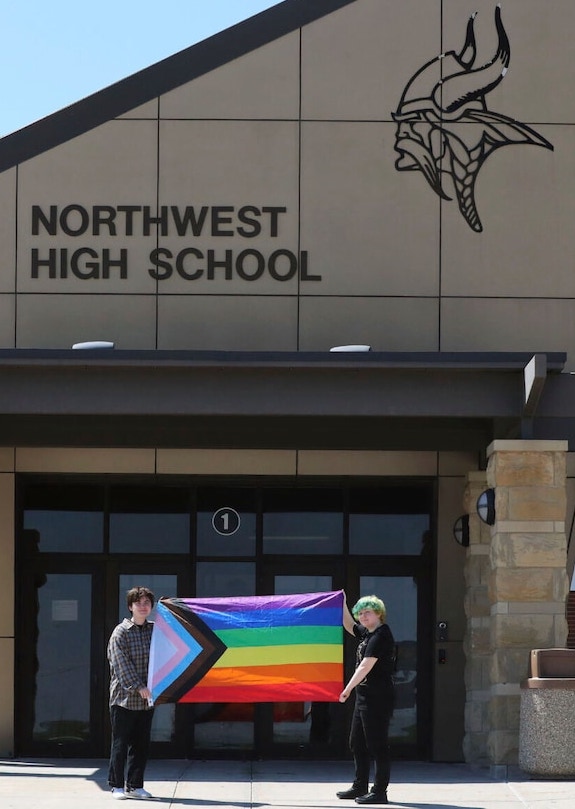
Marcus Pennell, left, and Emma Smith — former Viking Saga newspaper staffers — outside Northwest High School in Grand Island, Neb., July 20. (McKenna Lamoree/The Independent via AP)

It’s never good for a high school when a reporter or editor of the school paper is writing a commentary for the Washington Post. Generally, when that happens, the school administration or school board has come down hard with some form of censorship on the student newspaper. That’s what happened in Grand Island, Nebraska, in June 2022.

Northwest High School’s Viking Saga had a pretty conventional cover, with a lead story about four siblings who had moved through a range of foster care but were now getting adopted into one family. Other stories on the cover told the story of a student whose sculpture was honored in a national competition, the appeal of trapshooting as a competitive sport, and the success of the school’s Future Business Leaders of America group. But what caught the attention of the school’s administration and the school board were a collection of articles dealing with LGBTQ+ issues, including a history of Pride Month under the headline “Pride and Prejudice: LGBTQIA+” written by associate editor Emma Smith, a commentary on the science of gender by staff writer Hiapatia McIntosh, and an editorial on Florida’s controversial “Don’t Say Gay” bill written by trans staff writer Marcus Pennell.

Only Marcus’s article was under the name “Meghan Pennell,” the name Marcus had been born with. A month or so before the paper was shut down and the newspaper journalism class canceled, the staff had been reprimanded after publishing preferred pronouns and names for bylines and in articles. District officials told students they could use only birth names from that point on.

The Washington Post helped bring national attention to the newspaper’s shutdown, or “cancellation” as some of the students referred to it, when it published a commentary by Pennell. Following his graduation, Pennell wrote:

The trouble started when I changed five letters in my first name.

My birth certificate reads “Meghan.” But my peers at Northwest High School in Nebraska knew me as “Marcus.” Changing my name wasn’t supposed to be a political statement. But our local school board has turned it into one…. Whether the administra- tion, parents or other students liked it or not, there were LGBTQ kids at Northwest, and taking away our liberty to be ourselves wasn’t going to change that.

Officially, the school district’s administration declined to say why or how the newspaper was shut down, but an email from a school employee to the Grand Island Independent local newspaper said it was “because the school board and superintendent are unhappy with the last issue’s editorial content.” The school board vice president had been previously quoted as saying, “I do think there have been talks of doing away with our newspaper if we were not going to be able to control con- tent that we saw (as) inappropriate.”

This all raises the question: Can the school district legally do this? Can it shut down a long-running, award-winning newspaper and cancel the newspaper curriculum just because it doesn’t like the paper writing about queer issues? In Nebraska, the answer was mostly “yes,” even if the district in the long run had a hard time making the cancellation stick. In principle, high school students do have free speech rights, but if a student newspaper is produced as part of a class activity, the school can control its content for any “legitimate education reason,” under the U.S. Supreme Court’s Hazelwood School District v. Kuhlmeier decision that ruled that high school newspapers have only minimal protection under the First Amendment. And unlike some nearby states like Iowa and Kansas, Nebraska has not passed a law protecting the free speech rights of student publications.

After enrolling as a journalism major at the University of Nebraska Omaha, Pennell, along with the Nebraska High School Press Association, with help from the American Civil Liberties Union of Nebraska, sued Grand Island Northwest Public Schools and its superintendent in federal district court, claiming that the district had violated Pennell’s First Amendment rights. The case was eventually dismissed by the judge because Pennell was no longer a student at the high school, but he noted, “School administrators would be wise to remember that policies and decisions to restrict speech in student newspapers … may run afoul of the First Amendment if they reflect ‘an effort to suppress expression merely because the public officials oppose a speaker’s view.’”

As for the student newspaper Viking Saga, it returned in the spring of 2023 as an online publication with a new faculty adviser, along with the class for producing it.

Posted in Uncategorized | Tagged , , , , | Leave a comment

How “Death of a Unicorn” connects with reality

So there is a strange, violent, bloody, incredibly funny movie out this spring called Death of a Unicorn starring Paul Rudd, Jenna Ortega, Téa Leoni, and Richard E. Grant. Dear Wife and I saw it Thursday evening at The World Theatre, our local non-profit, volunteer-run community movie theatre.(Playing also Friday night and Sunday afternoon  – Full disclosure, I’m a regular volunteer there.)

On our way home from this oddball film, it occurred to me that I had already known quite a bit of its backstory from an article I thought I had read in the New Yorker maybe 10 years ago that might have been written by science and thriller writer Douglas Preston.

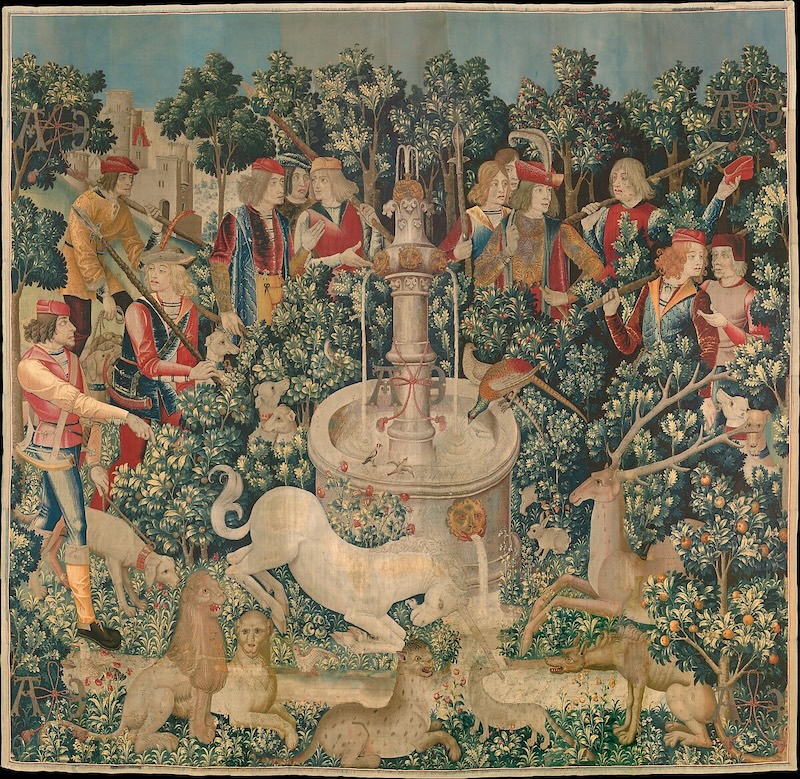
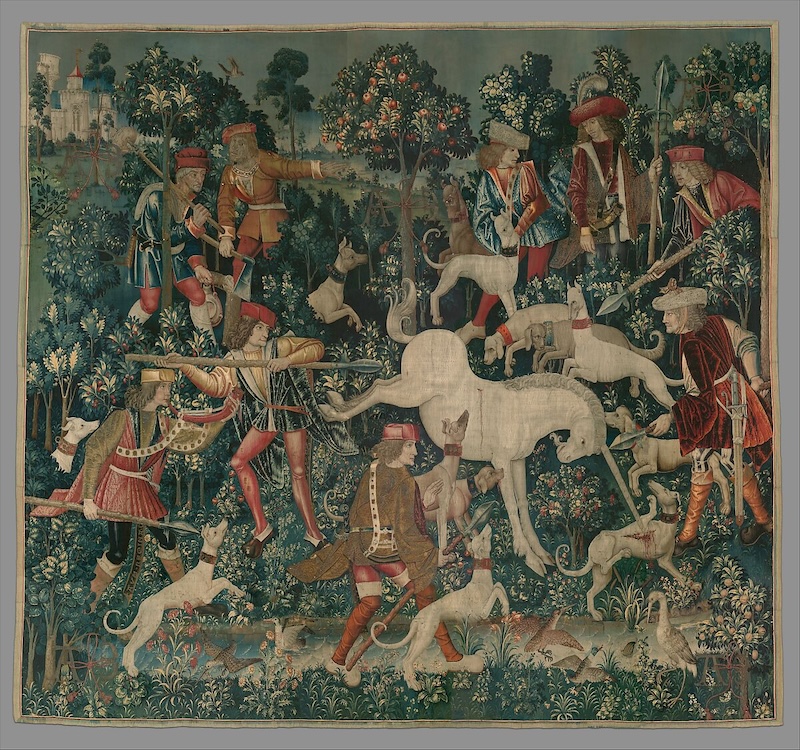
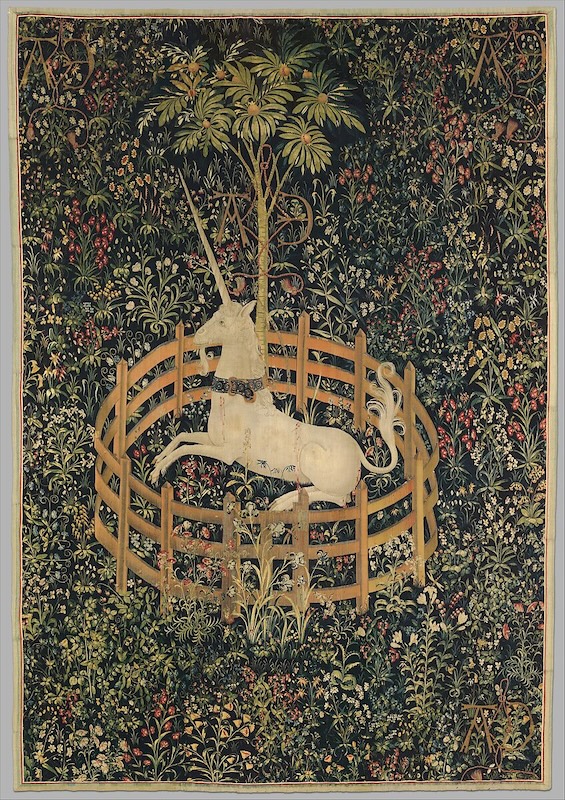
I was sorta close – It was almost exactly 20 years ago and the article was written by Doug’s brother, Richard Preston. Capturing the Unicorn tells the story of a collection of seven tapestries known as “The Hunt for the Unicorn” that hang in the Cloisters annex of the New York Metropolitan Museum of Art. They were created for unknown purposes in approximately 1500, most likely in Brussels or Liège, and are commonly considered to be both the greatest tapestries of all time and some of the greatest art of the Middle Ages.


There are a host of theories about why they were made and by whom.  A night guard at the Cloisters spent a lifetime of work observing the tapestries and attempting to derive the meaning from them. Art historians question the guard’s unconventional interpretations of them, but then again they haven’t spent decades living in direct proximity of them, either. JSTOR Daily discusses much of the imagery in these multicolored hangings enhanced with sliver and gold thread, but I will leave it to you, Dear Reader, to investigate.

Here are images of three of them from the Met’s web site:

The Unicorn Purifies Water – from the Unicorn Tapestries at The Met. Click on image for more information.

The Unicorn Defends Himself – from the Unicorn Tapestries at The Met. Click on image for more information.

The Unicorn Rests in the Garden – from the Unicorn Tapestries at The Met. Click on image for more information.


These tapestries have inspired a great deal of modern storytelling about unicorns, including animation in the opening sequence of the film The Last Unicorn.

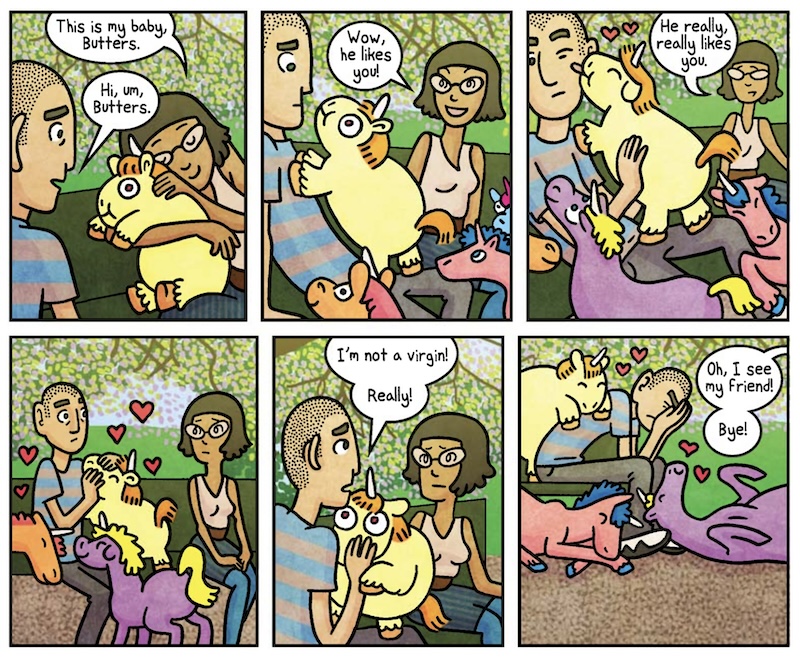
They also showed up as inspiration for the art in my favorite graphic novel, Darwin Carmichael is Going to Hell, by Sophie Goldstein and Jenn Jordan. The scene below is taken from a sequence about Darwin visiting a unicorn park in New York City.

Scene from the graphic novel Darwin Carmichael is Going to Hell, by Sophie Goldstein and Jenn Jordan. For those who are wondering, Yes, Butter’s the Unicorn is a shout-out to Kate Beaton’s Fat Pony.


SPOILER ALERT – From here on out we will be discussing plot points from the movie Death of a Unicorn.


So after those digressions, let’s get back to the subject at hand.

Death of a Unicorn starts with the premise that these tapestries were something more than art, something more than guidance to young French aristocrats, something more than art designed to torment art curators centuries after their creation. Suppose that they portrayed a previous time when unicorns and humans really interacted with each other, where unicorns had magical powers and loved virgins who were pure of heart.

Suppose then also that these unicorns were hiding out in the present day in the mountains of British Columbia and that their blood was a cure for all that ailed humans….

That’s the story writer/director Alex Scharfman tells in his horror/comedy film from the trendy A24 studio (which brought us both Everything, Everywhere, All At Once and The Brutalist).  The film is full of standard movie tropes – the evil pharmaceutical exec; his self-absorbed, selfish family; the neglectful father and his disaffected daughter; and monstrous unicorns. Ok, that last part is not such a standard trope.

I went down the rabbit hole this morning digging into the story of the tapestries because I wondered how accurately the movie told the story of the tapestries – both about where they came from and what story the fabrics themselves told. Aside from the idea that the tapestries were telling a true story, the one bit of fictional speculation in the movie was where missing sections (in real life) from the tapestries were replaced by segments depicting more extreme unicorn violence. The rest stays fairly close to the story told within the tapestries.


Death of a Unicorn is undoubtedly violent and silly. It’s also an enjoyable, fun movie if you like your horror with a good dose of art history.


Posted in Uncategorized | Tagged , , , , | Leave a comment

Go For Broke – When old editorials become new again

I’ve been teaching Civil Rights Era Pulitzer Prize-winning editorials in my commentary class since 1988. And it seems crazy to me how some of them keep emerging to the surface from current news events over the years.

For example, Ralph McGill’s devastating “A Church, A School” from the Atlanta Constitution in 1958 was brought to mind for myself and many other people following the attack on a Pittsburgh synagogue in October of 2018.

Then last week I was reminded of Hodding Carter’s stirring 1946 defense of the all-Japanese-American 442nd Infantry Regiment for their bravery during WW II. These “Nisei” (second generation Japanese-Americans) were members of the most decorated unit from WWII with ” thousands of Purple Hearts, 21 Medals of Honor and eight Presidential Unit Citations.” Carter wrote for the Delta Democrat-Times in Greenville, Mississippi.

Carter’s editorial was made relevant once again when  the webpage discussing these brave troops was temporarily taken down as part of an effort to purge all “DEI content” from government web sites. (DEI stands for “diversity, equity and inclusion.”) The page was deleted along with Arlington National Cemetery’s  page highlighting the graves of the Tuskegee Airmen.

Here is the full text of Hodding Carter’s Pulitzer Prize-winning editorial “Go For Broke.” Please note this editorial contains racist language from the period depicting the Japanese.


Go For Broke
By Hodding Carter
Delta Democrat-Times
Greenville, Miss.
August 27, 1945
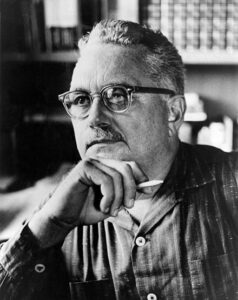
Hodding Carter, 1962

Company D of the 168th Regiment which is stationed in Leghorn, Italy, is composed altogether of white troops, some from the East, some from the South, some from the Midwest and the West Coast.

Company D made an unusual promise earlier this month. The promise was in the form of a communication to their fellow Americans of the 442nd Infantry Regiment and the 100th Infantry Battalion, whose motto is “Go for Broke,” and it was subscribed to unanimously by the officers and men of Company D.

In brief, the communication pledged the help of Company D in convincing “the folks back home that you are fully deserving of all the privileges with which we ourselves are bestowed.”

The soldiers to whom that promise was made are Japanese-Americans. In all of the United States Army, no troops have chalked up a better combat record. Their record is so good that these Nisei were selected by General Francis H. Oxx, commander of the military area in which they are stationed, to lead the final victory parade. So they marched, 3,000 strong, at the head of thousands of other Americans, their battle flag with three Presidential unit citation streamers floating above them, their commander, a Wisconsin white colonel, leading them.

Some of these Nisei must have been thinking of those soul-shaking days of last October, when they spearheaded the attacks that opened the Vosges Mountain doorway to Strasbourg. Some of them were probably remembering how they, on another bloody day, had snatched the Thirty-Six Division’s lost battalion of Texans from encircling Germans. And many of them were bearing scars from those two engagements which alone had cost the Nisei boys from Hawaii and the West Coast 2,300 causalities.

Perhaps these yellow-skinned Americans, to whose Japanese kinsmen we have administered a terrific and long overdue defeat, were holding their heads a little higher because of the pledge of their white fellow-soldiers and fellow-Americans of Company D. Perhaps when they gazed at their combat flag, the motto “Go for Broke” emblazoned thereon took a different meaning. “Go for Broke” is the Hawaiian-Japanese slang expression for shooting the works in a dice game.

The loyal Nisei have shot the works. From the beginning of the war, they have been on trial, in and out of uniform, in army camps and relocation centers, as combat troops in Europe and as frontline interrogators, propagandists and combat intelligence personnel in the Pacific where their capture meant prolonged and hideous torture. And even yet they have not satisfied their critics.

It is so easy for a dominant race to explain good or evil, patriotism or treachery, courage or cowardice in terms of skin color. So easy and so tragically wrong. Too many have committed that wrong against the loyal Nisei, who by the thousands have proved themselves good Americans, even while others of us, by our actions against them, have shown ourselves to be bad Americans. Nor is the end of this misconception in sight. Those Japanese-American soldiers, who paraded at Leghorn in commemoration of the defeat of the nation from which their fathers came, will meet other enemies, other obstacles as forbidding as those of war. A lot of people will begin saying, as soon as these boys take off their uniforms, that “a Jap is a Jap,” and that the Nisei deserve no consideration. A majority won’t say or believe this, but an active minority can have its way against an apathetic majority.

It seems to us that the Nisei slogan of “Go for Broke” could be adopted by all Americans of good will in the days ahead. We’ve got to shoot the works in a fight for tolerance. Those boys of Company D point the way. Japan’s surrender will be signed aboard the Missouri and General MacArthur’s part will be a symbolic “Show Me.”

Posted in Uncategorized | Tagged , , , , | Leave a comment

Honoring World Poetry Day 2025

In honor of World Poetry Day 2025, here are two of my favorite poems.


The Hemophiliac's Motorcycle book coverThe first is by West Virginia poet Tom Andrews, who in addition to being a great poet was also a first-generation hemophiliac who died way too young of blood-borne disease, as all too many hemophiliacs do. He grew up in an evangelical home, and questions about faith are frequent topics for him to interrogate with his poetry. This is drawn from his collection The Hemophiliac’s Motorcycle.

PRAYING WITH GEORGE HERBERT IN LATE WINTER
By Tom Andrews

1

In fits and starts, Lord,
our words work
the other side of language

where you lie if you can be said
to lie. Mercy upon
the priest who calls on you

to nurture and to terrorize
him, for you oblige.
Mercy upon you, breath’s engine

returning what is to what is.
Outside, light swarms
and particularizes the snow;

tree limbs crack with ice
and drop. I can say
there is a larger something

inside me. I can say,
“Gratitude is
a strange country.” But what

would I give to live there?

2

Something breaks in us,
and keeps breaking. Charity,
be severe with me.
Mercy, lay on your hands.

White robes on
the cypress tree. Sparrows
clot the fence posts;
they hop once and weave

through the bleached air.
Lord, I drift on the words
I speak to you —
the words take on

and utter me. in what
language are you not
what we say you are?
Surprise me, Lord, as a seed

surprises itself…

3

Today the sun has the inward look
of the eye of the Christ Child …
Grace falls at odd angles from heaven

to earth: my sins are bright sparks
in the dark of blamelessness.
Yes. From my window I watch a boy step

backwards down the snow-covered road,
studying his sudden boot tracks.
The wedding of his look and the world!

And for a moment, Lord, I think
I understand about you and silence…
But what a racket I make in telling you.


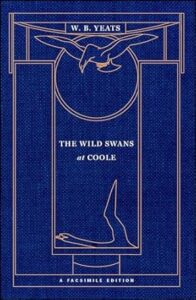
The Wild Swans at Coole coverThe second is from W.B. Yeats, perhaps best known for his rather apocalyptic “The Second Coming.”  But I love his more personal verse, especially “Her Praise,” which tells a story of desperate, unrequited love. Drawn from his collection The Wild Swans at Coole.

HER PRAISE
W.B. Yeats

She is foremost of those that I would hear praised.
I have gone about the house, gone up and down
As a man does who has published a new book
Or a young girl dressed out in her new gown,
And though I have turned the talk by hook or crook
Until her praise should be the uppermost theme,
A woman spoke of some new tale she had read,
A man confusedly in a half dream
As though some other name ran in his head.
She is foremost of those that I would hear praised.
I will talk no more of books or the long war
But walk by the dry thorn until I have found
Some beggar sheltering from the wind, and there
Manage the talk until her name come round.
If there be rags enough he will know her name
And be well pleased remembering it, for in the old days,
Though she had young men’s praise and old men’s blame,
Among the poor both old and young gave her praise.


Sorry I don’t have a W.H. Auden poem for you to go with these, but I have written about him here previously.

Posted in Uncategorized | Tagged , , , , , | Leave a comment