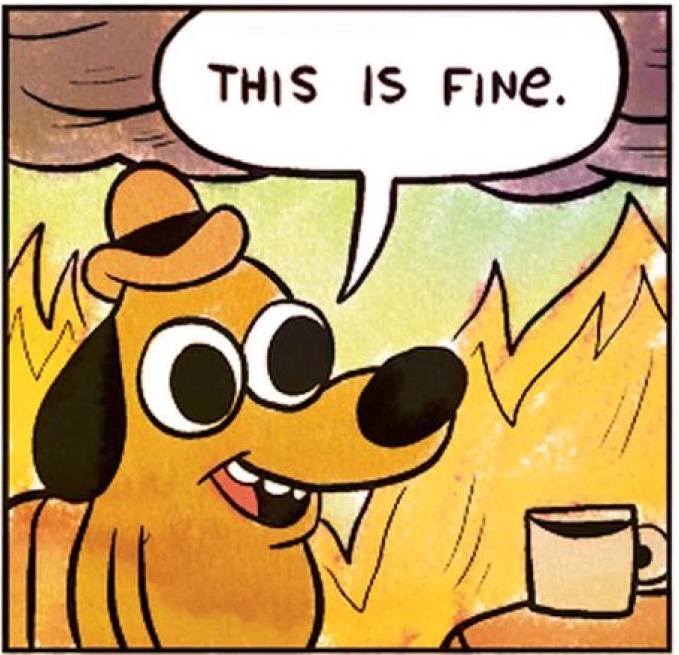
You all know the Dog-in-the-Burning-Room “This Is Fine” meme, right?
Artist KC Green’s comic “On Fire” which has become the omnipresent “This is Fine” meme.
As reported in the LAist blog, Green drew the iconic image as part of his comic Gunshot back in 2012 when he was fighting depression and feeling overwhelmed. The image has since been used uncounted number of times with a variety of texts by groups as diverse as the Republican National Committee and Comedy Central’s The Daily Show.
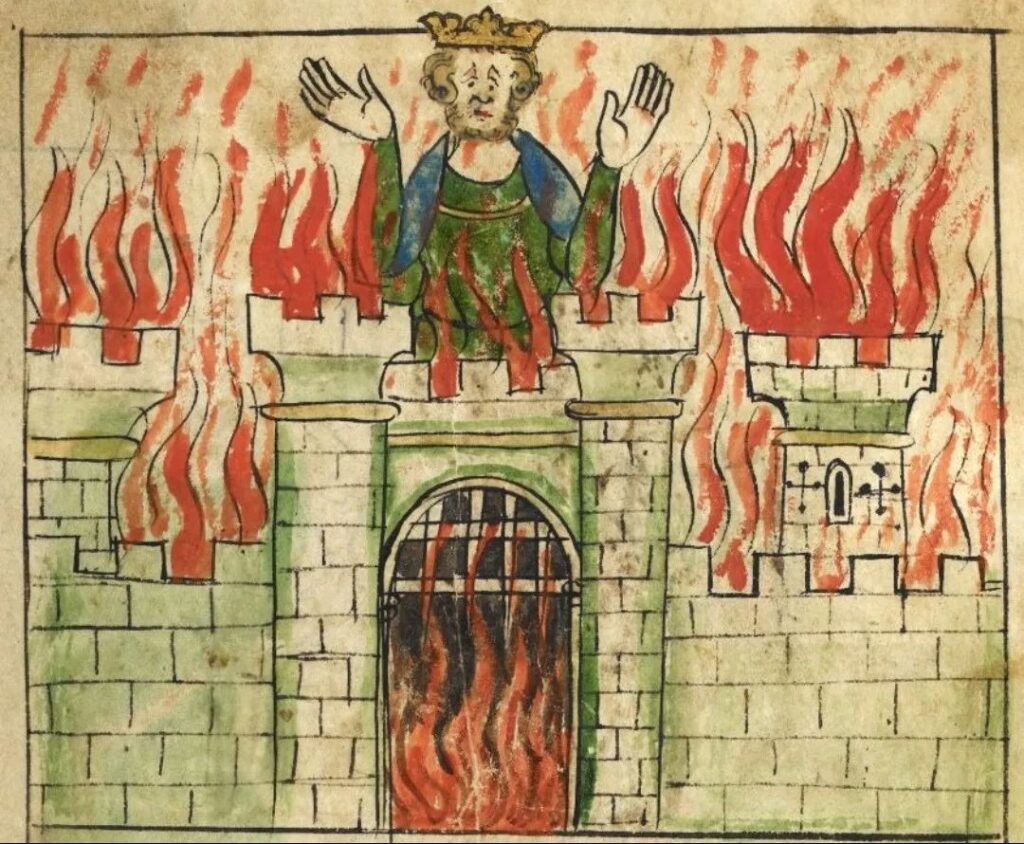
While the image of the self-satisfied dog sitting in a burning room with his coffee is undoubtedly original, it interestingly enough echos an illustration from a 14th century illuminated manuscript.
British King Vortigern had a “This is Fine” vibe in an ilustration from a 14th century illuminated manuscript.
This illustration, from a 14th-century manuscript (labeled BL Royal 20 A II, f. 3 in The British Library) depicts a scene from British legend. Atop the burning castle is Vortigern, a legendary figure from the 5th century who is credited with inviting Saxons into Britain, setting in motion the eventual Anglo-Saxon domination of England that would last for centuries… This scene of Vortigern being besieged and ultimately dying in an inferno set by his enemies is what is depicted in the manuscript illustration featured above.
Thanks to Sarah Cardin on Threads for pointing out the rhyming imagery here. How often do we get to look at an example of Media Secret 4 – Nothing’s new: Everything that happens in the past will happen again with examples from one of our earliest media, hand copied books, rhyming with our most recent social media?
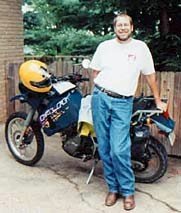
From my last day of collecting towns for this grand tour. For this one I took as many off-pavement roads as possible on my little Honda CRF 300L Rally.
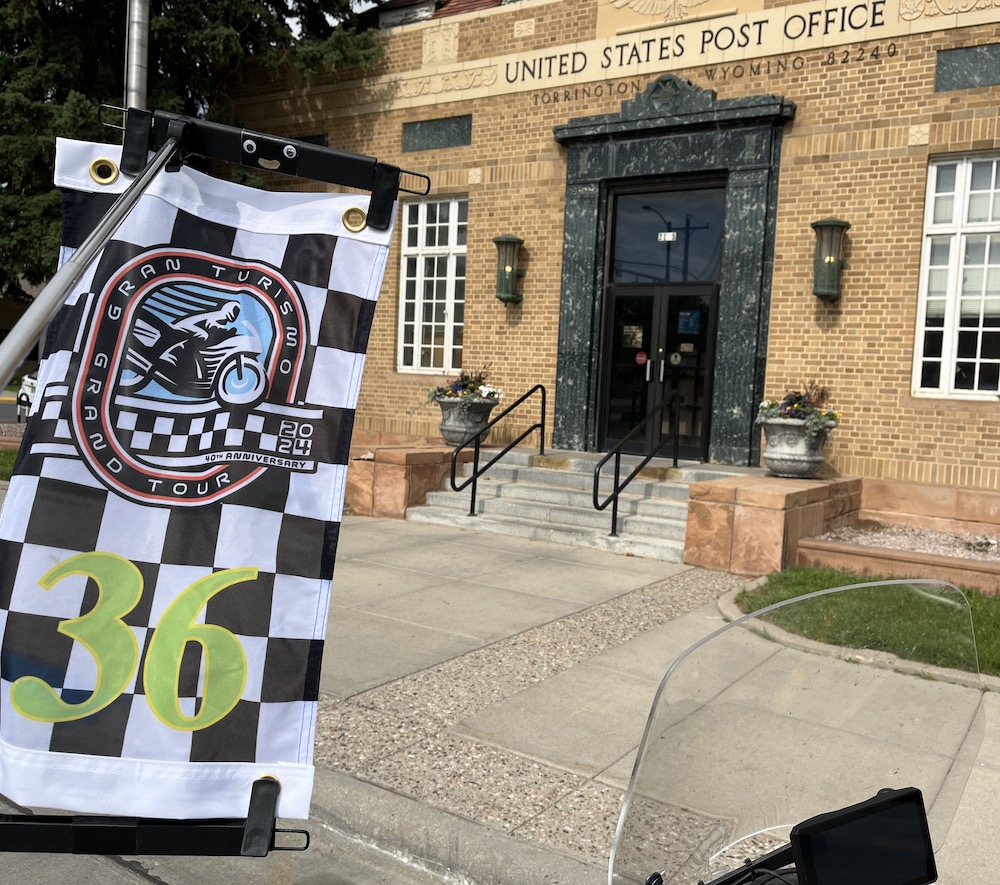
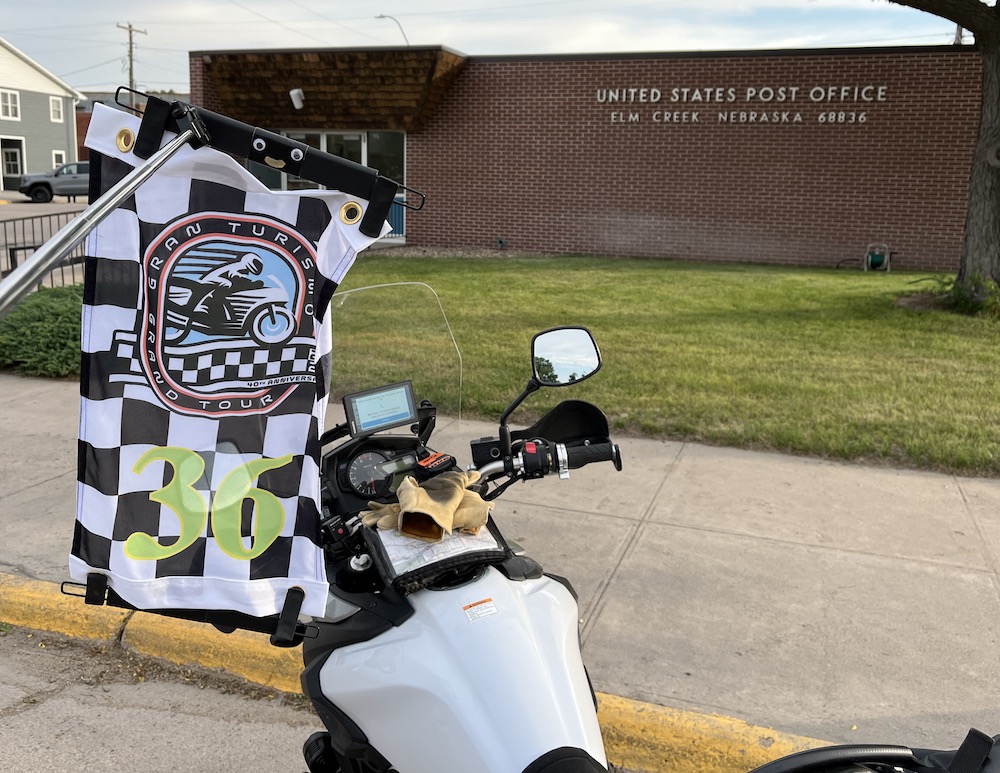
This year’s event runs from April into November, and under the name of “Gran Truismo Grand Tour” it actually offers two different events – one involves visiting race tracks, which I did not compete in; the second is the Team Strange Airheads 40th Anniversary Grand Tour. To complete this, you need to collect the photos of town names that start with each of the letters of “Team Strange Airheads” followed by a “40” state or county highway sign.
I collected these photos over multiple trips, including one to Wyoming near the edge of the Grand Tetons and one following the Lewis & Clark Trail up through the Dakotas. I rode my V-Strom 650 for most the photos, but a few were with my Rally 300. These photos will be presented in the order needed to spell out each of the words.
Team
Torrington, Wyoming, June 14, 2024.
Elm Creek, Nebraska, June 14, 2024
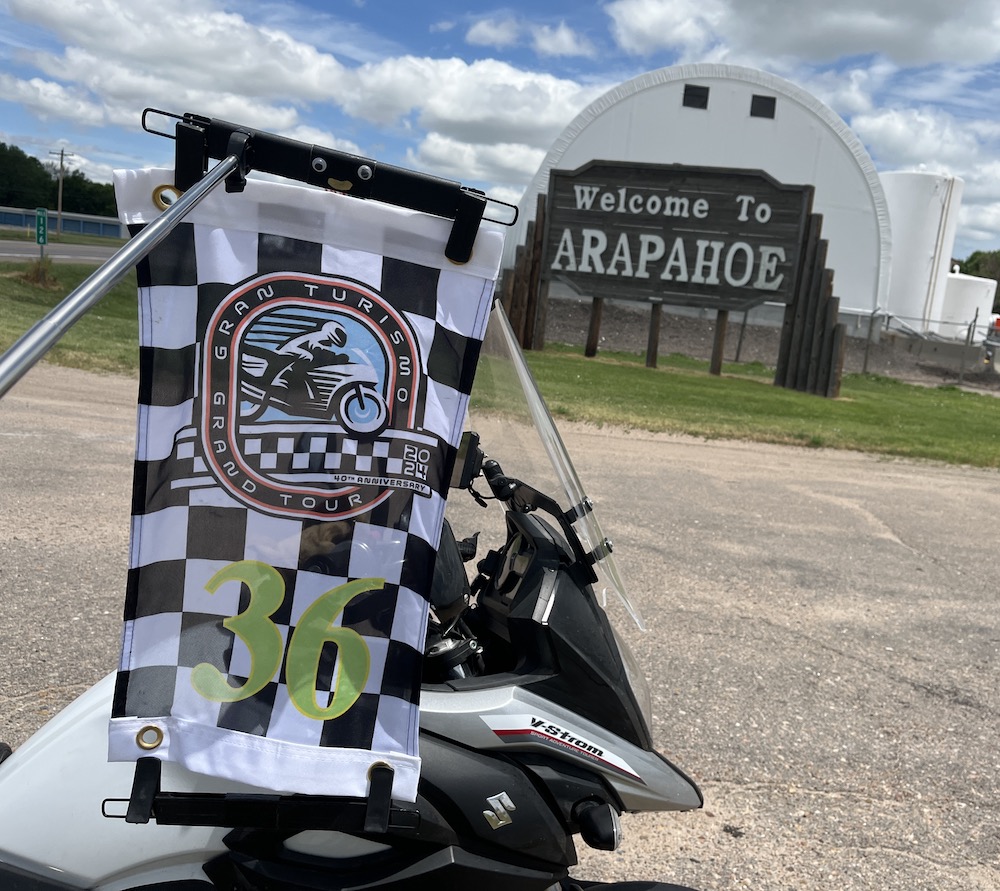
Arapahoe, Nebraska, June 22, 2024
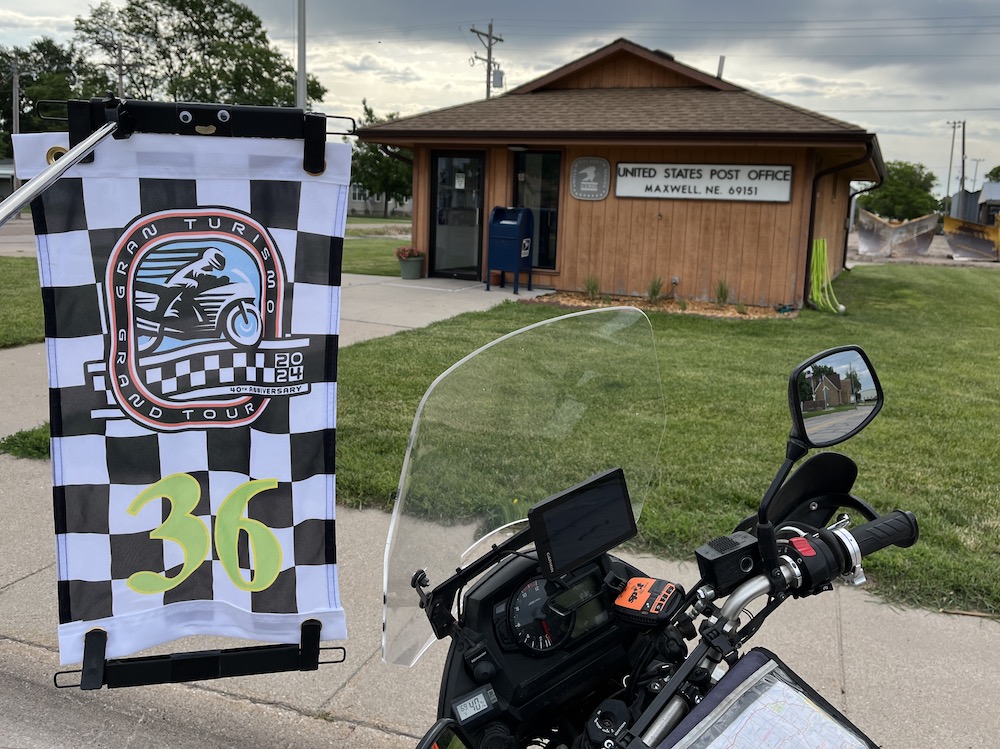
Maxwell, Nebraska, June 14, 2024.
Strange
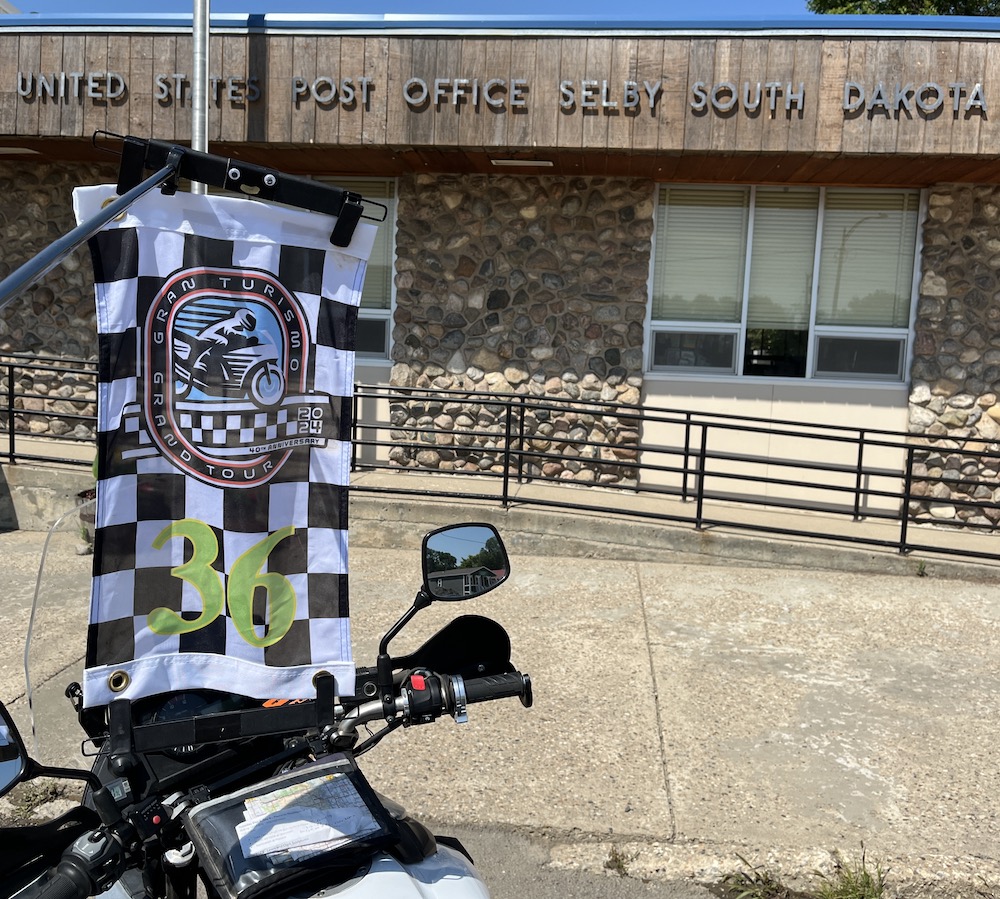
Selby, South Dakota, July 9, 2024
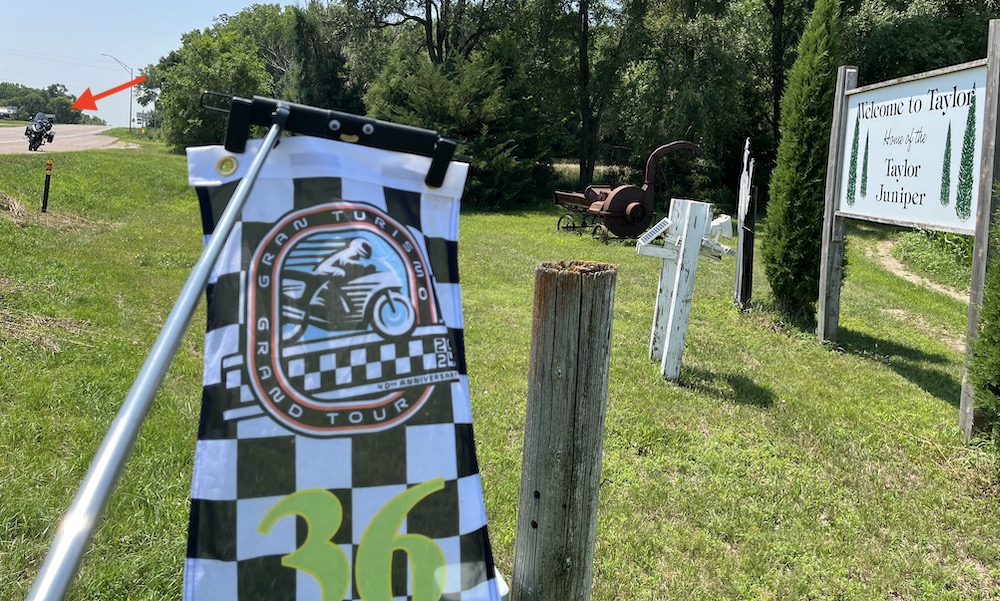
Taylor, Nebraska, July 11, 2024
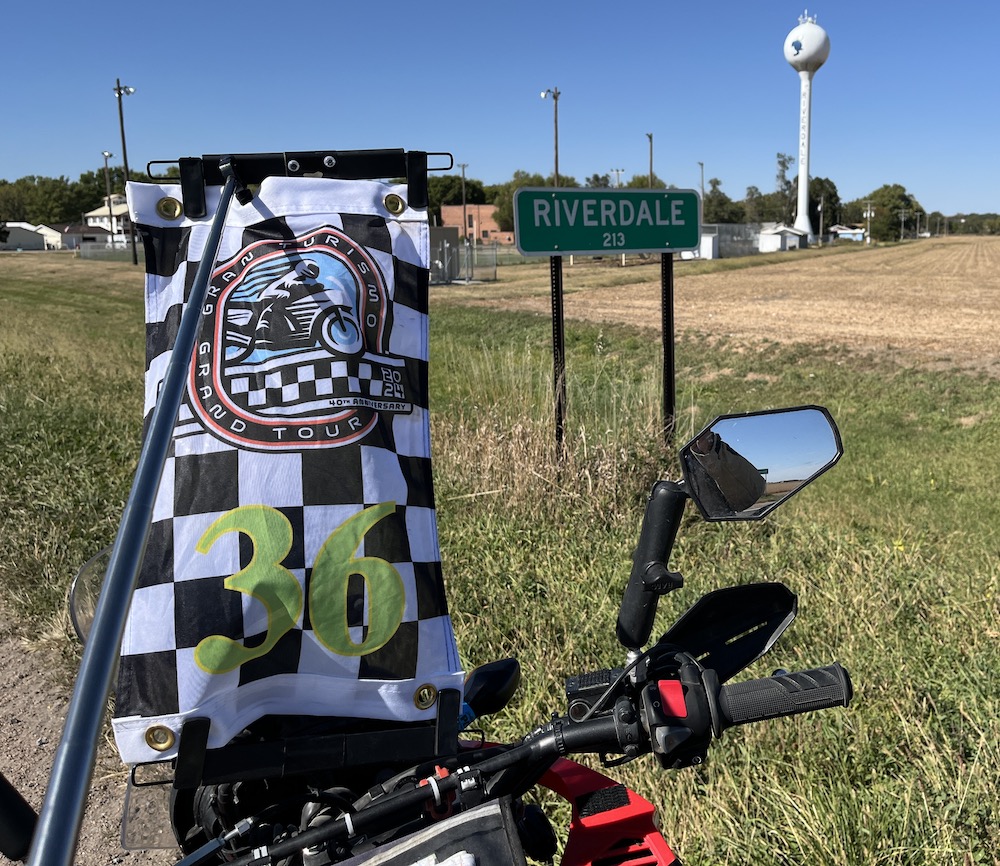
Riverdale, Nebraska, Sept. 28, 2024
To those of you paying attention, this one was with my Rally 300.
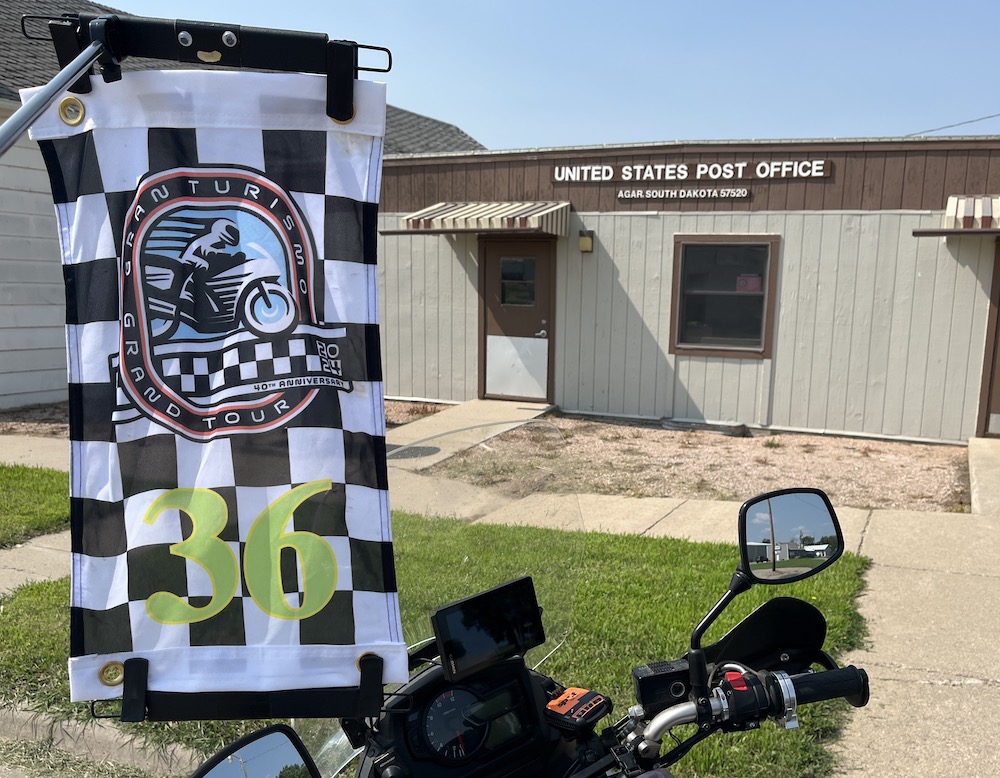
Agar, South Dakota, July 10. 2024
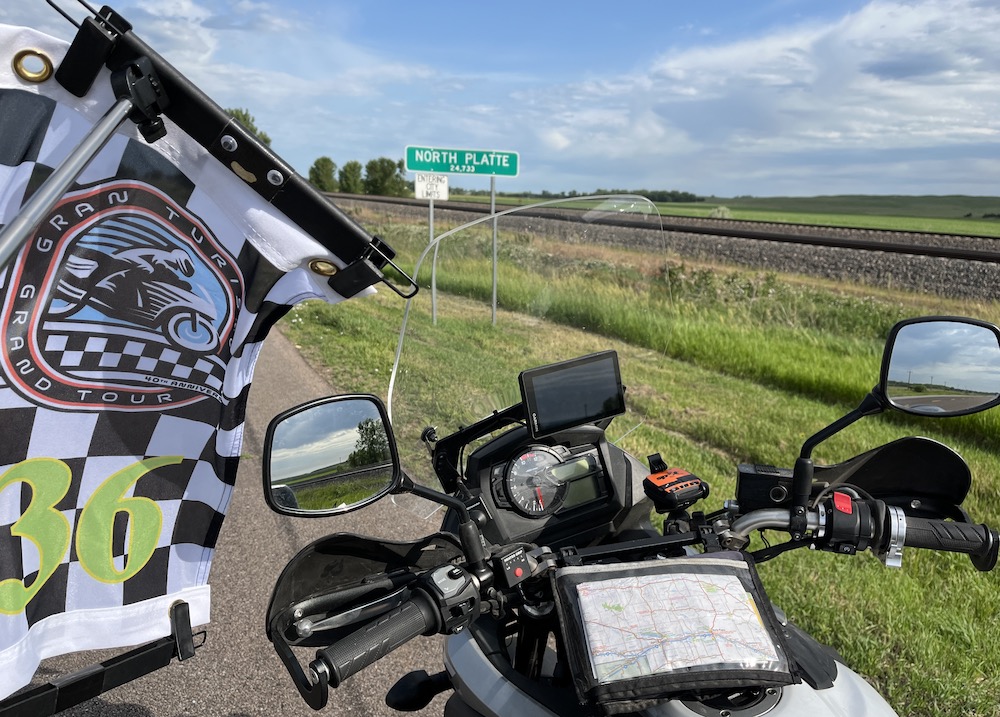
North Platte, Nebraska, June 14, 2024
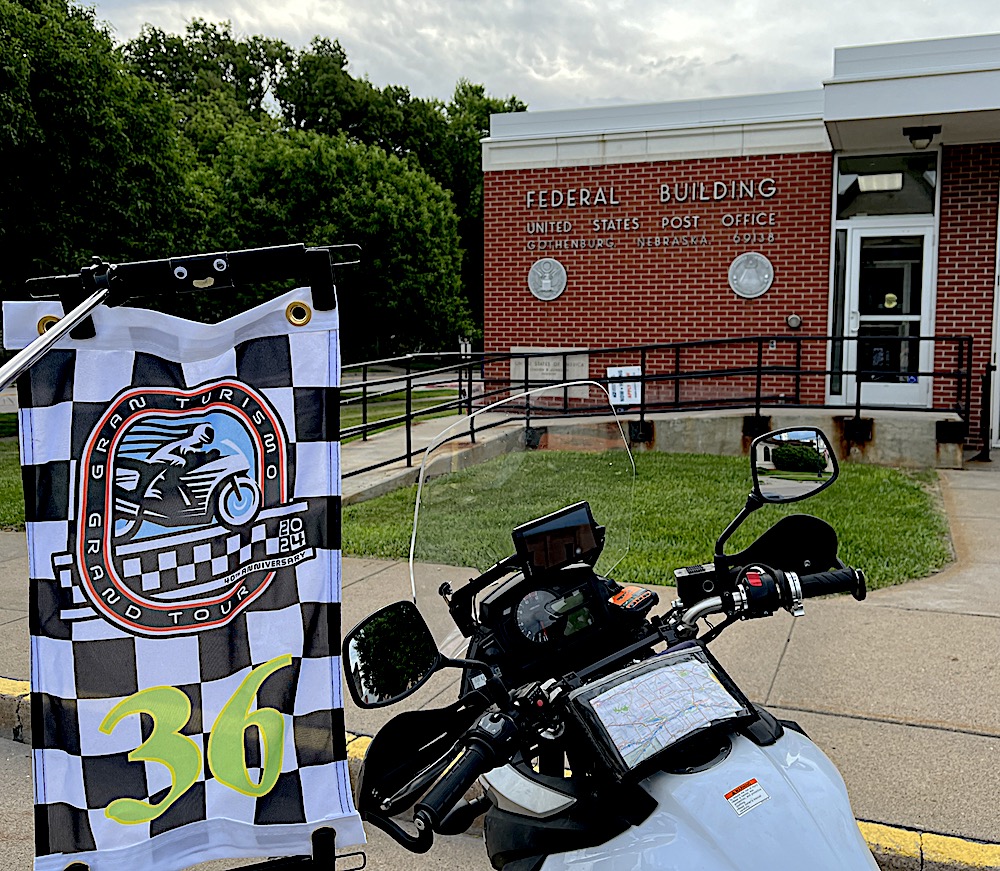
Gothenburg, Nebraska, June 14, 2024
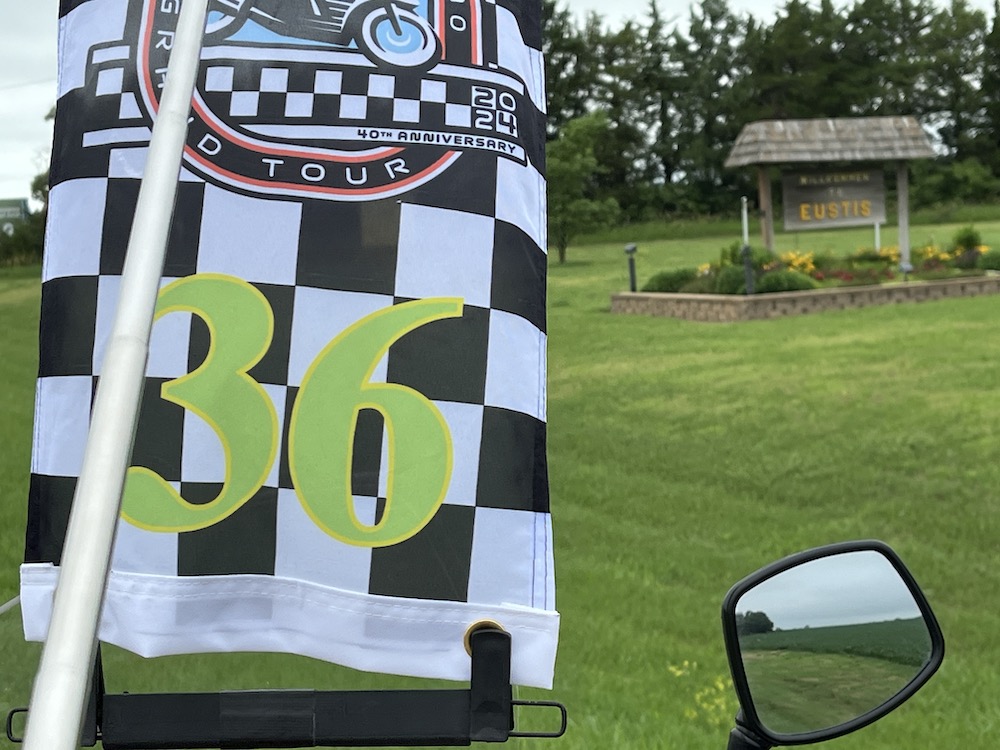
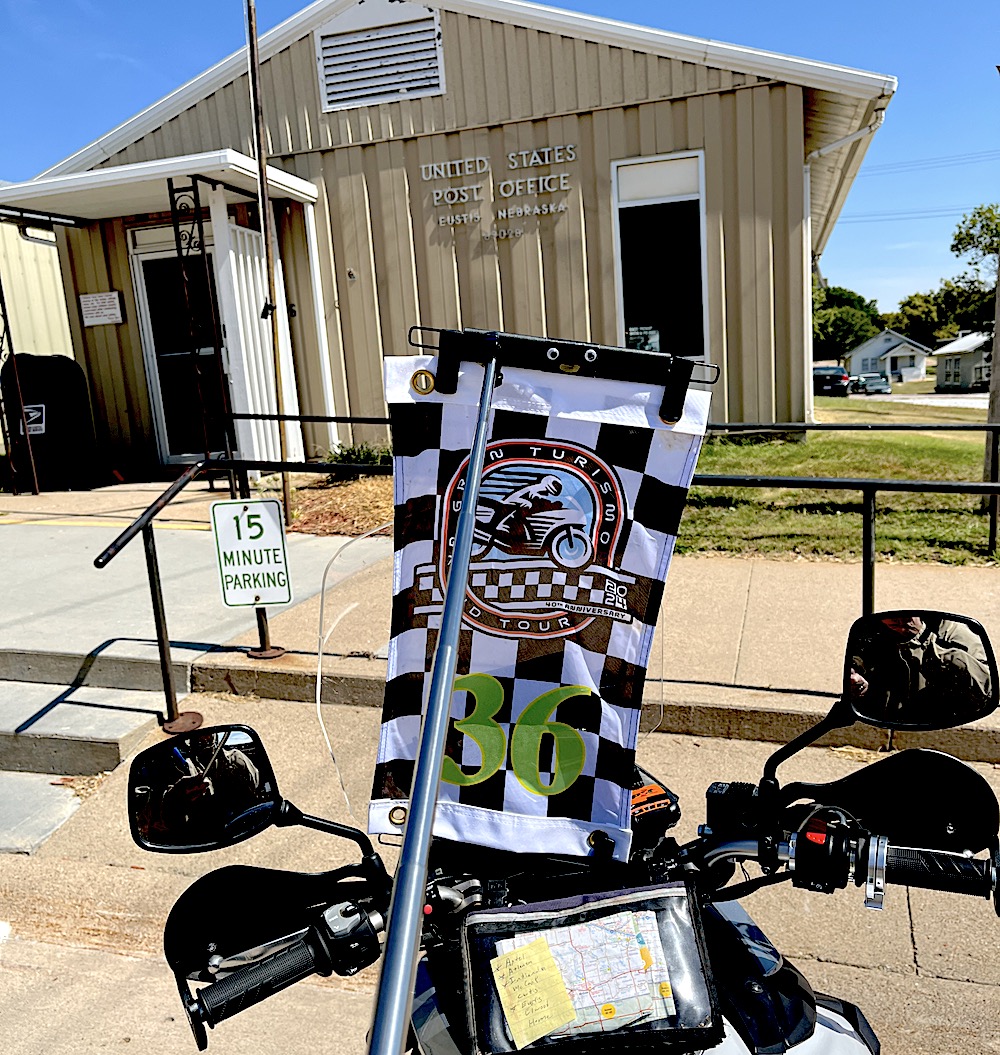
Eustis, Nebraska, June 22, 2024
And just for fun, here’s a second photo of Eustis because I messed up and grabbed the same town on two separate rides to use two different places. Oops. Looks like I’m going out riding again before the end of the week.
Another visit to Eustis which won’t count as I can only use each town once. From September 15, 2024
Little rant about Eustis. This was where the awesome Village Pie Maker factory used to be where some of the best frozen pies you could get anywhere were made. And Eustis was the “village” in the name. Then the Rickets family (Pete Rickets is the U.S. senator from Nebraska and former governor) bought out the company, shut down the Eustis plant and moved it to Omaha. Now I get it, they needed to expand. But having a billionaire family come in, buy up the small business that’s a leading employer in a small town, then close it to move to the big city is just really a bit too on the mark for the world we seem to live in now. You can still get lunch at the grocery store in Eustis. Last time I ate there, you could get a sauerkraut and summer sausage pizza. If you ever wanted one… Rant over.
Airheads
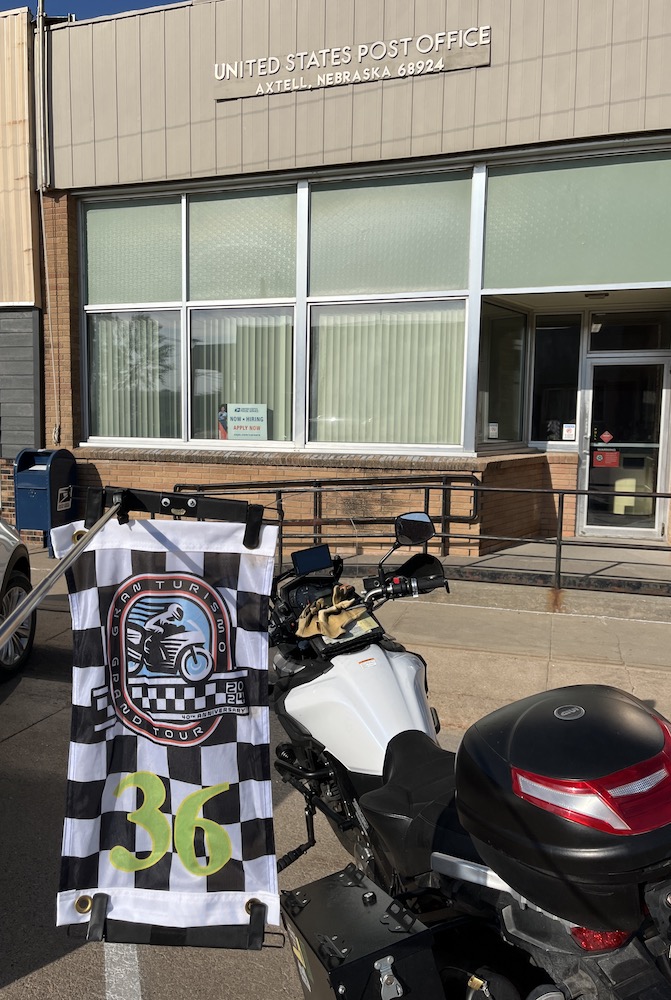
Axtel, Nebraska, Sept. 15, 2024
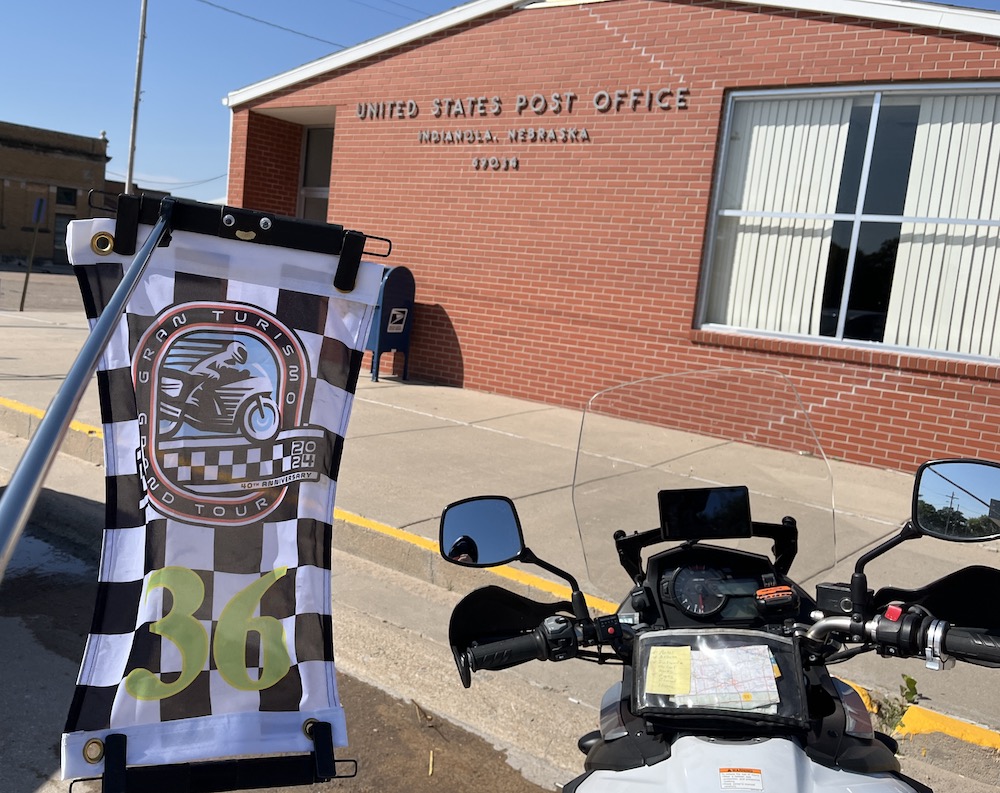
Indianola, Nebraska, September 15, 2024
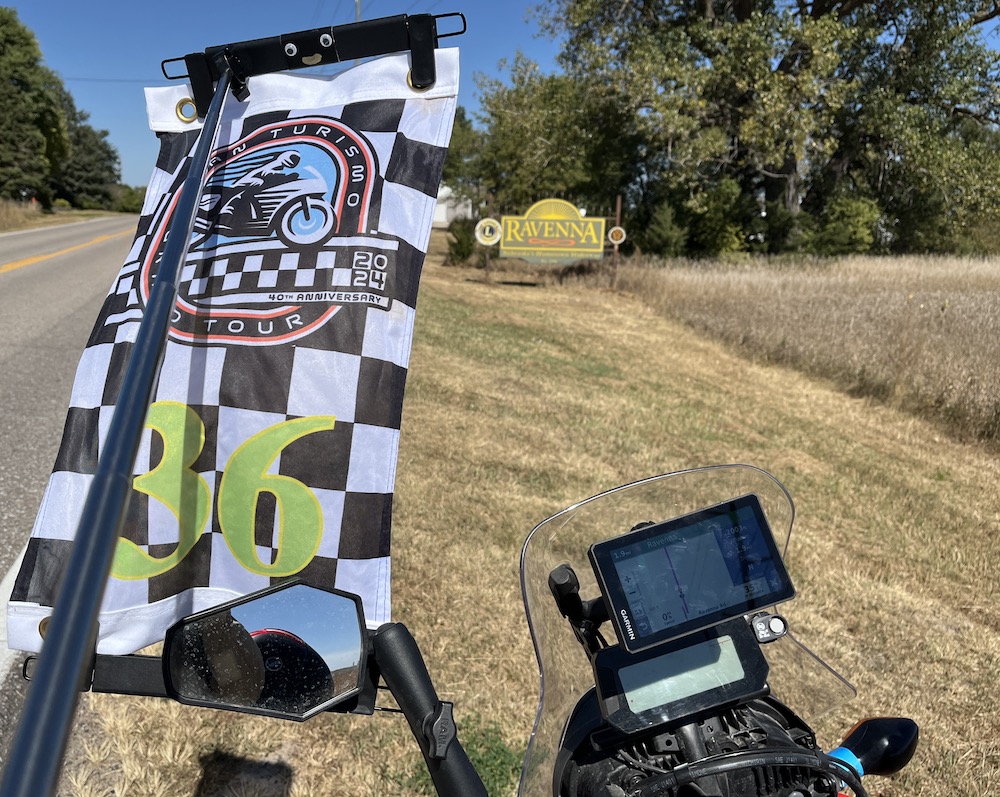
Ravenna, Nebraska, Sept. 28, 2024
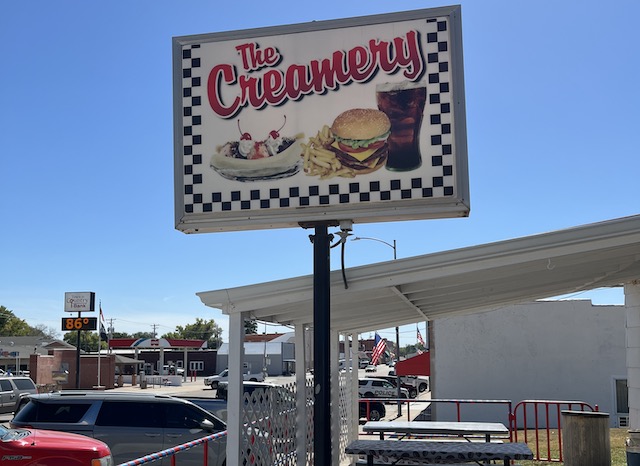
And if you should ever visit Ravenna, stop at The Creamery on the north side of town for a burger & fries, or ice cream, or pie. (Or have all three; I won’t tell.) Ride for this one was my Rally 300.
The Creamery Drive In in Ravenna
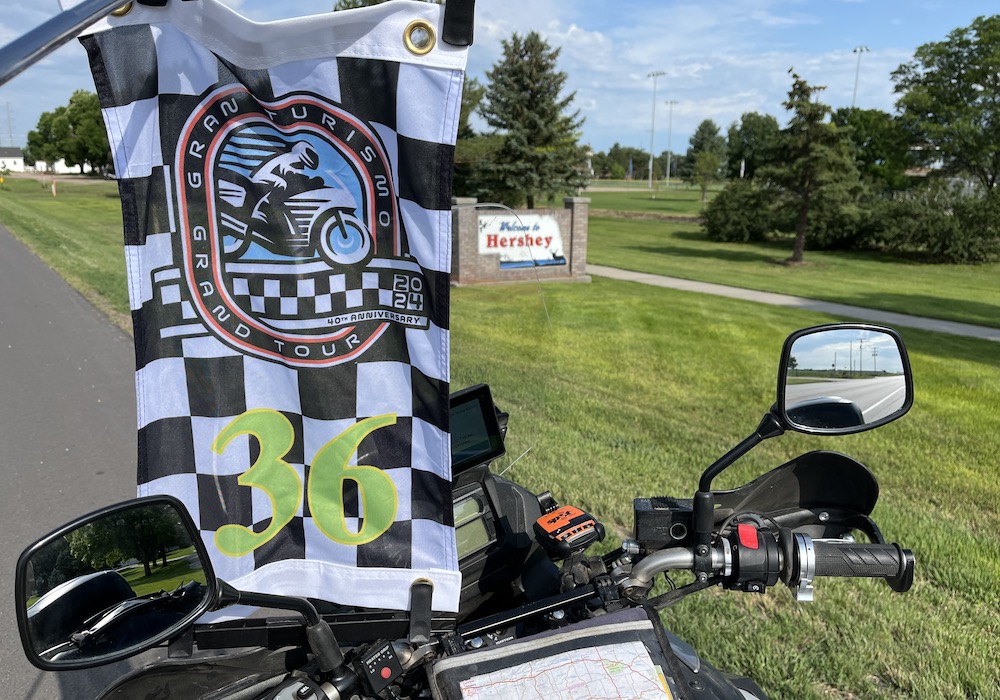
Hershey, Nebraska, June 14, 2024
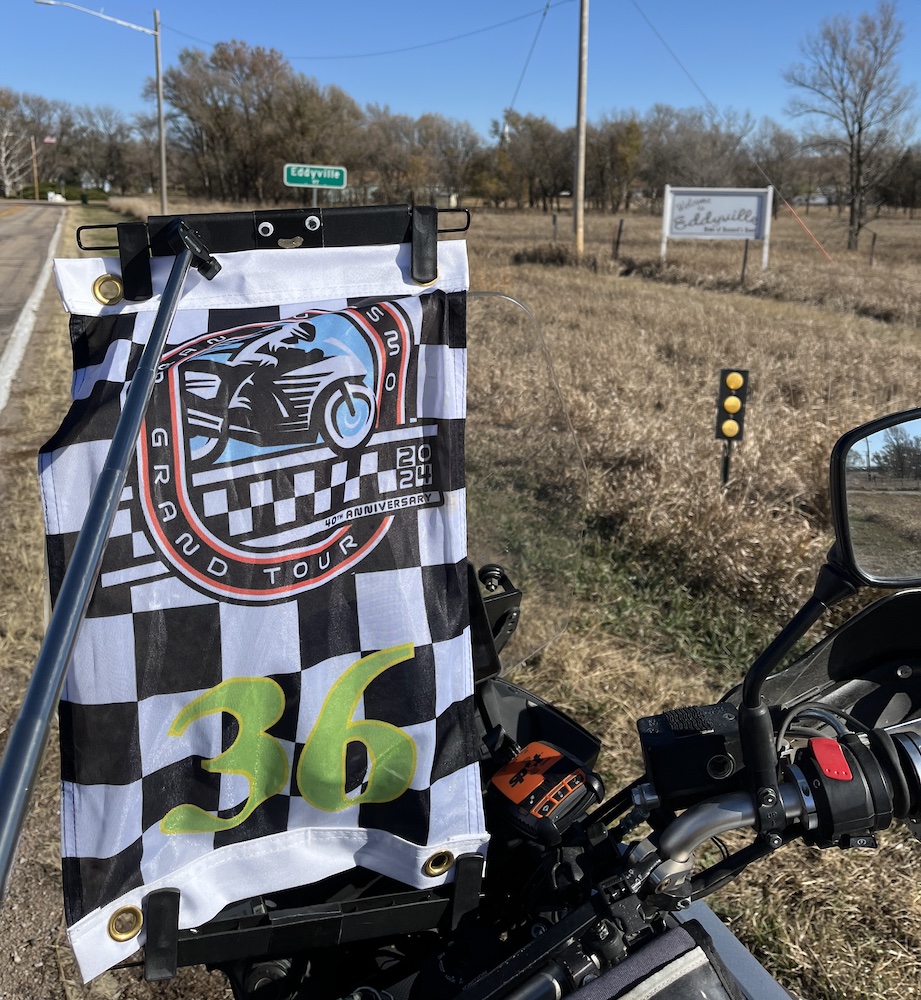
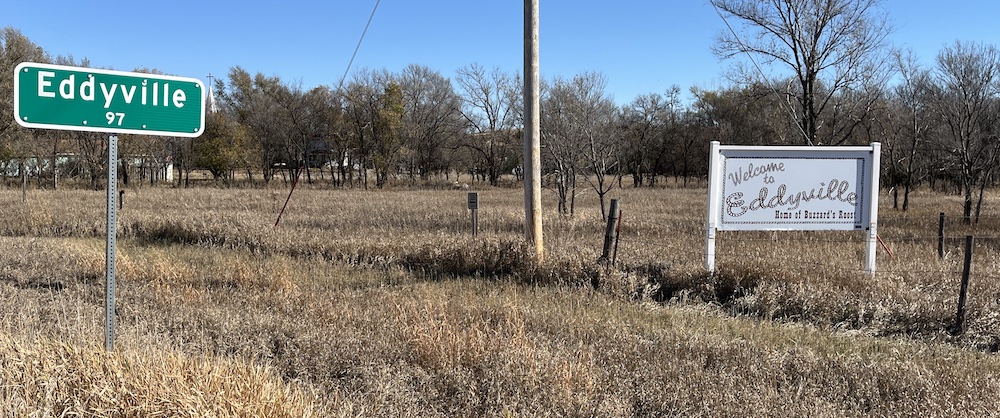
Eddyville Nebraska, Nov. 15, 2024
Readable close up of Eddyville village signs. Nov. 15, 2024
Eddyville, Nebraska was the town I needed to get to today, the last day of the 40th Anniversary Grand Tour, to pick up my missing letter “E.” Fortunately the weather was pretty good for mid-November in the state, with temps in the low 60s accompanied by a fair bit of wind. Seems appropriate I would finish up a Team Strange event with the town of Eddyville.
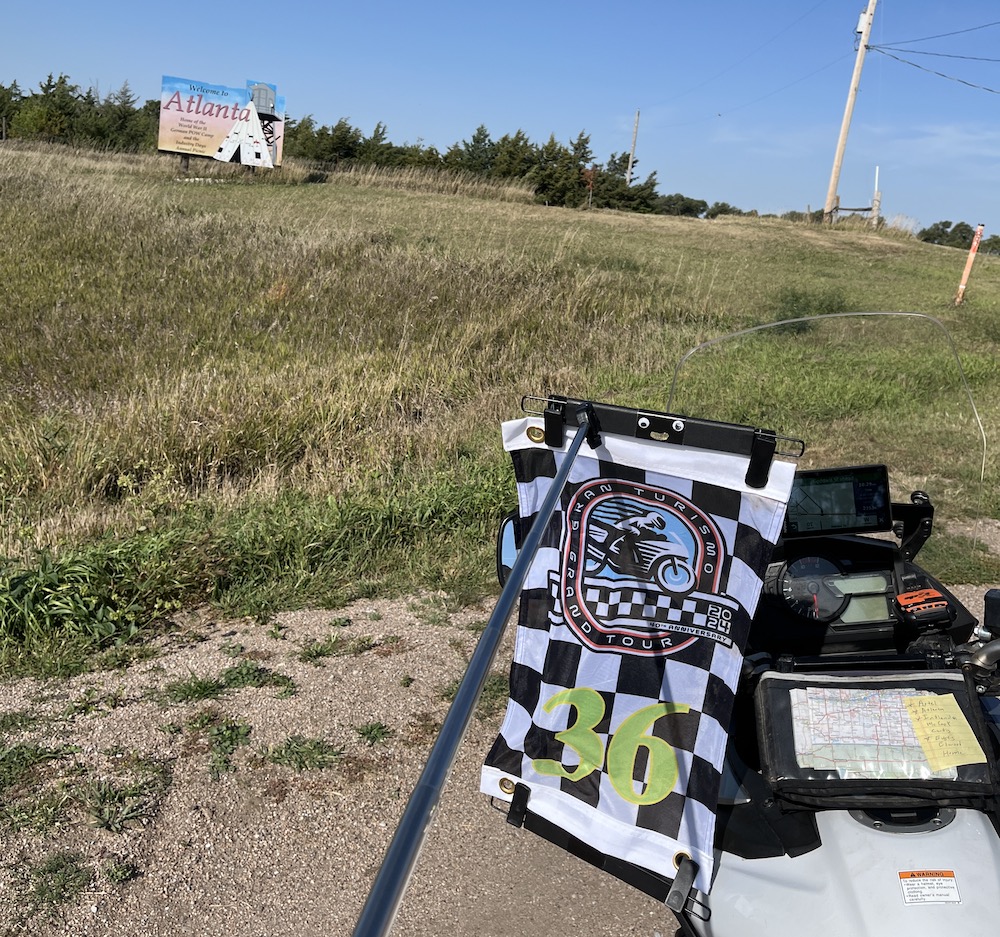
Atlanta, Nebraska, Sept. 15, 2024
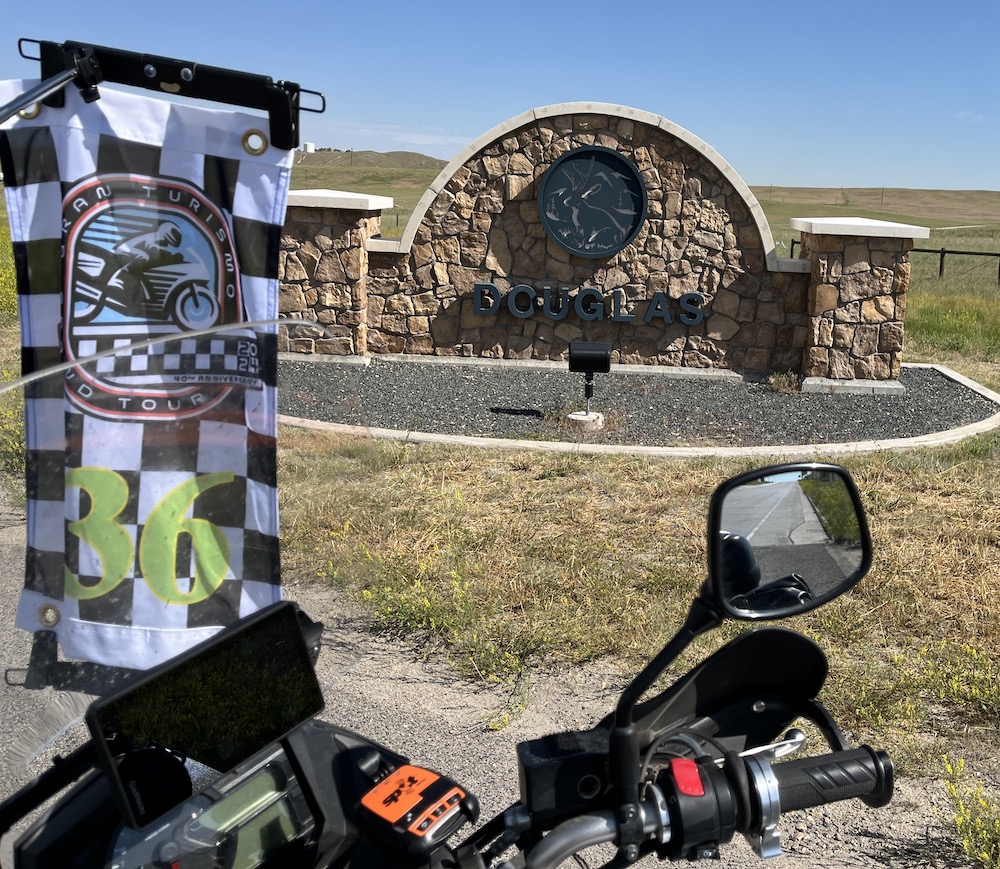
Douglas, Wyoming, June 15, 2024
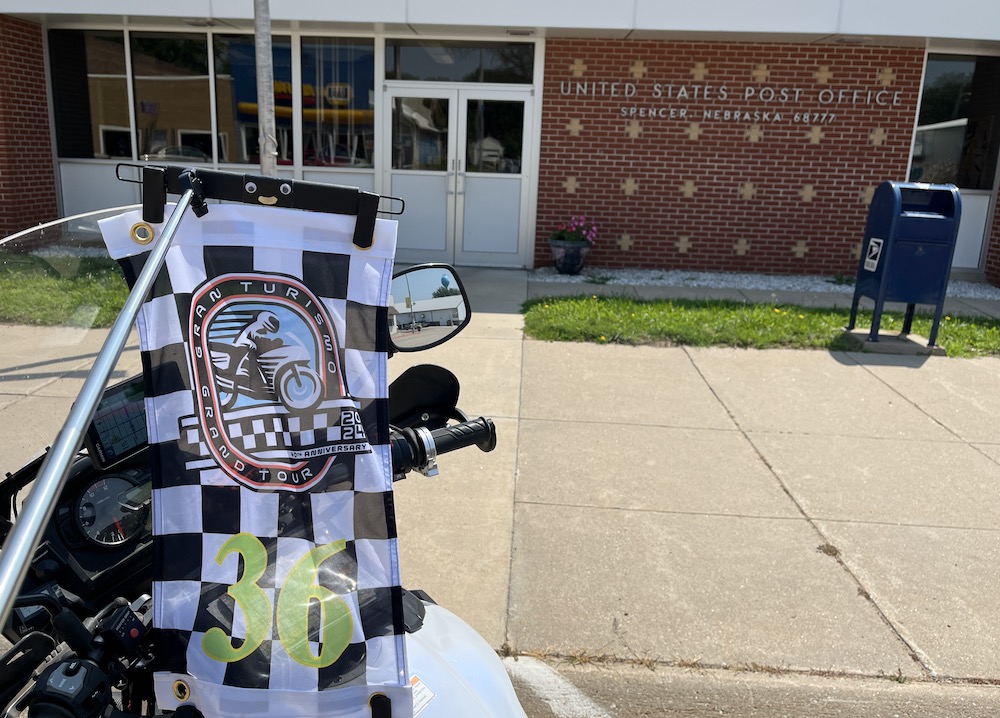
Spencer, Nebraska July 8, 2024
40th Anniversary
Nebraska Highway 40 to signify 40th Anniversary, Sept. 28, 2024
Nebraska Highway 40 was the third photo I collected on the Rally 300
And so I finish up my 11th Team Strange grand tour – of which I have completed 10. The only one I entered that I didn’t finish was the 2022 steam engine-themed one I ended up bailing on for a range of reasons, including the two “live” steam engines I was supposed to visit that didn’t work out – one didn’t have a licensed operator and the other was actually gas powered while wearing a steam engine costume. Still feel bad about that one.
Anyway, my V-Strom (vanity plate FAFHRD) is now ready for winter with a full tank of stabilized gas and the Battery Tender plugged in. The little Rally (vanity plate MOUSER) will likely get taken out a time or two more before getting tucked in for the cold season. Though with any luck, both will get out occasionally during the winter. Ride safe, everyone.
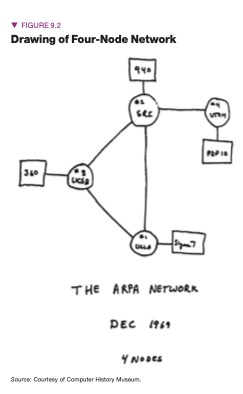
Each mainframe computer in the original ARPANet configuration communicated over the network using a Interface Message Processor, a minicomputer that could handle all of the network communication, allowing otherwise incompatible computers to talk with each other.
The Advanced Research Projects Agency Network (ARPANet), the first wide-area packet-switching network, made its first successful computer-to-computer connection on Oct. 29, 1969. Unlike some earlier conceptions of the network, it was intended to serve the needs of academic researchers, not to survive nuclear war.
The network was built by a farsighted division of the Pentagon called the Advanced Research Projects Agency (ARPA). In 1968, the contract to build the network was given to a Boston-based consulting firm on the condition that it be built in less than one year. By the fall of 1969, ARPAnet connected four different institutions, and the first component of what would eventually become the internet was running.
As the hand-drawn map of ARPAnet shows, the initial nodes were University of California–Los Angeles, Stanford Research Institute, University of California–Santa Barbara, and University of Utah. ARPAnet came online at about the same time as the first moon landing. Whereas Neil Armstrong’s “one small step” was noted throughout the world as one of the great achievements of humanity, no one outside of ARPA was aware that a new, world-changing medium had just been born.
Editor’s note: Last week, the Washington Post’s publisher and CEO William Lewis announced that the paper for the only the second time in 50 years would not be endorsing a candidate for the presidency of the United States. In a column published on the Post’s website Oct. 25th, he wrote:
“We recognize that this will be read in a range of ways, including as a tacit endorsement of one candidate, or as a condemnation of another, or as an abdication of responsibility. That is inevitable,” Lewis wrote. “We don’t see it that way. We see it as consistent with the values The Post has always stood for and what we hope for in a leader: character and courage in service to the American ethic, veneration for the rule of law, and respect for human freedom in all its aspects.”
According to a story from the Post, the paper’s editorial board had written an editorial endorsing the Democratic Harris/Walz ticket and was preparing to publish it when it was killed by owner Jeff Bezos, who also founded Amazon.com and the Blue Origin space launch company.
The controversy exploding from this is not so much that the paper has discontinued endorsements at the presidential level as that it was done just 10 days before the intensely controversial 2024 presidential election. Criticism of the move by Bezos and Lewis to cancel the endorsement has been massive by the current and former staff of the Post, who see the move as being done out of fear that Bezos’ companies would be hurt should Trump win the presidency again. It has resulted in a number of resignations from the paper’s staff. One of the most outspoken has been former editor Marty Baron.
This has also led to a massive number of people publicly cancelling their subscriptions to the Washington Post in hope of sending a message to the paper. I have argued on social media that nothing readers can do will hurt Bezos. But cancelling subscriptions can and will hurt the journalists and opinion writers at the paper, none of whom had anything to do with cancelling the endorsement.
For the record, I have continued my subscription, which I have had in one form or another since the 1980s. I value the paper intensely, as I do the New York Times, the Wall Street Journal, the Omaha World-Herald, the Lincoln Journal-Star, and the Kearney Hub — all of which I have paid subscriptions to, all of which have driven me crazy on one occasion or another.
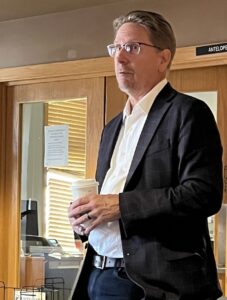
I am reprinting below a social media post from award-winning WaPo food journalist Tim Carman, who is also an alum of the University of Nebraska at Kearney where I teach. I think he gives us an important look from inside the Post about how this controversy is affecting the staff. (Full disclosure: Tim is a friend of mine, and I am reprinting this by permission.)
Washington Post food journalist Tim Carman speaking on the UNK campus in October of 2023.
Over the past two days, while laying in bed, sick with flu, I’ve watched one friend after another announce that he/she/they have cancelled their subscription to The Post. I understand the anger that fueled these decisions. A similar anger can be felt among the rank and file at the paper — and in my own heart.
I also understand that, as money and power are consolidated in the hands of so few, we the people feel the need to express our anger/frustration/pain in tangible, meaningful ways. I understand the resentment sparked when one person decides to place self-interest above the public good. I understand how this single act can, almost instantly, destroy the trust that The Post has built over multiple generations.
I’ve been at ch almost 14 years now. I’ve worked with editors and reporters across multiple sections: Metro, Foreign, Business, Style, Food, and others. I know the impenetrable wall that separates the Opinions department from the News/Features department. They operate independently, each serving its own function, though I think their roles are often blurred in the public’s mind.
I know the people who produce the news, graphics, features, videos and more that you see daily. These people are journalists of the highest caliber. Their standards for publication are demanding, rigorous and, most important of all, accountable to readers. This kind of independent journalism is dying before our eyes, its demise fostered by people who have a vested interest in not ever being challenged.
Our country needs more serious journalism, not less. If you’ve already cancelled your subscription, I hope we can earn your trust back. Don’t give up on us. There are hundreds of reporters working daily to hold people accountable and to inform the public about things they might not otherwise know. It needs your support more than ever.
You’ve probably seen this link already from my colleagues, but I’ll post it again. It’s another way to express your anger. I hope you’ll give them the full measure of your rage.
Gone With the Wind is a controversial film these days because of its problematic portrayal of race. But it is still an important film. I show this clip to help illustrate how GWTW was able to play fast and loose with the production code rules of the late 1930s, in part because it was such a big budget studio film that it had to be allowed to do what the filmmakers wanted to.
Love With The Proper Stranger – 1963
This little romantic drama tells the story of a relationship between jazz musician Steve McQueen and shop girl Natalie Wood. In the movie, McQueen gets Wood’s character pregnant from a one-night stand, and Wood wants McQueen to help her find “a doctor.” Given that this was made during the Production Code era, the filmmakers made an entire film about getting an illegal abortion without once using the term “abortion.”
Midnight Cowboy Trailer – 1969
Midnight Cowboy was the first, and only, movie to win the Oscar for best picture while having the toxic X-rating. The ratings board tried to get the producers to make some minor changes (remove a single frame) so they could say the movie had been re-edited and give it a more acceptable R rating, but the film’s producers refused. The rating board still went ahead and claimed the movie had been edited and gave it an R rating.
Titanic – 1997
Like Gone With The Wind, Titanic was a movie that was “too big to fail,” so it ended up with a PG-13 rating to make it more accessible to the target teen audience even though it had an attempted suicide, extended nudity, a sex scene, violence against women, and an extended, disturbing death scene.
Jaws – 1975
Jaws was the first of the big summer blockbuster films featuring the very young Steven Spielberg as director and the iconic score that helped make John Williams the most sought-after composer in Hollywood.
Star Wars – 1977
While Star Wars did not have digital effects in it, it was the first movie to have computer-controlled motion cameras that could make multiple passes making the exact same motions each time, allowing for spectacular practical effects.
Sky Captain and the World of Tomorrow – 2004
Sky Captain was the first feature-length American released film to have entirely digital sets. The movie was a financial and critical flop, but it showed how you could make an incredible-looking film for a reasonable budget. The techniques pioneered with this film have now become a standard for Hollywood.
Mad Max – Fury Road 2015
Mad Max – Fury Road has been credited with bringing back practical effects to big budget movies. Maybe… While it has lots of computer generated imagery in it, they have mostly been created out of scenes that were actually shot in the field with real-life stunts. The CGI looks so good in this movie because they are all based on things that actually happened.
Black Panther – 2017
Black Panther illustrates one of the ways to make a movie profitable. Make a movie for a big budget ($200 million), load it up with movie stars and an up-and-coming director, then promote with lots of marketing tie-ins. Because it had a great director, cast and script, and was well promoted. it is in the Top 10 all-time box office.
Everything Everywhere All At Once – 2022
Everything Everywhere was made for a modest $25 million budget but made $143 million globally. It it had had a Black Panther-level budget, it would have been a failure. But with low costs of production and promotion, it didn’t need to make a lot to be a success. All those Oscars didn’t hurt, either.
Hip Hop artist T-Pain from NPR’s Tiny Desk. Image from Entertainment Weekly.
Back in 2014, hip-hop artist T-Pain was famous for his creative use of Auto-Tune software, not to put his voice on the correct pitch but rather to produce a sound that was instantly recognizable as his own. But that wasn’t what he delivered when he showed up to do a stripped-down show for an NPR Tiny Desk Concert. (NOTE: This video contains potentially offensive language.)
“The audience was expecting to hear classic T-Pain, his trademark autotuned voice with its robotic-like pitch singing over a hip-hop beat that gets the club moving,” says NPR Weekend Edition host Ayesha Rascoe in a program looking back at the concert series. Instead, they got T-Pain sitting in front of a crowded bookshelf with his keyboard player, a classic soulful R&B singer with a subtle jazz-infused accompaniment. He was singing his hits, but in an all-new way sitting back behind show producer Bob Boilen’s tiny desk, no other technology in sight. (NOTE: If you have a little time, listen to the stream of Rascoe’s program. Much better than reading the transcript!)
Tiny Desk got started in 2008 when NPR Music producers Bob Boilen and Stephen Thompson were in Austin for the South By Southwest music and tech festival. They tried to hear musician Laura Gibson at a bar, but the noise there was so bad, they couldn’t hear a thing. So they told Gibson that she should come to their office at NPR headquarters in Washington, D.C., and play some music at their desks. Thompson says he was “half joking” about it, but three weeks later Gibson showed up, the producers recorded her singing for about 15 minutes in Boilen’s office, and history was made.
It took two months before the second show in the series with the late Vic Chestnutt, but they now come out on a steady basis. Audiences and performers love the shows, which are streamed via video over the internet rather than airing on the radio. By 2022, Tiny Desk was an institution, hosting its 1,000th concert with West African singer and activist Angélique Kidjo. (NPR used to be known as National Public Radio, but as of 2010 it started going by just its initials because it sends out as much programing online as it does on its affiliate radio stations. )
It’s almost impossibleto classify what kind of music you will get from a Tiny Desk. Artists who have appeared include hip-hop star Megan Thee Stallion from before her ”WAP” fame, pop music queen Taylor Swift, jazz greats Chick Corea and Gary Burton, the cast of the Broadway musical Wicked, and even cello legend Yo-Yo Ma.
Senior Tiny Desk producer Bobby Carter says that when he’s prepping artists for their show, he tries to explain how different this will be from their regular shows: “We always let them know, like, listen, whatever you’re used to doing on stage, once you come into this building, it is going to be the complete opposite. This not a soundstage, which many artists think it is. This is an office and a real desk, real shelves, real NPR employees.”
You might think that Tiny Desk with its basic setting and no room for lots of equipment would focus more on singer-songwriter coffee house type performers, but as we have seen, it’s a major home for hip-hop presented in a new way. Producer Carter says, “I’m fulfilled the most when we really, really nail a hip-hop Tiny Desk because in many ways, that’s the biggest adjustment for most artists because that’s not the way they originally recorded these songs. So with hip-hop Tiny Desk, you usually almost get a completely new interpretation of the records, and you make them new.”
You can find all of my Tiny Desk posts using the link below:
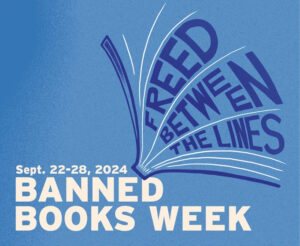
Editor’s Note: This week is the American Library Association’s Banned Book Week. The following blog post looks at a history of book challenges in the US and how these efforts have massively escalated in the 2020s.
Books are capable of inciting great passion in readers who love them and those who hate them. So wherever there are books, there are people who will want to ban or control them for one reason or another. Attempts at control can range from removing the book from a school library to threatening to kill the author.
Until recently, most book censorship efforts in the United States were local rather than national in scope, with efforts focused on removing specific titles from school libraries or reading lists. Typically, the focus was on books thought to contain sexually explicit material, offensive language, violence, or offensive treatment of religion. Other reasons given are for being “unsuited” for a given age group or for being “anti-family.”
Occasionally, though, a book’s publisher would instigate the censorship. Ray Bradbury’s novel Fahrenheit 451 tells the story of a “fireman” whose job is to burn books rather than put out fires. (Fahrenheit 451° is the temperature at which book paper starts to burn.) The book was originally published in 1953, but in 1967, Ballantine Books brought out an edition for high schools that modified 75 passages in the text to eliminate such words as hell, damn, and abortion. This was done without Bradbury’s knowledge or consent. When he found out about it 13 years later, he demanded that the edited version be withdrawn.
Different titles show up on various lists of banned or challenged books, but a few appear repeatedly. Maya Angelou’s I Know Why the Caged Bird Sings has had its position on many school reading lists challenged because of its description of the rape of the author as a child. Other frequently challenged books include the Goosebumps series by R. L. Stine, J. D. Salinger’s coming-of-age novel The Catcher in the Rye, and Kurt Vonnegut’s account of the firebombing of Dresden, Slaughterhouse-Five.
But in the 2020s, there started to be coordinated efforts nationwide to remove all books from public schools that included depictions of sexual activity, LGBTQ+ content, material that could make people feel uncomfortable about race, and material that was critical of police.
In 2023, the Washington Post took a deep dive into the issue of who was objecting to books in schools and what kinds of books these people disliked. Reporters looked at more than 1,000 challenges filed during the 2021–22 school year from 150 school districts nationwide. Topics objected to included a biographical book on assassinated gay San Francisco politician Harvey Milk, a story about a boy who dresses as a mermaid, and a story about a Black child’s reaction to the killing of a girl by police in his hometown.
WaPo reporters also found that a small number of people were responsible for a large proportion of the challenges. In fact, the Post’s research found that just 11 people were responsible for 60% of all the objections. That meant that 6% of the objectors were responsible for 60% of the objections. One woman who submitted 24 challenges went online looking for books she might object to, checked them out from a local library, and then filed her challenges. Among the titles she was attempting to remove were Vladimir Nabokov’s Lolita, Khaled Hosseini’s The Kite Runner, and Toni Morrison’s The Bluest Eye. Other efforts to challenge books have come from activist groups such as Moms for Liberty who would look for books they might object to by searching for “keywords such as ‘incest,’ ‘rape,’ and ‘pedophilia’” in the school library’s catalog.
Work done by the writers’ group PEN America found 2,362 instances of book bans in the United States during the 2022–23 school year. PEN’s research showed that in addition to activists working to remove books, several states have passed laws requiring school districts to remove whole categories of books from libraries and classrooms. Florida, which passed stringent limits on books that could be housed in schools, had more than 40% of all book bans in the United States, followed by Texas, with 625 book bans.
The American Library Association has been tracking the most-challenged books for many years. Challenged books are those that some individual or group has attempted to remove or restrict. The challenger does not need to have been successful in getting the title banned for it to appear on the list. Not all challenged books are contemporary. Several classics have received complaints as well. According to the American Library Association, the following books are frequently challenged:
The Scarlet Letter by Nathaniel Hawthorne, because a book about adultery conflicts with a community’s values
Of Mice and Men by John Steinbeck, because it contains profanity
Twelfth Night by William Shakespeare, because the comedy is perceived as promoting homosexuality
In a North Carolina school district, merely discussing school book censorship became controversial when district officials told principals not to have their schools participate in events tied to the American Library Association’s annual Banned Book Week. The message to principals said, “It is not something we teach in our classrooms or as supplementary material for out of school learning.” The district was also concerned that discussion of banned books might violate a new state law that said parents had the right to control what their children learned in school. Edward Helmore, writing for the British newspaper The Guardian, said that this might be the first time that “efforts to draw attention to banned books has itself been banned.”
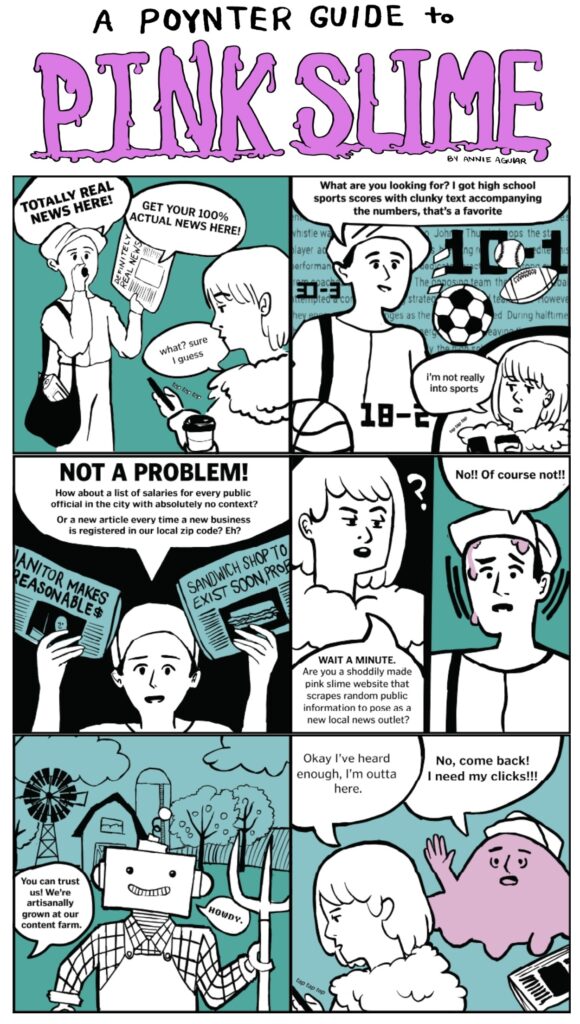
Graphic by Annie Aguiar of the Poynter Institute. Click on image to go to the source at Poynter.org.
Back in 2012, American consumers were grossed out by stories that found ground beef sold in plastic chubs was often supplemented with the meat byproduct euphemistically known as “finely chopped beef.” This collection of “trimmings” is sprayed with ammonia gas to kill off the bacteria in meat and fat. Accompanied by unappealing photos, this “finely chopped beef” was dubbed “pink slime” by critics, a label the meat industry fought largely unsuccessfully against.
Journalist Ryan Zickgraf first applied the term“pink slime” to journalism back in 2012, when he was reporting on how content farms were using low-paid writers located in the Philippines to rewrite (i.e., plagiarize) stories published on other sites. Annie Aguiar, writing for Poynter, a journalism think tank, says that “pink slime” has more recently been used to describe automated websites that publish poor-quality news stories and political propaganda while pretending to be high-quality local news sites. They often thrive in areas that are news deserts with few other legitimate news outlets. Former Washington Post media analyst Margaret Sullivan talks about how this variant of fake news has become popular:
Increasingly, “articles” that look like news may be something entirely different—false or misleading information grounded not in evidence but in partisan politics, produced not by reporters for a local newspaper but by inexperienced writers who are paid, in essence, to spread propaganda.
As an example, Sullivan pointed to a story published on the West Cook News website, serving the suburban Chicago area, that claimed without evidence that a local school district would “require teachers next school year to adjust their classroom grading scales to account for the skin color or ethnicity of its students.” This story, which had no basis in fact, then got picked up by bloggers and social media influencers and spread across the country with predictable levels of outrage. The school district completely denied the story. While some of the people who shared the false story issued corrections or took down their posts, the story still spread.
Brian Timpone, one of the publishers for Metric Media, operated an online portal in 2023 that allowed political operatives to request stories and submit opinion pieces to be published on his sites designed to look like legitimate news pages in “communities where there is ‘little or no local news.’”
Until recently, pink slime sites have been powered by stories created by low-paid writers working in so-called content farms. But now generative artificial intelligence (AI) programs such as ChatGPT are being used to completely automate the process, creating hundreds of stories a day for these sites.
UPDATE: Pink slime sites have not gone away in the months since this was first posted. In fact, AI-powered pink slime sites continue to grow, infesting people’s news diet.
Nieman Lab ran a big story in January of 2025 about a network of AI-generated newsletters that operate as Good Day News. The AI-engine scans everything it can find about the community and turns it into brief, positive stories. In essence, Good Day takes the work done by local newspapers, radio stations, TV stations, and independent digital outlets It then repackages the information and sells advertising to go with it.
The newsletters have testimonials that go with them. Local news publishers say the endorsements are fabricated. The publisher of the newsletters denies this, saying the names “anonymized” and the quotes “sanitized amalgamations of some of our favorite (and most common) testimonials.”
(Hmmm… I know what I would say to a student who made those statements.)
I highly recommend reading Andrew Deck’s story and would argue that this is a perfect example of pink slime journalism, even though Deck does not use the term.
Have you encountered pink slime sites? Leave a comment below!
9/11/24 Editor’s note: Yesterday morning I showed the “Welcome to the Rock” clip from the 9/11 themed musical Come From Away as my pre-class video in JMC 100 – Global Media Literacy. I then tried to tell my class the following story about my experiences on Sept. 11, 2001, but I got about one sentence in before I choked up too much to go on. Even 23 years later, the feelings from that awful day are still really raw.
The following stories and videos are drawn from a series of annual posts I have made over the years to commemorate 9/11.
What are your 9/11 memories? Feel free to add them to the comments below.
It was 23 years ago this morning that I was teaching my freshman media literacy course at West Virginia University. I had a class with close to 350 students in it. C-SPAN’s Washington Journal morning show was playing on the big screen as students gathered. At 8:30 a.m. I shut off C-SPAN and started teaching. When I got back to my office an hour-and-a-half later, news that our world was changing was in the process of breaking.
No one knew what was happening. An airliner had hit one of the World Trade Center towers, and the skyscraper was burning. Then a second plane hit, and everyone then knew that this couldn’t have been an accident.
9/11 has always been highly personal to me.
One of my (and my Dear Wife’s) student’s father was supposed to be working in the section of the Pentagon that was hit by one of the planes. But since that area was under renovation, his dad ended up safe.
Another one of my students had a mother who was a flight attendant who flew out of the same airport the Twin Tower planes had departed from. She was desperate for news. Fortunately, her mother was not on one of the attack planes.
One of my friends was the public radio correspondent for the area, and he ended up providing much of NPR’s coverage of the United 93 crash in Shanksville, PA.
And one of my colleagues, who taught advertising, lost an old friend in the Twin Towers collapse.
As someone who lived in West Virginia at the time, less than 100 miles from the United 93 crash site, the Sept. 11th attacks will always be personal. This was not a remote event; it was a local story directly affecting people I knew. And I will never forget the worries for my students, my neighbors, and my colleagues.
One of the last plays I saw before live theater shut down for the pandemic in March of 2020 was the brilliant and heartbreaking musical Come From Away that tells the story of the town of Gander, Newfoundland, where many of the planes crossing the Atlantic were diverted when United States airspace was shut down on 9/11. I still have to be careful when I listen to the soundtrack from the show. I don’t think I’ve ever made it through the show without crying. Here are two of my favorite songs from the show in a radio concert performance.
“Welcome to the Rock,” that tells how everything changed for Gander in just a moment.
“Me and the Sky” is for me the heart of the show where pilot Beverly tells her story of becoming American Airlines first female captain and her horror of airliners being used as weapons.
A performance by many of the original members of the Broadway cast is now airing on Apple TV+. Watching Come From Away is one of the best ways to honor the memory of 9/11.
My next memory is a look at cameos the Twin Towers made in numerous Hollywood films. Those two giant buildings defined the New York skyline from the 1970s until 9/11:
Finally, Paul Simon singing his achingly beautiful American Tune is a good way to remember our beautiful country.
This last memory has nothing to do with the media. It’s a brief story about a ride I took on my motorcycle to the United 93 Memorial on a rainy June day back in 2004. It was written shortly after I had recovered from a fairly serious illness, and I was happy just to be back on the road. I’ve taken to posting every year on 9/11.
Took a short ride last Saturday. The distance wasn’t much, under 200 miles, but I went through two centuries of time, ideas, and food. Which felt really good after having been ill for the last month-and-a-half.
Headed out of Morgantown about 7:30 a.m. on I68. Stopped at Penn Alps for breakfast. Nice thing about being on insulin is that I can include a few more carbs in my diet these days. Pancakes, yum! (Penn Alps, if you don’t know, runs a great Pennsylvania Dutch breakfast buffet on weekends that is well worth riding to. Just outside of Grantsville, MD.)
Then off on the real purpose of the trip. Up US 219 toward the Flight 93 Sept. 11 memorial. The ride up north on 219 is beautiful; I’ve ridden it before. I always like when you come around the bend and see the turbines for the wind farm. Some people see them as an eye sore; for me they’re a potential energy solution and a dramatic sight. Chalk one up for industrial can be beautiful.
Continue on up to Berlin, PA, where I take off on PA 160 into Pennsylvania Dutch country. I start seeing hex signs painted on bright red barns, or even hung as a wooden sign. Not quite cool enough to put on my electric vest, but certainly not warm. Then it’s heading back west on a county/state road of indeterminate designation.
Now I’m into even more “old country” country. There’s a horse-and-buggy caution sign. Off to the left there’s a big farmstead with long dark-colored dresses hanging from the line, drying in the air. They may not stay dry, based on what the clouds look like.
The irony of this ride hits pretty hard. I’m on my way to a memorial of the violence and hatred of the first shot of the 21st century world war, and I’m traveling through country that is taking me further and further back into the pacifist world of the 19th century Amish and Mennonites.
A turn or two more, following the map from the National Parks web site, and I’m on a badly scared, narrow road that is no wider and not in as good of shape as the local rail trail. (Reminds me why I like my KLR!)
It’s only here that I see the first sign for the memorial. No one can accuse the locals of playing up the nearby memorial. Perhaps more flags and patriotic lawn ornaments than usual, but no strident statements. And then the memorial is off a half-mile ahead.
The crash site is to the south, surrounded by chain-link fencing. No one but families of the victims are allowed in that area. Off a small parking area is the temporary memorial, in place until the National Park Service can build the permanent site. There’s a 40-foot long chain-link wall where people have posted remembrences, plaques on the ground ranging from hand-painted signs on sandstone, to an elaborately etched sign on granite from a motorcycle group. The granite memorial is surrounded by motorcycle images.
The messages are mostly lonely or affirming. Statements of loss, statements of praise for the heroism of the passengers and crew. But not statements of hatred. It reminds me in many ways of the Storm King Mountain firefighter memorial. Not the formal one in Glenwood Springs, but the individual ones out on the mountain where more than a dozen wildland firefighters died several years ago.
It’s time to head home. When I go to join up with US 30, it’s starting to spit rain, so I pull out the rain gloves, button down the jacket, and prepare for heading home. It rains almost the whole way back on PA 281, but I stay mostly dry in my Darien. The only problem is the collar of my too-big jacket won’t close far enough, and water dribbles down inside. It reminds me that riding in the rain, if it isn’t coming down too hard, can be almost pleasant, isolated away inside a nylon and fiberglass cocoon.
I’m home before 1 p.m.. I’ve ridden less than 200 miles. But I’ve ridden through a couple of centuries of people’s thoughts, actions, and food. And I’m finally back on the bike.
President Lyndon Johnson was famous for his coarse language, with one of his most famous examples being “I do know the difference between chicken sh– and chicken salad.” He also knew that in the 1960s his profanity was never going to find its way into print.
President Joe Biden has been known throughout his political career for letting his enthusiasm get the best of him. At the signing ceremony for the Affordable Care Act, then Vice President Biden was heard telling President Barack Obama, “This is a big f—ing deal.” President Obama got some static for calling his opponent Mitt Romney a “bullsh—er” in Rolling Stone magazine. Neither made much of a splash.
It was really President Richard Nixon who forced the press into dealing with how to report profanity. Nixon recorded every conversation in his office, and when the Watergate hearings made those tapes public, many people were shocked to hear the torrent of bad language pouring out of his mouth. When transcripts of the tapes were published, they did not contain the troubling words; instead, they were always replaced with the now iconic phrase “expletive deleted.”
President George W. Bush was caught on tape at a dinner in Russia talking to British Prime Minister Tony Blair saying, “See, the irony is that what they need to do is get Syria to get Hezbollah to stop doing this s—, and it’s over.” There was little fuss over this quote in 2006 as it was not said in a particularly public setting, and it was seen as a fairly honest statement of the situation he was discussing in Lebanon. In this case, the Washington Post did not deem it necessary to quote the actual word.
During his term in office, President Donald Trump was known for frequently using profanity in public and private, but he generated the most news for it after making some highly offensive and obscene remarks about the country of Haiti, the continent of Africa, and presumably several countries in Central America, referring to them as “shithole countries.”
But as my Seven Media Secrets state:
Secret 4: Everything from the margin moves to the center.
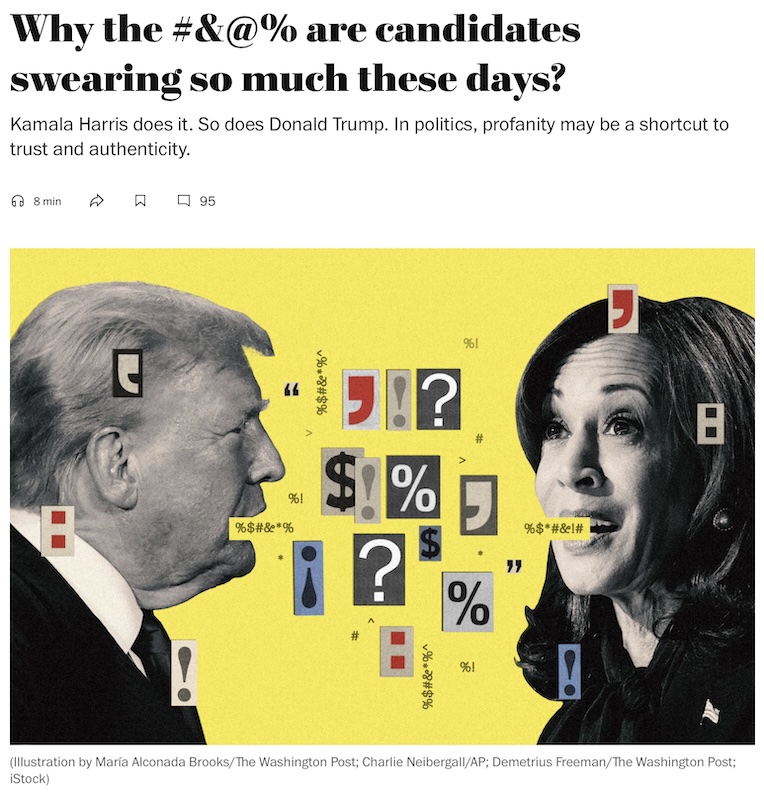
So this morning the WaPo ran an article asking the question:
In the article, Maura Judkis reports on a wide range of examples:
From Vice President Kamala Harris:
Trying to get governors to rally for President Joe Biden early this summer before he dropped out, she told them: “This is about saving our f—ing democracy.”
“We have to know that sometimes people will open the door for you and leave it open. Sometimes they won’t. And then you need to kick that f—ing door down.”
From former President Donald Trump:
“Why are we having all these people from shithole countries come here?” Trump said.
Why are candidates developing such potty mouths these days? Judkis gives a host of reasons:
It can make candidates seem more relatable.
It can be cathartic.
It can be to break taboos.
She goes on to note that profanity can be used in multiple ways. Harris, for example, tends to use profanity as a tool for emphasis, while Trump tends to use it as an insult.
But it could also be because it coarse speech is becoming more acceptable following Trump’s first term. Toward the end, Judkis writes:
Criticism of Harris’s swearing has not been nearly as pointed as it was for [Hillary] Clinton — a sign that language and manners are evolving. (Whether that’s in a positive or negative direction is up for interpretation.) Or maybe we’re actually ready to focus on the issues, and not the utterances.
In other words, Everything from the margin moves to the center.