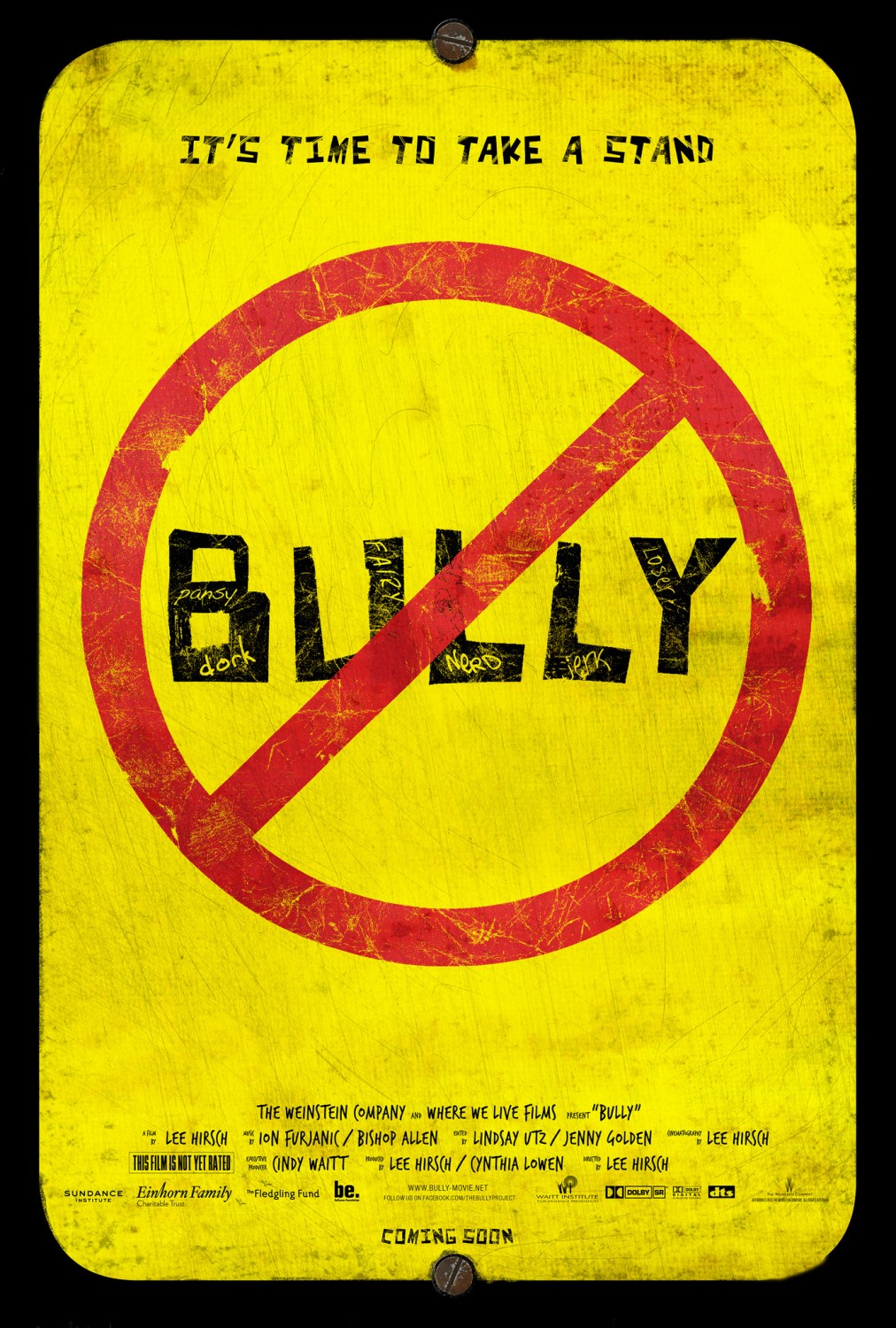
Bully will carry a “Common Sense” rating issued by Common Sense Media of “Pause 13+,” the same rating that the group gave The Hunger Games. The rating means that for age 13 and higher, parents should “know your child, some content may not be right for some kids.”
Common Sense Media is dedicated to improving the lives of kids and families by providing the trustworthy information, education, and independent voice they need to thrive in a world of media and technology.
We exist because our nation’s children spend more time with media and digital activities than they do with their families or in school, which profoundly impacts their social, emotional, and physical development . As a non-partisan, not-for-profit organization, we provide trustworthy information and tools, as well as an independent forum, so that families can have a choice and a voice about the media they consume.
As a side note, unrated versions of movies are quite often the standard when it comes to video releases. So it’s not as though theaters showing an unrated movie would be a sign of the cultural apocalypse.
Michael Cimino’s epic failure of a motion picture Heaven’s Gate is credited with/blamed for sinking the United Artists film studio. Some claim it was a masterpiece. Me? My wife-to-be and I saw it on our first date back in 1981. The date was fine, the movie was awful.
The documentary Final Cut: The Making and Unmaking of Heaven’s Gate tells the story of how the movie came to be the disaster that it was. It’s in 8 parts on YouTube:
As members of the audience, the actual amount of money a movie makes at the box office probably shouldn’t matter to us. All we ought to care about is whether we liked the movie. But with box office information constantly in the news and readily available on the Internet, it seems as though everyone talks about the movies the way that studio executives do. So to feed this error in our ways, here are links to several of Box Office Mojo’s All-Time Box Office charts. (And, yes, I confess, I’m absolutely addicted to this site!)
All-Time Domestic Gross
In general, when people talk about box office records, this is the list they are talking about. As of March 2012, Avatar was #1 on this list with a lifetime gross of $760 million.
Worldwide Grosses
This list looks at how much movies have made around the world, including its U.S. box office. Movies can sometimes be a flop domestically but still do well on the international market. As of March 2012, Avatar was also #1 on this list with a lifetime worldwide gross of $2.78 billion.
Adjusted for Ticket Price Inflation
Prices for movie tickets have gone up over the years, so the top of the all-time domestic box office list tends to be biased toward more recent movies. But what if you took the number of tickets sold for each movie and multiplied them by the current average ticket price? That would give you a much better read on what the most popular movies of all time have been. Number 1 on this list belongs to Gone With The Wind with an adjusted gross of $1.58 billion, followed by the original Star Wars with $1.39 billion. Avatar, which is #1 on the other two lists, comes in at #14 on the adjusted list.
UPDATE: Box Office Mojo disappeared for a couple of days in mid-October 2014, prompting speculation that the site had been absorbed into IMDb.com, which owns BOM. But then it just as mysteriously re-appeared. And no one will say what happened. Hmmm….
I’ve been listening to Coverville nearly 10 years now and continue to be amazed at the fascinating covers host Brian Ibbott comes up with. Here are links to several classic episodes from over the years:
Coverville 1000: Live From Nerdtacular 2013
A recording of the concert celebrating Coverville’s 1000th episode, including John Anealio doing his original songs “Nerds Arguing About Spaceships” and “George R.R. Martin Is Not Your Bitch.”
The Joshua Tree Album Cover
Covers of every song from U2’s classic album The Joshua Tree. Each song interpreted by a different artist in a different style.
Coverville Hall of Fame 2009 Every year Brian Ibbott has listeners vote for there favorite covers. This voting produces a top 40 cover countdown that gets posted every December. But some songs were coming to dominate the countdown year after year, and so starting in 2009 Brian started retiring the most popular covers by placing them in the Coverville Hall of Fame. This episode has classics such as William Shatner’s cover of Pulp’s “Common People” as well as the Polyphonic Spree’s cover of Nirvana’s “Lithium.”
Student radio KLPR-FM broadcasts at 91.1 FM as a service of the Department of Communication at University of Nebraska at Kearney. It is scheduled to be broadcasting at 3,800 watts in the Fall of 2011 and has a reach to the rural areas outside of Kearney, NE. But through streaming on the Internet, you can listen to Loper radio anywhere in the world.
(The Antelope is UNK’s mascot, and so its teams are the Lopers.)
Every time I work on a new edition of Mass Communication: Living in a Media World, I wish I could have it updated with the latest statistics about the industry. I can’t do that yet, but I can give you access to the latest industry reports:
There’s a heartwarming story that’s been up on the Interwebs this week about President Obama giving a speech on energy policy at St. George Community College. Stephon, a deaf student had front-row seating for the event, got to shake the president’s hand after the speech and signed to him, “I am proud of you.” To Stephon’s surprise, the president signed back at him, ” Thank you.”
Since then, Stephon has posted a YouTube video in which he tells the story of what happened in American Sign Language. The video is up at several sites, along with a transcription for those of us who don’t sign.
Video of Stephon meeting Obama
Video of Stephon discussing his meeting with Obama in ASL
As I said, the story has been posted a variety of place. I saw it a link to it on Twitter that took me to the Washington D.C. blog Distriction where the story was posted under the rather clever headline “SIGN OF THE TIMES.”
My former student, who is hearing, found the headline to be “at least mildly offensive,” and he asked me what I thought of it. I read the story and found the following quote from Stephon. (The quote was transcribed from ASL):
“Oh my gosh! I was like wow! He understood me after I said I was proud of him. It was so amazing…I was just speechless.”
So my analysis was that the headline was fine. It accurately portrayed what was in the story. But as I read through the other comments on Facebook, I got to wondering, was the “speechless” pun in bad taste, referring to someone who communicates primarily (I assume) through signing?
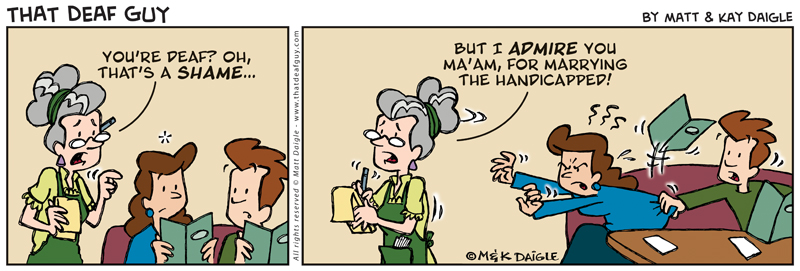
But to really answer the question, I thought I would turn to Matt Daigle, who along with his wife Kay, produces the witty and enlightening web comic That Deaf Guy. Now I don’t presume that Matt can speak for the entire deaf community, but he can give us a the point of view of someone who takes a humorous look at the issues deaf people and their families face. Here’s what he had to say in a series of e-mails today:
“I looked over the article and I was not personally offended by the title. Myself, as well, as many of my deaf friends, are aware that the term speechless means in ASL SHOCKED ASTOUNDED. We know that the English languages uses figurative language in the form of idioms and metaphors and such so we see those terms and just automatically translate them into meaning–like anyone else.
It is the same concept with the word “hear.” Deaf people often sign NEVER HEARD meaning no one told me or I didn’t know about that. Within that context the word “hear” has the meaning of KNOW. We don’t really think of the literal sense of that word just the meaning.”
On a related note, Matt had this to say about media portrayal of deaf people in general:
“The media does misrepresent deaf people often that is true. We pretty much can agree that the most hated word used in the media concerning deaf people is “Hearing Impaired.” Now I say that and yet I know some (very very few) deaf people who preferred to be called Hearing Impaired.”
10/27/2007 – Dealing with diversity – Is disability the last great barrier? The Washington Post’s Date Lab feature matched up an English teacher and a disability consultant for a blind date. He was in a wheelchair, she wasn’t. They ended up being a better than average match for the series, but what made the story great was that it has people talking about issues many of us try to ignore or pretend don’t exist.
11/23/2010 -Disability, Humor, and Pop Culture
I’m a big, big fan of the web comic Girls With Slingshots by the brilliant Danielle Coresetto. In her comic, Danielle has a supporting character who is deaf and a relatively minor character who is blind. Danielle’s work on this topic manages to avoid the “very special episode” humor and instead deals with disability genuinely from the point of view of the people who have to live with it. It was through Girls With Slingshots that I discovered Matt’s comic. (GWS has changed servers since I made that post so many of the links back to the strip there are broken. I will try to fix them on my post at some point, but not today.)
Texas singer/songwriter Lyle Lovett told Billboard.com in 2008 that despite selling more than 4.6 million albums, he’s “never made a dime” from his recordings. Instead, he’s made all his income from performing and touring. So why does he record? It’s a great way to promote his concerts.
Here are a couple of live performance videos of Lovett:
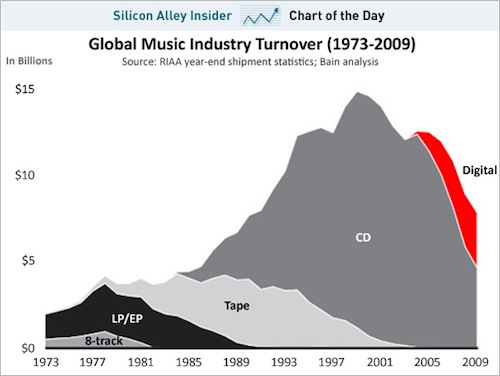
In February of 2011, a graph was making the rounds based on data attributed to Bain & Company showing a huge growth in the music industry peaking in about 2009 followed by a fairly sharp drop off. The graph was labeled as “Global Music Industry Turnover (1973 – 2009).
The graph, however, had a number of problems with it:
It was about US sales, not global sales.
It was not adjusted for inflation.
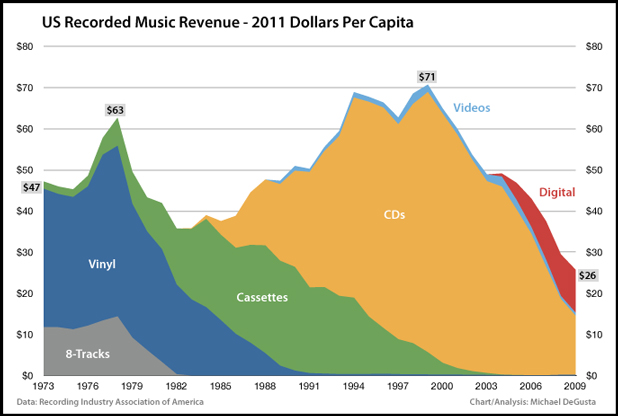
Because of these errors, it the graph hid some significant changes in the market over the 1980s, it understated the more recent declines in the music industry, and it made claims about the scope of the information that were flat out wrong.
The chart clearly shows a peak in music sales in about 1977, a sharp falloff until CDs grew in popularity in the 1990s, and then a second sharp fall with the rise of digital file sharing and downloads in the 2000s.
As a side note, blogger Matthew Yglesias also notes that this graph is only about the decline of the recording industry, not the music industry as a whole. While his comments are based on the original flawed graph, his arguments hold up just as solidly on the corrected version.
And this is why any time I see a graph or claims about what’s going on the media industry, I want to get the story behind the claim. This is a prime example of Truth 6:Activism and Analysis Are Not The Same Thing.