Most of us in the United States eat a less than ideal diet. Many of us are overweight.
But, but deep-fried twinkies! Butter-fried butter!
I get it. Deen’s cooking shows feature foods other than brown rice and tofu. Does that mean she deserves a chronic illness that in the long run could leave her blind or with toes amputated?
Deen’s going to have people judging and making fun of her every time she eats something.
Would you really want everyone around you watching everything you eat and then tell you, “Oh, oh, oh. You can’t eat that. You’re a diabetic.”
Her body has now failed her with an evil, insidious autoimmune disease. For the rest of her life, Paula will have to count her carbohydrates. She will have stick her fingers several times a day. She will have to take medications with serious potential side effects. She will have to deal with the daily challenges of high and low blood sugars.
Would you laugh at someone for having the autoimmune disease lupus? Would you make fun of someone for having cancer?
Our bodies are a wonderful thing when they work right. You get a real appreciation of that when you start having to take personal responsibility for running your body’s metabolism of carbohydrates when your body refuses to do it for you.
Posted inBook Link, Chapter 3|TaggedABC, Disney|Comments Off on Link Ch. 3 – Disney tells ABC affiliates they can’t cover premiere of non-Disney Johnny Depp movie
Civil rights leader Martin Luther King Jr. displayed a brilliant understanding of public relations throughout the campaign to integrate the South in the 1950s and 1960s. King knew that it would take a combination of action, words, and visibility in the media to eliminate segregation laws and integrate lunch counters, restrooms, water fountains, and businesses. He practiced public relations in churches, hotel rooms, and even jail.
In 1963 King and the Southern Christian Leadership Conference, a civil rights group, wanted to do something highly visible that would let the entire nation see the evils of segregation. The goal of the campaign was to hold nonviolent demonstrations and resistance that would force segregated stores and businesses to be opened to African Americans.
King and his colleagues picked Birmingham, Alabama, as one of their targets, in part because the city’s police commissioner was Eugene “Bull” Conner. Conner was a racist who could be counted on to attack peaceful marchers. King’s campaign was called Project C, for confrontation, and it included press conferences, leaflets, and demonstrations in front of hundreds of reporters and photographers. Starting in April 1963, African American volunteers marched in the streets, held sit-ins at segregated lunch counters, and boycotted local businesses. As the protests started, so did the arrests. The story was covered by the New York Times and the Washington Post. King and his colleagues knew that all the protests in the world would be ineffective if they were not covered by the press, and that being beaten up by police would accomplish little if no photographers were present to document the event.
David Halberstam, who was a newspaper reporter in the South at the time, commented on civil rights leaders’ understanding of public relations:
The key was to lure the beast of segregation out in the open. Casting was critical: King and his aides were learning that they needed to find the right venue, a place where the resistance was likely to be fierce, and the right local official to play the villain. Neither was a problem: King had no trouble finding men like . . . Bull Connor, who were in their own way looking for him, just as he was looking for them.
On Good Friday, King and Ralph Abernathy joined in the marching so that they would be arrested. While King was in jail, he wrote the “Letter from Birmingham Jail,” which was smuggled out and published as a brochure. His eloquent words, given added force by having been written in jail, were reprinted across the country.
After King was released, he and his followers raised the stakes. Adults would no longer march and be arrested; instead, children became the vanguard of the movement. The images, which appeared in print media throughout the world, were riveting. In his biography of King, Stephen Oates writes, “Millions of readers in America—and millions overseas—stared at pictures of police dogs lunging at young marchers, of firemen raking them with jet streams, of club-wielding cops pinning a Negro woman to the ground.”
King faced criticism for allowing young people to face the dangers of marching in Birmingham. But he responded promptly by criticizing the white press, asking the reporters where they had been “during the centuries when our segregated social system had been misusing and abusing Negro children.”
Although there was rioting in Birmingham and King’s brother’s house was bombed, the campaign was ultimately successful. Business owners took down the “WHITE” and “COLORED” signs from drinking fountains and bathrooms, and anyone was allowed to eat at the lunch counters and sit on the buses. The successful protest in Birmingham set the stage for the March on Washington in August 1963, where King would give his famous “I Have a Dream” speech.
The NY Times public editor really set off a bit of a firestorm today with his column. In it, Arthur Brisbane asks, apparently seriously, whether reporters ought to be calling out sources for claiming things as “facts” that are demonstrably not true. The column appeared under the headline Should The Times Be a Truth Vigilante?
The question Brisbane raised drew a huge range of responses, many of which could be summed up by the comment, “Well, duh!”
NYU journalism prof Jay Rosen has an excellent post up explaining why there was this explosive reaction and why the reaction surprised Brisbane. (In brief, Rosen says that Brisbane’s asking the question shows the failure of the concept of “the view from nowhere” in which journalists behave as though they can be completely detached in their reporting and take on no point of view.
“The way that this policy seems to work,” she said, “it’s like nobody can use dirty words or nudity except for Steven Spielberg.” – Supreme Court Justice Elena Kagan
Justice Kagan sums up the issues surrounding the FCC’s regulation of broadcast decency perfectly with this quote. The Supreme Court heard arguments on Tuesday on whether the FCC has the right to regulate nudity and language on broadcast stations.
The problem at Kagan alludes to here is that broadcasters have a hard time coming to terms with what they can or can’t broadcast. For example, network television has shown the Spielberg World War II movies Schindler’s List and Saving Private Ryan complete and uncut. The first has full-frontal nudity of concentration camp victims heading to the gas chambers and the second had graphic war violence and soldiers using extreme profanity. But then there was the edgy police series NYPD Blues that routinely showed the naked backside of characters. But in 2003, actress Charlotte Ross showed her naked backside for 7 seconds, and the FCC proposed fines of nearly $1.4 million for stations in Central and Mountain time zones that showed the program at 9 p.m. (Eastern and Western time zone stations played the show at 10 p.m. which supposedly made it all OK.)
But while these were broadcast without much controversy, stations across the country faced large fines for show Janet Jackson’s nipple for 9/16ths of a second during the 2004 Super Bowl. And other stations were fined for “fleeting expletives” used in live programs by celebs such as U2’s Bono and Cher. Following the fuss over Miss Jackson’s Super Bowl appearance, some stations became so worried about getting into trouble with the FCC that they refused to carry ABC’s Veteran’s Day broadcast of Saving Private Ryan. And though nobody’s really talking about it, there was no talk of fines for Dancing with the Stars when cable news host Nancy Grace briefly pulled a Janet Jackson for close to second, almost twice as long as the Janet Jackson flash.)
Here’s what I had to say five years ago this week when Apple announced the iPhone. How’s it hold up? (For the record, it took me almost 5 years for me to actually get an iPhone. But this was more an issue of waiting for Verizon to get the iPhone than anything else.)
Apple announced it’s new iPhone on Wednesday, and in typical Apple fashion it is absolutely too cool for words. As the NYT’s David Pogue puts it, the iPhone is “not so much a smartphone as something out of Minority Report.”
In typical Apple fashion, the iPhone is already becoming a pop culture icon, just the way the iMac and iPod did before it.
In typical Apple fashion, the iPhone is redefining what we think a cell phone should be able to do. It’s not enough for it to have a lame “mobile” browser. It’s got to have a fully functional standard browser. It’s not enough for it to have voice mail, it’s got to have a voice mail system that looks just like E-mail. It’s not enough to be able to show movies, it’s got to have widescreen video. It needs to be smart enough to turn off the power hungry screen when you put it up to your face to talk.
In typical Apple fashion, it has a my-way-or-the-highway idiosyncratic interface that says however Steve Jobs think you should use it is the only way you should use it because he’s cooler than you are.
In typical Apple fashion, the company neglected to clear all its trademark issues in advance, but instead just assumes that “Hey, we’re Apple, and we’ll clear up all our problems because we’re too cool not to have what we want.”
In short, it is a typical, mind blowing, infuriating Apple product. I’m glad I’ve got a new PDA that I won’t be ready to replace for a couple of years, which gives the technology the time to catch up to Apple’s brilliant vision.
BTW, Apple is no longer Apple Computer. Just Apple.
How can we connect Jon Huntsman to Ridley Scott’s Alien prequel Prometheus in just three steps? Well, it takes some serious stretching, but it can be done.
Follow the tortured logic:
Step 1: A New Hampshire based anti-Jon Huntsman ad is circulating on the Internet that claims to be from a Ron Paul group. It’s fascinating to read the comments on this ad, which accuses Huntsman of having Chinese values rather than American values (He’s a former ambassador to China), that suggest that the ad was actually created by the Huntsman campaign to discredit the Paul campaign. To me what makes this ad so fascinating is that it illustrates what we learned back in 2007 — that anyone with a source of video and a MacBook can create a professional-looking political ad.
Step 2: A Ron Paul spokesman answers questions on C-SPAN about the Federal Reserve (which makes perfect sense for a Paul supporter). He also declines to answer a question about a government coverup of contact with space aliens.
Step 3: There’s a new trailer out for Ridley Scott’s sort-of-Alien prequel that is being written by co-written by Lost’s Damon Lindelof, and it looks just too-cool-for words. Of course you have to remember that I saw Alien at a 70mm theater on opening night back in 1979.
And so there you go: Jon Huntsman to Ron Paul, Ron Paul to government coverup of space aliens, gov’t coverup of space aliens to Ridley Scott’s sort-of-Alien prequel. What other blog can give you this kind of service?
One more thing: I post a lot of videos up to my Tumblr blog: ralphehason.tumblr.com. Check it out.
Wired’s Steven Levy talks with Amazon founder Jeff Bezos
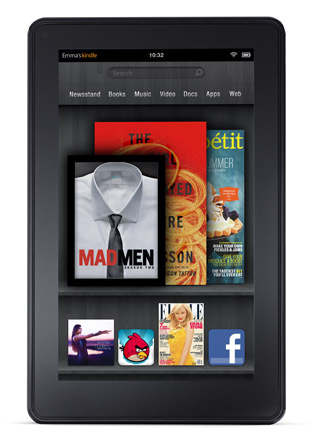
Fascinating look at how differently Amazon views the Kindle Fire from how Apple views the iPad. Bezos call the Fire a “media service” that is a portal into the Amazon world. That’s why you can buy one for $199. Bezos also talks about the Zappos shoe business and his space launch business. (Yeah, space launch.)
Rule 34 Variation: Kindle as a channel for e-reader porn
“Every time a major new content platform—print, film, cable, VHS, DVD, the Internet, mobile phones—has experienced massive growth, it has either been driven by a porn boom or at least brought the porn industry along for the ride.” NOTE: No porn at this link. NOTE 2: Rule 34 says that if it exists, there is porn of it, no exceptions. NOTE 3: While you can certainly access porn on your iPad, Apple won’t sell it. Amazon will.
Back in 1939, a young actress by the name of Rita Hayworth was trying to become a household name, and her press agent, the legendary Henry Rogers was willing to do whatever it would take to make her a Hollywood star. Among his efforts was putting out a made-up press release naming Hayworth the winner of a non-existent “best dressed off-screen actress” by a nonexistent group. That story landed Hayworth a big photo story in Look magazine (a competitor of Life) and launched the buxom actress’s career.
“It’s Rihanna at her sexiest. She’s never looked this good,” they said, adding: “She’s in amazing shape and the pictures are stunning.”
The only problem? As Romenesko points out, Adversiting Age didn’t actually give out an award for the sexiest ad. That’s why none of the stories about it (from Huffington Post, and the Hindustan Times, the Global Grind, and others) had links back to Ad Age.) Rihanna tweeted it about as well. (As a side note, the “they” in the attribution should have been a tip off that there was not really a source behind the story. Remember Truth 7 – There is no “they.”
The actual source of the story? A company called TNI Press Ltd. that writes stories for British tabloids and is the source for recent stories extolling Rihanna’s sexiness.
In his NY Times obit, Henry Rogers was quoted as saying, “If I did now what I did then,” Mr. Rogers said in 1987, “I’d be barred from every news media outlet.”
Hmmm…. I don’t think so. In fact, thinks that very little has changed from the 1930s. This would be a prime example of Truth 4: Nothings’s new: Everything that happens in the past will happen again.
As a side note, I just ran a Google search on Rihanna’s Armani ad and found 24 media stories on Rihanna’s award but only one link to the actual correction. When it comes to celebrity gossip, gossip likely put forward by the celeb herself, do we really care whether it’s true? Doesn’t look like it.
Roger Ebert on why the 2011 box office was down.
HINT: It wasn’t piracy, it was a lack of good reasons to go to the movies. Hollywood really needs to listen. Pretending that its problem is piracy is not going to make its problems go away. HT: TechDirt.
PBS’s Media Shift lists the top 10 media stories of 2011 Can’t argue too much with these. Arab Spring and the social media revolutions (Social media didn’t cause the revolutions, but they were a part of it); the death of Steve Jobs (but it wasn’t just the tech world who mourned); and phone hacking at News of the World are their top three. What was missing? Rising importance of Al Jazeera English online in the Western world.

 Paula Deen’s diagnosis of diabetes is not funny.


 .
.